Key takeaways
- Motor configuration: Single-motor frames are quieter and cheaper; dual-motor frames lift faster, handle heavier loads, and stay level under uneven weight. If you’ll be raising the desk several times a day, dual motors reduce the friction that makes people give up on standing entirely.
- Height range, measured against your body: Standing elbow height is the number that matters, not the maximum spec. Aim for a frame whose top end clears your elbow height plus the thickness of your desktop, and whose bottom end lets you sit with feet flat and thighs parallel to the floor.
- Noise output: Anything at or under roughly 55 dB is conversational-volume and won’t derail a call or a late evening in a shared room. Loud lifts create a subtle behavioral penalty; you adjust less, and the desk quietly becomes a fixed-height desk.
- Weight capacity and lateral stability: Add up monitors, arms, a laptop, and the desktop itself, then leave meaningful headroom. Stability at full extension matters more than the raw capacity figure — wobble at standing height is the most common complaint across every price tier.
- Memory presets and anti-collision: Presets remove the decision-making from switching positions, which is the whole behavioral battle. Anti-collision sensors protect drawers, window sills, and anything living underneath the desk.
What's inside
As a sleep-wellness practitioner, I spend most of my day talking about what happens between 10 p.m. and 6 a.m. — but the honest truth is that the quality of your night is mostly decided by your daytime posture, light exposure, and movement. People come to me convinced they have a mattress problem. Frequently what they actually have is a chair problem: nine sedentary hours that leave the hip flexors shortened, the thoracic spine stiff, and the nervous system under-stimulated. By the time the bedroom lights go out, the body has no accumulated physical fatigue to convert into deep sleep, and the low-grade ache across the shoulders makes it hard to settle into any position for long.
A height-adjustable desk frame is one of the few home-office purchases with a plausible line to better sleep. Alternating between sitting and standing keeps the circulatory system engaged, nudges you toward the natural mid-afternoon movement your circadian rhythm expects, and spreads spinal load across the day instead of stacking it into one posture. This guide covers the frames worth buying in 2026 — the motors, capacities, and stability figures that matter — with an emphasis on quiet operation, since a lift mechanism loud enough to startle you is a mechanism you’ll stop using. Buying the frame alone also lets you pair it with a desktop you already own or genuinely like, which is usually the cheaper and better-looking route.
As an Amazon Associate we earn from qualifying purchases.


How to Choose a Standing Desk Frame (2026)
- Motor configuration: Single-motor frames are quieter and cheaper; dual-motor frames lift faster, handle heavier loads, and stay level under uneven weight. If you’ll be raising the desk several times a day, dual motors reduce the friction that makes people give up on standing entirely.
- Height range, measured against your body: Standing elbow height is the number that matters, not the maximum spec. Aim for a frame whose top end clears your elbow height plus the thickness of your desktop, and whose bottom end lets you sit with feet flat and thighs parallel to the floor.
- Noise output: Anything at or under roughly 55 dB is conversational-volume and won’t derail a call or a late evening in a shared room. Loud lifts create a subtle behavioral penalty; you adjust less, and the desk quietly becomes a fixed-height desk.
- Weight capacity and lateral stability: Add up monitors, arms, a laptop, and the desktop itself, then leave meaningful headroom. Stability at full extension matters more than the raw capacity figure — wobble at standing height is the most common complaint across every price tier.
- Memory presets and anti-collision: Presets remove the decision-making from switching positions, which is the whole behavioral battle. Anti-collision sensors protect drawers, window sills, and anything living underneath the desk.
The Best Standing Desk Frames (2026) Reviewed
HUANUO Brushless Motor Frame
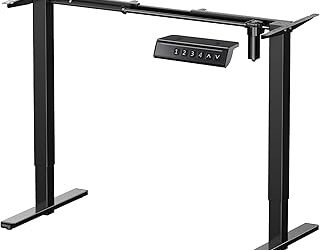
The brushless motor is the headline here: it runs noticeably quieter than brushed equivalents and should outlast them, which matters on a component you’ll cycle thousands of times. With 220 lbs of capacity, four presets, and a 28.3″–46.5″ range plus an included cable tray, it’s the frame I’d suggest to most first-time buyers working with a standard 75″ x 35″ top.
TOPSKY Dual Motor Frame
A genuinely wide 43″–59″ adjustment span and 225 lbs of capacity make this the flexible choice if your desktop is unusual or you haven’t bought one yet. Dual motors and a 27.6″–47.3″ range mean it accommodates both shorter users seated and taller users standing, which is rarer than the spec sheets suggest.
VIVO DESK-V100EBY
VIVO’s brushless single-motor workstation is the value pick — memory controller, 220 lbs capacity, and quiet operation without the dual-motor premium. Expect a slightly slower lift, which is a fair trade if your setup is light and you want reliability over speed.
HUANUO Dual Motor 265 lb Frame
The T-shaped legs accept desktops up to 90″ x 31.5″, so this is the frame for wide, heavily loaded setups — multi-monitor arrays, audio gear, or a thick solid-wood top. At 265 lbs it has the most headroom of the standard rectangular frames here.
ErGear Electric Standing Desk Legs
Rated at a quiet 55 dB with four presets and anti-collision, this is the sensible DIY option for 39.4″–63.3″ tops. The 176 lb capacity is the tightest on the list, so tally your hardware before committing.
Frequently Asked Questions
Can a standing desk actually improve my sleep?
Not directly, but indirectly and meaningfully. Breaking up prolonged sitting increases daytime energy expenditure and reduces the musculoskeletal discomfort that fragments sleep, and standing near a window increases your daytime light dose — the single strongest input to circadian timing.
How long should I stand each day?
Start with roughly fifteen minutes per hour and adjust by feel. The goal is variation, not endurance; standing rigidly for four hours simply swaps one static posture for another and often produces foot and low-back complaints.
Do I need a corner or L-shaped frame?
Only if your room genuinely calls for it. The VIVO DESK-V130EB triple-motor corner frame holds up to 300 lbs and suits dual-workflow or multi-monitor setups, but L-shaped desks are harder to reposition and usually cost more.
Is buying a frame without a top worth the hassle?
Usually, yes. Frames arrive with pre-drilled or self-tapping hardware, assembly is typically under an hour, and you avoid paying a premium for a laminate top you may not want.
Final Thoughts
For most home offices, the HUANUO Brushless Motor Frame is the best-balanced choice — quiet, durable, and well-priced for a 220 lb frame with presets. Choose the TOPSKY Dual Motor if you need a wider adjustment span or faster lifts, and the HUANUO 265 lb Dual Motor if you’re building on a large, heavy desktop. Whichever you pick, set your presets on day one; the desk only helps if you actually move it.