Key takeaways
- Flame-only mode: Insist on the ability to run the visuals with the heater off. You’ll use this far more than you expect — most of the year, you want the glow without adding a single degree to the room.
- Fan noise: Anything above a soft whisper becomes intrusive once the house goes quiet. Look for units reviewed as quiet at their low heat setting, and plan to sleep with the heater cycled off rather than running.
- Warm color temperature and dimming: Deep amber and orange flame settings in the 1800–2200K range are the ones to use after dark. Multi-color LED options are fun, but the cooler blues and whites suppress the very drowsiness you’re trying to cultivate.
- Thermostat precision: A unit with a true adjustable thermostat (roughly 62–95°F) lets you hold a bedroom in the 65–68°F range that sleep research consistently favors. Simple high/low switches tend to overheat small rooms.
- Timer and safety cutoffs: A programmable timer of one to eight hours means the fireplace shuts itself down after you’ve drifted off. Overheat protection and tip-over shutoff are non-negotiable in any bedroom.
What's inside
Most people shop for a freestanding electric fireplace with their eyes: they want the flicker, the glow, the sense that a room has a center. As someone who spends most days talking with clients about why they can’t fall asleep, I’d ask you to also shop with your nervous system in mind. Warm, low-intensity light in the evening hours does something that overhead lighting cannot — it signals to your body that the day is closing. The trouble is that a poorly chosen unit does the opposite: a fan that whirs at 45 decibels, a flame bed that pulses cold blue, a thermostat that overshoots and leaves your bedroom at 74°F when your core temperature needs to be dropping. That combination will keep you awake more reliably than caffeine.
This guide looks at the current crop of freestanding and easy-install electric fireplaces through two lenses at once: how well they work as furniture, and how well they work as part of an evening wind-down. I’ve weighted quiet operation, dimmable amber flame settings, accurate thermostats, and independent flame-without-heat modes heavily, because those are the features that determine whether a fireplace becomes a sleep asset or a sleep liability. Below you’ll find my picks, followed by a buying framework and answers to the questions I get asked most often.
As an Amazon Associate we earn from qualifying purchases.




How to Choose an Electric Fireplace Freestanding (2026)
- Flame-only mode: Insist on the ability to run the visuals with the heater off. You’ll use this far more than you expect — most of the year, you want the glow without adding a single degree to the room.
- Fan noise: Anything above a soft whisper becomes intrusive once the house goes quiet. Look for units reviewed as quiet at their low heat setting, and plan to sleep with the heater cycled off rather than running.
- Warm color temperature and dimming: Deep amber and orange flame settings in the 1800–2200K range are the ones to use after dark. Multi-color LED options are fun, but the cooler blues and whites suppress the very drowsiness you’re trying to cultivate.
- Thermostat precision: A unit with a true adjustable thermostat (roughly 62–95°F) lets you hold a bedroom in the 65–68°F range that sleep research consistently favors. Simple high/low switches tend to overheat small rooms.
- Timer and safety cutoffs: A programmable timer of one to eight hours means the fireplace shuts itself down after you’ve drifted off. Overheat protection and tip-over shutoff are non-negotiable in any bedroom.
The Best Freestanding Electric Fireplaces of 2026, Reviewed
55″ Electric Fireplace with Mantel and TV Stand
This is the most complete evening-routine package here: a genuine 62–95°F thermostat, a 0.5–8 hour timer, and a 23″ insert set into a white mantel that doubles as a media console. Program it to shut off an hour after bedtime and you get warmth during the wind-down without a stuffy room at 3 a.m.
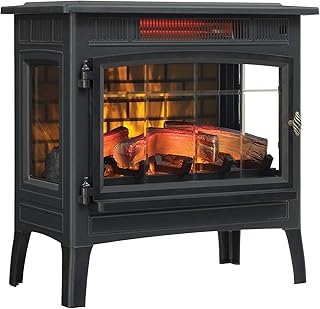
duraflame Freestanding Electric Stove Heater
The classic cast-iron-look stove, and still the one I recommend most often for bedrooms and reading corners — the 3D flame effect reads as convincingly warm at low brightness, and it heats up to 1,000 square feet without dominating the space visually. Its compact footprint also means you can position it away from the bed, which matters for airflow.
24″ Freestanding Electric Fireplace Stove Heater
A smart pick for small bedrooms, nurseries, and home offices where a full mantel would swallow the room. Six flame colors let you settle on a warm amber for evenings, and the 1000W/1500W split with overheat protection means you can run it gently rather than all-or-nothing.
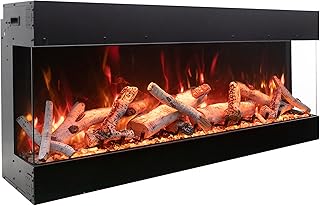
Touchstone Sideline 50″ Smart Electric Fireplace
If you’re willing to recess a unit into the wall, the Sideline 50 offers 30 ember and flame combinations plus a real thermostat, and its Alexa and WiFi integration is genuinely useful for a hands-free routine — “turn off the fireplace” from bed beats hunting for a remote. Choose the log hearth over crystals for the warmer, less clinical glow.
Touchstone Sideline Elite 42″ Smart Electric Fireplace
The Elite trades a little width for far more control, with 60 color combinations and log, crystal, and driftwood hearth options in a clean black surround. It’s the most tunable light source in this roundup, which is exactly what you want if you’re building a deliberate lighting hierarchy for the last hour of your day.
Frequently Asked Questions
Is it safe to leave an electric fireplace on overnight?
Electric fireplaces don’t produce flames or combustion byproducts, so the fire risk is low, and models with overheat and tip-over protection add another layer. That said, I recommend using the timer instead — a heater running all night pushes bedroom temperature well past the range that supports deep sleep.
Will the flame effect keep me awake?
At a low brightness with a warm amber setting, a flame effect behaves more like a candle than a screen — the light is dim, indirect, and lacks the short-wavelength intensity that suppresses melatonin. Bright multi-color modes are a different story; save those for entertaining.
What room temperature should I aim for?
Most adults sleep best somewhere between 65 and 68°F, with the room cooling slightly through the night. Use a thermostat-equipped model, set it conservatively, and let the heater cycle off well before your target sleep time.
Do I need venting or professional installation?
Freestanding units like the duraflame stove and the 24″ model simply plug into a standard outlet. Recessed models such as the Touchstone Sideline require wall framing and, depending on your wiring, an electrician.
Final Thoughts
For most bedrooms, the duraflame Freestanding Electric Stove is the easiest and most sleep-friendly choice — plug it in, keep it warm-toned and low, and let the timer do the rest. If you want the fireplace to anchor a living room and hold your television, the 55″ Electric Fireplace with Mantel offers the best thermostat-and-timer combination at its size, while the Touchstone Sideline Elite 42″ is the pick for anyone building a genuinely tunable evening lighting scheme.