Key takeaways
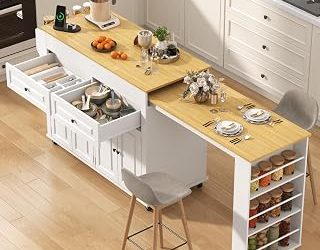
- Butterfly leaves: Store inside the table and are convenient, but the hinge and folding mechanism add weight and can require careful alignment.
- Drop-in leaves: Usually offer a broad, stable surface, but the separate leaves need a dry storage location and two people may be needed to install them.
- Self-storing extension systems: Fast for occasional hosting, though the mechanism can reduce legroom or make the table heavier.
- Two-leaf extensions: Give more size options, such as 72, 84, and 96 inches, but introduce more seams and storage considerations.
Best Large Dining Tables for Spacious Gatherings
The best large dining table for most homes is a solid or veneered wood table measuring about 84–96 inches long, seating eight comfortably and ten when needed, with at least 36 inches of walking clearance around it.
The right choice depends less on the maximum number of chairs and more on how often you host, the shape of your room, and whether the table must pass through narrow doors or serve a smaller household between gatherings. Use the comparisons below to match capacity, dimensions, materials, and extension features to your space.
Large Dining Table Sizes at a Glance
| Table size | Comfortable seating | Occasional maximum | Approximate room size with 36-inch clearance | Best for |
|---|---|---|---|---|
| 72 x 36 inches | 6 | 8 | 12 x 10 feet | Everyday family meals and compact dining rooms |
| 84 x 40 inches | 8 | 10 | 13 x 11 feet | Most eight-person dining rooms |
| 96 x 42 inches | 8–10 | 12 | 14 x 12 feet | Frequent entertaining and larger homes |
| 108 x 44 inches | 10–12 | 14 | 15 x 13 feet | Large open-plan dining areas |
| 60-inch round | 6 | 8 | 11 x 11 feet | Conversation-focused square or open rooms |
| 72-inch round | 8 | 10 | 13 x 13 feet | Large rooms where everyone should face the center |
These room dimensions allow approximately 36 inches between the tabletop edge and a wall, sideboard, or other obstruction. Increase that to 42–48 inches where people regularly walk behind seated diners. A chair typically needs 18–24 inches of depth, so a table placed in a traffic route can require more space than the basic clearance suggests.
Which Large Table Shape Works Best?
Rectangular tables: the most efficient choice
A rectangular table provides the most seating per square foot and fits naturally in elongated rooms. An 84-inch table usually accommodates three chairs on each long side and one at each end. At 96 inches, four chairs can fit along each side if the chairs are relatively narrow and diners do not need unusually generous elbow room.
Allow approximately 24 inches of table edge per person for comfortable everyday seating. Eighteen to 20 inches is possible for crowded holiday meals, but it leaves little room for serving dishes or broad armrests. A trestle base can improve legroom, especially at the ends, while corner legs may interfere with chairs.
Oval tables: softer edges without losing capacity
An oval table works well when you want the capacity of a rectangle but have a circulation path near a corner. Its rounded ends reduce sharp collisions in busy homes, although the curved ends may provide slightly less usable surface for place settings. An 84-inch oval commonly seats six to eight, while a 96-inch model can seat eight to ten.
Round tables: best for conversation
Round tables eliminate a formal “head” position and allow diners to see one another. They also need a relatively square room. A 60-inch round table is a practical six-person size; a 72-inch table can seat eight comfortably but may require diners to lean forward to pass food. Round tables become difficult to serve efficiently above about 72 inches unless the room and centerpiece arrangement are generous.
Square tables: attractive but space-hungry
A 60-inch square table can seat eight, but each diner receives less continuous table edge than at a similarly sized rectangle. Choose square only when the room is close to square and you prefer balanced sightlines. Measure carefully: a 60-inch square with 36 inches of clearance needs roughly 11 feet 6 inches of unobstructed width and length.
Fixed or Extendable: Which Is Better?
A fixed 84- or 96-inch table is usually sturdier and simpler to maintain. It has fewer moving parts, a consistent tabletop, and no leaves to store. This is the better choice when the table is used daily at full capacity and there is no convenient storage area.
An extendable table is more flexible for households that normally seat four to six but host larger groups several times a year. Look for a table that is usable both closed and open: a 60-inch table extending to 84 inches is more practical than a permanently undersized table that is uncomfortable every day.
- Butterfly leaves: Store inside the table and are convenient, but the hinge and folding mechanism add weight and can require careful alignment.
- Drop-in leaves: Usually offer a broad, stable surface, but the separate leaves need a dry storage location and two people may be needed to install them.
- Self-storing extension systems: Fast for occasional hosting, though the mechanism can reduce legroom or make the table heavier.
- Two-leaf extensions: Give more size options, such as 72, 84, and 96 inches, but introduce more seams and storage considerations.
Check whether the manufacturer’s seating claim includes the table ends. Also measure the extended length against nearby furniture. A table that expands from 84 to 108 inches needs the room for the full 108 inches before you buy it, not merely for its everyday configuration.
Materials Compared: Appearance, Maintenance, and Stability
| Material | Advantages | Trade-offs | Best match |
|---|---|---|---|
| Solid hardwood | Repairable, durable, substantial, and naturally varied | Heavy; can expand and contract with humidity; often costs $700–$2,500 or more | Long-term ownership and frequent hosting |
| Wood veneer over engineered wood | More dimensionally stable, lighter, and often $300–$1,200 | Thin veneer can be damaged by deep sanding or prolonged moisture | Renters, apartments, and value-focused buyers |
| Engineered wood with laminate | Consistent finish, easy cleaning, and usually $250–$800 | Chipped edges and surface damage are harder to repair invisibly | Children, pets, and demanding everyday use |
| Glass with wood or metal base | Visually light and suitable for modern interiors | Shows fingerprints, feels less forgiving, and requires careful handling | Bright rooms where visual openness matters |
| Metal or stone top | Distinctive, highly stable, and resistant to some heat and scratches | Can be very heavy, noisy, cold to the touch, and difficult to move | Industrial interiors and permanent dining areas |
For wood tables, a durable clear finish matters more than an especially thick top. Look for a stable base, well-supported joints, and levelers on the feet. Solid wood is not maintenance-free: wipe spills promptly, use coasters for hot or wet items, and keep the room from swinging between very dry and very humid conditions.
Best Large Dining Table by Household Situation
| Your situation | Recommended choice | Why |
|---|---|---|
| Small apartment that occasionally hosts | 60–72-inch extendable rectangle | Preserves floor space daily and reaches eight seats when opened |
| Children and pets | Rounded-edge engineered wood or durable hardwood | Less vulnerable to dents and safer around sharp corners |
| Frequent dinner parties | 84–96-inch rectangle with a trestle base | Provides generous place-setting space and better end-seat legroom |
| Rental home or frequent moves | Veneer or engineered wood, preferably with a detachable base | Reduces moving weight and avoids paying for a table that is difficult to transport |
| Someone with back or knee discomfort | 74–30-inch-high table with supportive, armless chairs | Standard height makes sitting and standing easier; open legroom avoids awkward movement |
| Square dining room | 60–72-inch round or square table | Uses the room evenly without creating an overly long visual block |
Measurements That Prevent Regret
Most dining tables are 28–30 inches high. Dining chairs are commonly 17–19 inches high at the seat, leaving approximately 10–12 inches between the seat and tabletop. Before choosing chairs, confirm that armrests fit beneath the table apron; an apron can reduce usable clearance even when the tabletop height is standard.
Measure the complete delivery route, including the building entrance, elevator, stair turns, and the narrowest doorway. A 96-inch tabletop may arrive in a box longer than 100 inches, while a thick solid-wood top can weigh more than 150 pounds before the base is attached. A table with a detachable top and legs is much easier to move than a fully assembled one.
Do not rely on a product’s listed length alone. Mark the tabletop outline on the floor with painter’s tape, then place chairs around it. Pull each chair out as if someone were sitting down and walking behind it. This reveals whether the table blocks a doorway, radiator, cabinet, or kitchen route.
Construction Details Worth Checking
- Base stability: Push lightly against each corner. A large table should not rock or twist under ordinary pressure.
- Legroom: Compare the distance between legs with your intended chair width. Pedestal and trestle bases usually provide more flexible seating.
- Extension alignment: Open the table fully and inspect whether the leaves sit level with the main top.
- Surface finish: A matte finish hides minor marks better than a high-gloss finish, while a penetrating oil finish can be easier to refresh but needs more care.
- Weight and floor protection: Use felt pads or suitable glides, particularly on hardwood floors, and avoid dragging a heavy table across the room.
For many households, an 84-inch rectangular table with a strong trestle base is the best balance of size, seating, and flexibility. Choose a 96-inch or larger fixed table when ten or more people regularly dine together and the room can maintain at least 36 inches of clearance. If everyday space is limited, choose an extendable model instead—but plan its open footprint, leaf storage, delivery route, and chair arrangement before placing the order.