Key takeaways
- Buy well above your weight: Treat the stated capacity as a stress ceiling, not a target. Aim for at least 100 pounds of headroom so the gas lift, base welds, and seat plate operate with margin — that margin is what prevents the slow sag that ruins posture six months in.
- Match seat geometry to your body: You want roughly two inches of pan wider than your seated hip width, and two to three fingers of clearance between the seat edge and the back of your knees. Too narrow pinches the hips; too deep compresses the popliteal region and leaves your feet dangling.
- Prioritise pocket springs or high-density foam: Independently wrapped coils recover their shape overnight and distribute load across the sit bones rather than concentrating it. Cheap moulded foam loses resilience fast, and a collapsed cushion tilts the pelvis backwards for the rest of the chair’s life.
- Insist on adjustable lumbar and a locking recline: A fixed lumbar bump is a lottery. Height-adjustable support plus tilt tension you can actually set lets you cycle between an upright 100-degree working posture and a 130-degree unloaded position for short recovery breaks.
- Check the base, casters, and armrests: A five-star steel or reinforced nylon base with rubber-coated wheels rolls quietly on hard floors and won’t crack under lateral load. Padded, adjustable arms matter more than they sound — unsupported elbows drive shoulder and neck tension that follows you to bed.
What's inside
In sleep medicine, we obsess over the eight hours you spend on a mattress and almost entirely ignore the nine you spend in a chair. That’s a mistake. Musculoskeletal pain is one of the most common reasons adults wake in the small hours, and for larger-framed people the standard office chair is a reliable way to manufacture it: seat pans built around a 19-inch hip width, foam that compresses into a hammock by month three, gas cylinders rated for 250 pounds quietly sinking under 320. You spend the day fidgeting, the evening stiff, and the night rolling over every ninety minutes trying to unload an irritated lumbar spine.
A properly specified big-and-tall chair won’t fix insomnia, but it removes a genuine and underrated source of nighttime arousal. Below are six chairs rated from 400 to 650 pounds, assessed the way I’d assess a sleep surface: frame integrity, pressure distribution, cushion resilience over time, adjustability, and whether the recline actually supports restorative rest. A buying framework and answers to the questions I get most often follow the reviews.
As an Amazon Associate we earn from qualifying purchases.



How to Choose an Office Chair For Big People (2026)
- Buy well above your weight: Treat the stated capacity as a stress ceiling, not a target. Aim for at least 100 pounds of headroom so the gas lift, base welds, and seat plate operate with margin — that margin is what prevents the slow sag that ruins posture six months in.
- Match seat geometry to your body: You want roughly two inches of pan wider than your seated hip width, and two to three fingers of clearance between the seat edge and the back of your knees. Too narrow pinches the hips; too deep compresses the popliteal region and leaves your feet dangling.
- Prioritise pocket springs or high-density foam: Independently wrapped coils recover their shape overnight and distribute load across the sit bones rather than concentrating it. Cheap moulded foam loses resilience fast, and a collapsed cushion tilts the pelvis backwards for the rest of the chair’s life.
- Insist on adjustable lumbar and a locking recline: A fixed lumbar bump is a lottery. Height-adjustable support plus tilt tension you can actually set lets you cycle between an upright 100-degree working posture and a 130-degree unloaded position for short recovery breaks.
- Check the base, casters, and armrests: A five-star steel or reinforced nylon base with rubber-coated wheels rolls quietly on hard floors and won’t crack under lateral load. Padded, adjustable arms matter more than they sound — unsupported elbows drive shoulder and neck tension that follows you to bed.
The Best Office Chairs For Big People (2026) Reviewed
500lbs Big and Tall High Back Executive Chair
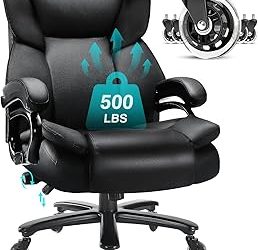
The sensible default for most buyers: a 500-pound rating, height-adjustable lumbar support, and a pocket-spring cushion that resists the bottoming-out effect foam seats develop within a season. Quiet rubber casters make it a good fit for shared or upstairs home offices.
600LBS Heavy Duty Chair with 5D Flip Arms
The 5D flip-up arms are the standout feature — swing them clear to tuck fully under a desk, or drop them to change posture through a long afternoon. With a 600-pound rating, dual rubber wheels, and a genuinely tall backrest, it suits broader and taller frames that outgrow conventional executive chairs.
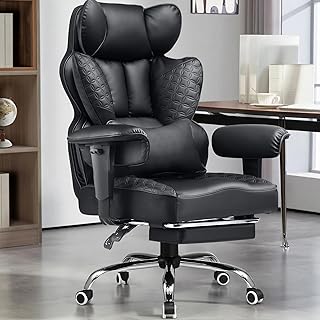
650lbs Big and Tall Leather Executive Chair
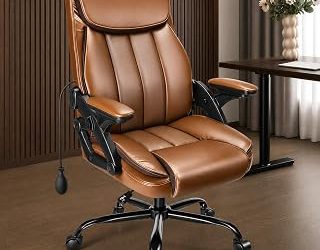
The highest capacity in this group, and the one I’d point toward anyone routinely sitting eight hours or more. Thick padding over a heavily reinforced frame means the structure is never working near its limit, which is precisely what keeps a chair supportive in year three rather than year one.
500lbs Extra Wide Seat Executive Chair
Built explicitly around back pain, with an unusually wide seat pan and thick armrest padding that spreads pressure instead of concentrating it at the hips and elbows. The upgraded wheels and heavy-duty base are a meaningful upgrade over the flimsy nylon assemblies common at this price.
GTPLAYER Big and Tall Gaming Chair (400lbs)
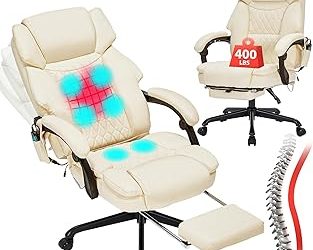
The retractable footrest and deep recline make this the best option here for genuine mid-afternoon recovery, and the saddle-shaped cushion keeps the pelvis neutral while upright. Note the 400-pound rating — the lowest of the group — so confirm your margin before ordering.
Frequently Asked Questions
Can a desk chair really affect how well I sleep?
Indirectly, yes. Chairs don’t cause insomnia, but low-back and hip pain accumulated over a working day is a well-documented trigger for nighttime awakenings and fragmented deep sleep. Reduce the daytime load and you remove one input.
How much weight capacity do I actually need?
Add roughly 100 pounds to your body weight. Sitting down generates transient forces well above your static weight, and a chair operating at 95 percent of its rating will develop play in the base and cylinder far sooner.
Are pocket springs better than memory foam for heavier users?
Generally, yes. Coils recover overnight and resist permanent compression, whereas memory foam softens under sustained heat and load. If you prefer foam, look for high-density specifications and a thick pad rather than a plush surface layer.
Should I nap in my office chair?
A reclined 15 to 20 minute break is restorative and won’t meaningfully disturb your night, provided you take it before mid-afternoon. Options like the massage chair with heat and a foot rest support this well, since gentle warmth relaxes paraspinal muscles — just avoid drifting past 30 minutes.
Final Thoughts
For most buyers, the 650lbs Big and Tall Leather Executive Chair is the safest long-term investment, simply because its engineering margin is so generous. The 600LBS chair with 5D flip arms is the most adaptable pick for tall frames and tight desks, while the GTPLAYER is worth considering if you value a reclining footrest for structured recovery breaks during the workday.