Key takeaways
- Capacity versus real-world conditions: Advertised square footage assumes mild dampness. A basement with visible condensation, a sump pit or a lingering earthy smell should be treated as one tier wetter, so size up rather than down — an oversized unit cycles less and runs quieter than a small one at full tilt.
- Drainage geometry: Gravity hoses only work downhill. Confirm the outlet port height, keep the run short with no dips, and if your drain sits above the unit, plan for a condensate pump instead of forcing a bad slope.
- Noise character, not just decibels: Compressor units produce low-frequency hum that carries through framing better than fan hiss. Look for a genuine sleep or quiet mode, and place the unit away from bedroom walls and directly above sleeping heads.
- Humidistat accuracy and auto shut-off: Target 45–50% RH. A reliable sensor plus auto shut-off prevents over-drying, which causes its own overnight problems — dry throat, cracked sinuses and fragmented sleep.
- Cold-weather performance: Unheated basements dip into the 50s. Auto-defrost and Energy Star certification keep the coil from icing and keep running costs from quietly climbing on a 24/7 duty cycle.
What's inside
Damp basements rarely stay in the basement. Moisture travels upward through joist bays, stairwells and return-air ducts, so by the time a musty note reaches the bedroom overhead, relative humidity has usually been parked above 60% for weeks. That matters more for sleep than most people realize. Dust mites and mold colonies flourish in that band, nasal passages swell overnight, and the body’s natural core-temperature drop — the physiological cue that initiates and protects deep sleep — is blunted when the air is too saturated to wick sweat off the skin. Fixing the basement is often the cheapest sleep intervention in the house.
The catch is maintenance. A dehumidifier pulling 40 or 60 pints a day fills a bucket faster than anyone remembers to empty it, and a unit that shuts off at 2 a.m. is a unit that isn’t working. Continuous gravity drainage through a hose to a floor drain, sump pit or utility sink removes that failure point entirely. This guide covers the drain-hose models worth your attention in 2026, a short framework for matching one to your space, and the questions I field most often from clients trying to dry out a house without introducing a new source of nighttime noise.
As an Amazon Associate we earn from qualifying purchases.


How to Choose a Dehumidifier For Basement With Drain Hose (2026)
- Capacity versus real-world conditions: Advertised square footage assumes mild dampness. A basement with visible condensation, a sump pit or a lingering earthy smell should be treated as one tier wetter, so size up rather than down — an oversized unit cycles less and runs quieter than a small one at full tilt.
- Drainage geometry: Gravity hoses only work downhill. Confirm the outlet port height, keep the run short with no dips, and if your drain sits above the unit, plan for a condensate pump instead of forcing a bad slope.
- Noise character, not just decibels: Compressor units produce low-frequency hum that carries through framing better than fan hiss. Look for a genuine sleep or quiet mode, and place the unit away from bedroom walls and directly above sleeping heads.
- Humidistat accuracy and auto shut-off: Target 45–50% RH. A reliable sensor plus auto shut-off prevents over-drying, which causes its own overnight problems — dry throat, cracked sinuses and fragmented sleep.
- Cold-weather performance: Unheated basements dip into the 50s. Auto-defrost and Energy Star certification keep the coil from icing and keep running costs from quietly climbing on a 24/7 duty cycle.
The Best Dehumidifier For Basement With Drain Hose (2026)s Reviewed
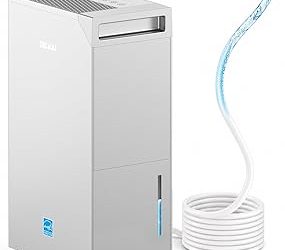
KNKA Energy Star 4500 Sq. Ft. Dehumidifier, Max 80 Pint/Day
This is my default recommendation for a finished basement under a bedroom: the dedicated sleep mode dims the display and drops fan speed, which addresses both the light and sound variables that disrupt sleep architecture. Energy Star certification keeps the cost of continuous operation reasonable.
80 Pints Energy Star Dehumidifier, 6000 Sq. Ft.
The front-facing humidity readout is genuinely useful — you can verify your basement is holding 45–50% at a glance instead of trusting a setpoint. The rotary compressor runs smoother than budget reciprocating units, and the 30–80% RH range gives you room to fine-tune seasonally.
120 Pint Dehumidifier, 6000 Sq. Ft. with Drain Hose
Reach for this one when you’re dealing with a chronically wet foundation, post-flood drying or an open basement over 1,500 square feet. The 24-hour timer lets you shift heavier extraction to daytime hours and keep overnight operation gentler.
4500 Sq. Ft. Dehumidifier with Humidity Control and Auto Shut-Off
A well-balanced middle option with a quiet smart compressor and dependable auto shut-off, suited to basements that are damp rather than dripping. It holds a setpoint without the frequent hard cycling that makes cheaper units intrusive at night.
2500 Sq. Ft. Dehumidifier, Max 34 Pints
The right scale for a small basement, walk-out apartment or laundry area, with four preset modes including a dry-clothes cycle. Its lower extraction rate means longer, steadier run times — which, acoustically, is easier to sleep through than a large unit slamming on and off.
Frequently Asked Questions
What humidity level should a basement hold?
Between 45% and 50% RH. Below 60% suppresses dust mite reproduction and mold growth; below 40% starts irritating airways and drying out wood floors and furniture above.
Is a gravity hose enough, or do I need a pump?
Gravity works if the drain sits below the unit’s outlet port with a continuous downward slope. Basements with the drain on the far wall, or units placed on a platform to avoid flooding, usually need a built-in or external condensate pump.
Can I run one overnight in a bedroom?
Yes, with caveats. Choose a model with a sleep mode, position it several feet from the bed on a hard surface rather than a hollow floor, and expect a steady low hum — many sleepers find it masks other noise effectively.
Does a larger dehumidifier cost more to run?
Not necessarily. A correctly oversized Energy Star unit reaches its setpoint faster and idles more, often using less total energy than an undersized model running near-continuously.
Final Thoughts
For most homes, the KNKA 4500 Sq. Ft. model offers the best combination of capacity, efficiency and sleep-conscious design, while the 80 Pints Energy Star unit earns its place through the transparency of its front humidity display. If your basement is genuinely wet rather than merely damp, step up to the 120 Pint model and let it work — drier air below usually means quieter, more restorative sleep above.