Key takeaways
- Lift range before presets: Marketing focuses on the top of the range, but the bottom matters more. If you’re under 5’6″, check the desk drops low enough for a 90-degree elbow angle while seated — otherwise you’ll shrug your shoulders all day and feel it at night.
- Motor noise, honestly assessed: A desk that groans loudly is a desk you stop adjusting, and an unadjusted standing desk is just a tall table. If your workspace shares a wall with a bedroom or nursery, prioritise dual-motor models advertised as quiet-lift.
- Depth over width: A 24-inch-deep top forces monitors closer than the roughly arm’s-length distance that keeps neck flexion neutral. Thirty inches gives you room to push screens back and set a lamp off to one side.
- Stability at standing height: Wobble is worst at full extension. Look at crossbar design and rated capacity — a 176 lb frame is fine for a laptop and single monitor; heavy multi-screen setups want 220 lb.
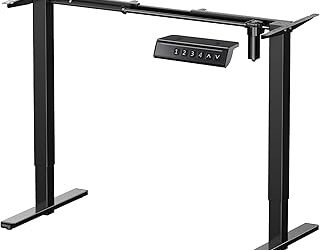
- Presets you’ll actually program: Three to four memory positions let you assign a seated height, a standing height, and one for stretching or a laptop. Treat the buttons as movement cues, not conveniences.
What's inside
Most people shop for a desk because their back hurts. As someone who spends their working life untangling why otherwise healthy adults lie awake at 1 a.m., I’d argue the more interesting consequence of a badly chosen desk shows up long after you’ve logged off. Sitting still for nine hours suppresses the accumulation of sleep pressure, flattens your daytime light exposure, and leaves the body confused about when the day is supposed to end. You then compensate with a 4 p.m. espresso, and the whole cycle tightens another notch.
An adjustable desk isn’t a sleep aid, and no motor is going to fix a chaotic bedtime. What it does is give you a low-friction excuse to change posture, move blood, and stay alert without stimulants — the ordinary daytime behaviours that make nighttime sleep consolidate properly. Below are the height-adjustable desks worth considering in 2026, assessed for lift range, frame stability, motor noise, and whether they genuinely encourage movement or just sit at one height gathering dust.
As an Amazon Associate we earn from qualifying purchases.


How to Choose an Adjustable Desk (2026)
- Lift range before presets: Marketing focuses on the top of the range, but the bottom matters more. If you’re under 5’6″, check the desk drops low enough for a 90-degree elbow angle while seated — otherwise you’ll shrug your shoulders all day and feel it at night.
- Motor noise, honestly assessed: A desk that groans loudly is a desk you stop adjusting, and an unadjusted standing desk is just a tall table. If your workspace shares a wall with a bedroom or nursery, prioritise dual-motor models advertised as quiet-lift.
- Depth over width: A 24-inch-deep top forces monitors closer than the roughly arm’s-length distance that keeps neck flexion neutral. Thirty inches gives you room to push screens back and set a lamp off to one side.
- Stability at standing height: Wobble is worst at full extension. Look at crossbar design and rated capacity — a 176 lb frame is fine for a laptop and single monitor; heavy multi-screen setups want 220 lb.
- Presets you’ll actually program: Three to four memory positions let you assign a seated height, a standing height, and one for stretching or a laptop. Treat the buttons as movement cues, not conveniences.
The Best Adjustable Desks (2026) Reviewed
FEZIBO 48″ Electric Standing Desk, Maple
A sensibly priced entry point with three memory presets and a warm maple finish that doesn’t scream “office equipment” in a bedroom corner. The 48 × 24-inch top suits laptops and single-monitor setups; you’ll want a monitor arm to claw back some depth.
ErGear 48″ Electric Standing Desk, Black
The steel frame is the story here — 176 lb capacity with noticeably less sway than similarly priced competitors, plus four presets and one-touch control. Assembly is genuinely quick, which matters more than it sounds when the alternative is a half-built desk sitting in your hallway for a fortnight.
VIVO 60 × 30 Standing Desk (1B6-P3B)
My default recommendation for anyone running two monitors. The 60 × 30-inch surface holds 220 lb, the included cable tray keeps trailing wires off the floor, and the full-size mouse pad top is a small comfort upgrade you’ll notice by the second week.
Veken 47″ Standing Desk with Drawers
The quiet lift mechanism and integrated drawers make this the best fit for a desk that lives in a bedroom, where visible clutter and mechanical noise both work against winding down. Three presets, a cable organiser, and a headphone hook cover the practical basics.
VIVO 60 × 30 Extra-Deep Standing Desk (1B6B-30)
Same generous footprint and 220 lb rating as the P3B, with an extra-deep top that lets you seat monitors properly far back — the single most underrated fix for forward head posture. A strong pick if your workstation doubles as a reading or hobby surface.
Frequently Asked Questions
Can a standing desk really improve my sleep?
Not directly, but indirectly and measurably. Breaking up sedentary time raises daytime energy expenditure and strengthens the homeostatic drive for sleep, and standing near a window increases the morning light exposure that anchors your circadian clock.
How long should I stand each day?
Aim to alternate rather than hit a target. Roughly 15 to 30 minutes standing per hour of sitting is comfortable for most people; standing rigidly for four hours simply swaps one static posture for another.
Should I stop using the desk in the evening?
Use it, but dim the room. Late standing work paired with bright overhead light delays melatonin onset — shift to a warm, low task lamp after sunset and finish screen work at least an hour before bed.
Is a fixed-height desk ever the better buy?
Yes. If you already move regularly and want storage above all, something like the Techni Mobili 51″ classic desk with three drawers costs less and never needs a power outlet.
Final Thoughts
For most home offices, the VIVO 60 × 30 (1B6-P3B) offers the best balance of surface area, stability, and cable management, while the extra-deep 1B6B-30 is the smarter buy if you sit close to your monitors. In smaller rooms — especially bedrooms, where noise and clutter carry real sleep costs — the Veken 47″ with its quiet lift and built-in drawers is the one I’d put on the list first.