Key takeaways
- Drawer nightstands: one or two drawers, usually 4 to 6 inches deep inside. Best for keeping clutter hidden.
- Open shelf nightstands: one or two shelves for books and baskets; easier to clean, but everything shows.
- Cabinet-door nightstands: taller storage for bottles, CPAP equipment or bulky items.
- Floating-style surfaces: a shelf attached to an extended headboard with open space beneath for a lighter look and easier vacuuming.
A king bed frame with built-in nightstands needs a wall roughly 9.5 to 10.5 feet wide, because the attached side tables add 16 to 24 inches on each side of a 76-inch mattress, so it suits primary bedrooms around 12 x 14 feet and larger. In return you get perfectly aligned bedside surfaces at mattress height, no gaps for pillows and phones to fall into, and often built-in outlets, USB ports or lighting. The trade-offs are flexibility, weight and the fact that you cannot move the nightstands if the room layout changes.
Our top picks

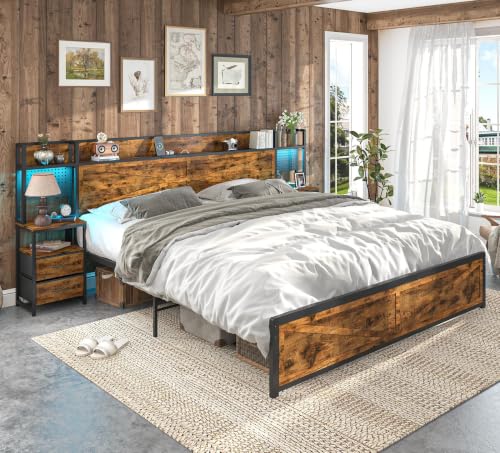
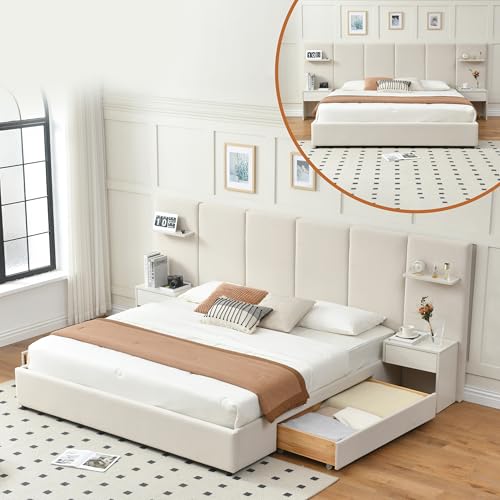

As an Amazon Associate we earn from qualifying purchases at no extra cost to you. Ratings are shown as listed on Amazon.
Total Width: The Number to Check First
| Configuration | Nightstand width (each) | Total frame width | Minimum wall width |
|---|---|---|---|
| Standard king with compact attached shelves | 12–16 in | 102–112 in (8.5–9.3 ft) | About 10 ft |
| Standard king with full-size attached nightstands | 18–22 in | 114–124 in (9.5–10.3 ft) | About 11 ft |
| King headboard spanning with floating or extended wings | 20–26 in | 118–132 in (9.8–11 ft) | About 11.5–12 ft |
| California king (72 in wide) with attached nightstands | 16–22 in | 106–118 in | About 10–11 ft |
Leave at least 6 inches between the outer edge of each nightstand and an adjacent wall or window casing so the room does not feel jammed, and check for outlets, heating vents, light switches and window sills along that wall. A built-in nightstand that covers a floor vent or blocks the only outlet behind it is a common and annoying mistake.
Bed Length and Walking Space
Frames with integrated nightstands are usually platform designs, so the length is the mattress (80 inches) plus 3 to 8 inches for the headboard and frame, around 84 to 88 inches total. Plan for 30 to 36 inches of clear walking space at the foot and 24 to 30 inches along the sides you get in and out from.
| Room size | Fits a king with built-in nightstands? | Notes |
|---|---|---|
| 11 x 12 ft | Only compact versions | Little room for a dresser on the side walls |
| 12 x 13 ft | Yes, with 16–18 in nightstands | Dresser fits on the wall opposite the bed |
| 13 x 15 ft | Yes, any width | Comfortable for dresser plus chair |
| 14 x 16 ft+ | Yes | Wide wing designs look proportional here |
Surface Height and Storage
The best bedside surface height is roughly level with the mattress top or up to 2 to 3 inches above it, so you can reach a glass of water without stretching. Integrated nightstands are fixed at a single height, typically 22 to 28 inches from the floor. If you plan a thick mattress (14 inches or more) on a platform frame 12 inches high, the mattress top lands around 26 inches, so a built-in nightstand under 24 inches would sit noticeably low.
- Drawer nightstands: one or two drawers, usually 4 to 6 inches deep inside. Best for keeping clutter hidden.
- Open shelf nightstands: one or two shelves for books and baskets; easier to clean, but everything shows.
- Cabinet-door nightstands: taller storage for bottles, CPAP equipment or bulky items.
- Floating-style surfaces: a shelf attached to an extended headboard with open space beneath for a lighter look and easier vacuuming.
Built-In Nightstands vs Separate Ones
| Factor | Built-in nightstand frame | Bed plus separate nightstands |
|---|---|---|
| Alignment | Perfect height and spacing | Depends on what you buy |
| Layout flexibility | Fixed | Move or swap any time |
| Corner placement | Usually impossible | Easy to put bed against a side wall |
| Assembly | 2–4 hours, two people | 1–2 hours total |
| Box count and weight | 3–6 boxes, 200–350 lb total | Spread across several purchases |
| Moving house | Must disassemble fully | Nightstands move in one piece |
| Typical price range | $600–$2,500 | $400–$3,000 depending on pieces |
Built-in designs make most sense if your wall can host the full width and you are confident the bed will stay on that wall for years. They make less sense in rentals, if you move often, or in rooms where the bed may need to go in a corner later.
Construction Details That Matter
How the nightstands connect
The nightstands attach to the headboard with metal brackets, bolts or a continuous headboard panel. Bolted connections that go through a solid wood or thick metal cross-member hold best. Connections that rely on cam locks in particleboard can loosen and sag, causing the nightstand top to tilt down slightly at the outer edge after months of leaning on it.
Slats and center support
A king platform should have slats no more than about 3 inches apart for most foam and hybrid mattresses (check your mattress warranty) and at least one center rail with two or more support legs. Built-in nightstands do not add structural support to the mattress area.
Power features
Many frames with integrated nightstands include AC outlets, USB-A and USB-C ports, and LED strips. These are convenient, but the frame then needs its own power cord to a wall outlet, so plan the outlet location before placing the bed. Low-power USB ports may charge a phone slowly; look for USB-C ports rated at 20 watts or more if fast charging matters.
King Headboards With Built-In Nightstands
If you already own a good metal frame or a platform base, a headboard-only version with attached nightstand wings is a cheaper route. These mount to the bed frame or the wall and usually span 100 to 120 inches. Wall-mounted versions avoid the wobble that freestanding wing headboards can develop and leave the floor clear under the side tables.
Quick Decision Checklist
- Measure the wall, then subtract window casings, outlets and vents.
- Match nightstand height to your planned mattress top height within 0 to 3 inches.
- Prefer bolted metal connections over cam locks for the nightstand attachment.
- Confirm slat spacing and center support for your mattress type.
- Plan the power cord route to an outlet before final placement.
- Budget a couple of hours and a second person for assembly.