Key takeaways
- Choose slats over a solid deck. For foam and hybrid mattresses, slat gaps of no more than about 3 inches are typical. Many mattress warranties specify this, so check yours.
- Keep some clearance. Even 2 to 4 inches of open space under the slats helps air move. Fully floor-level platforms are best paired with a breathable mattress and occasional airing.
- Lift and air it. In humid months, prop the mattress up for a few hours every few weeks if the frame sits within an inch or two of the floor.
- Use a moisture barrier mat. Thin breathable mesh pads made for floor beds help in damp rooms.
A low rise queen bed frame holds the mattress about 2 to 8 inches off the floor instead of the usual 12 to 18. With a typical 10- to 12-inch mattress, that puts the sleeping surface roughly 12 to 20 inches high. It looks modern, makes a small room or low ceiling feel bigger, and suits younger sleepers and kids. The trade-offs are harder getting up for some people, little to no under-bed storage, and more attention needed to airflow under the mattress.
Our top picks

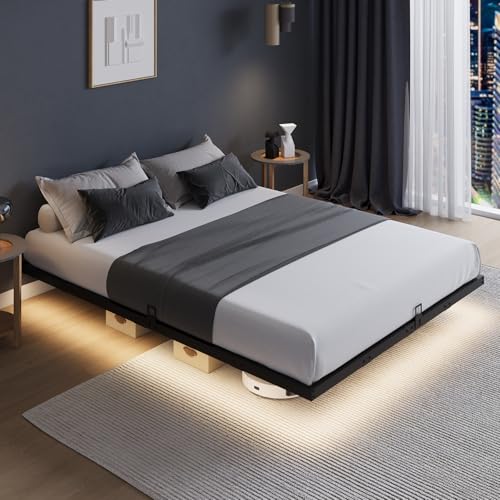
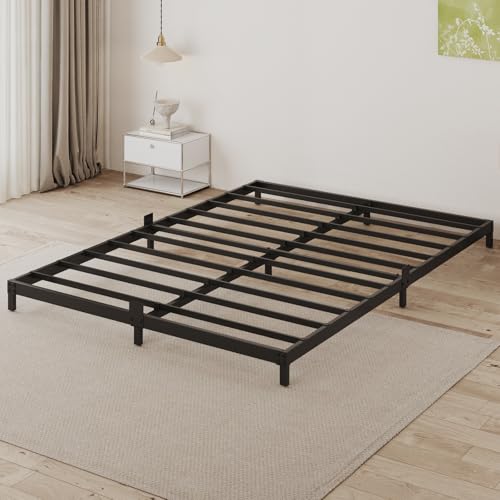
As an Amazon Associate we earn from qualifying purchases at no extra cost to you. Ratings are shown as listed on Amazon.
How low is “low”? Heights by frame type
“Low rise,” “low profile,” and “very low” are used loosely. These are the ranges you’ll actually see on queen frames, and the resulting top-of-mattress height with a 10-inch and a 12-inch mattress.
| Frame type | Deck height (floor to slats) | Sleep height, 10 in mattress | Sleep height, 12 in mattress |
|---|---|---|---|
| Floor / tatami-style platform | 1 – 3 in | 11 – 13 in | 13 – 15 in |
| Very low platform | 4 – 5 in | 14 – 15 in | 16 – 17 in |
| Low rise platform | 6 – 8 in | 16 – 18 in | 18 – 20 in |
| Standard platform (for comparison) | 12 – 14 in | 22 – 24 in | 24 – 26 in |
| Frame + box spring (for comparison) | 7 in + 9 in box | 26 in | 28 in |
A useful reference is knee height. For most adults, the floor-to-back-of-knee measurement is 18 to 22 inches. A sleep surface at or slightly above knee height is easiest to sit on and stand up from. A low rise frame with a 12-inch mattress gets close to that. A very low frame with a thin mattress puts you well below it.
Who a low or very low queen frame suits
| Situation | Recommended height | Why |
|---|---|---|
| Rooms with 7 to 7.5 ft ceilings or attic slopes | Very low or floor style | More visual headroom and space under sloped ceilings |
| Shorter sleepers (under about 5 ft 4 in) | Low rise, 16 – 19 in sleep height | Feet reach the floor when sitting on the edge |
| Young kids moving to a queen | Very low | Shorter distance if they roll off |
| Pets that jump on the bed | Low rise | Easier for small or older dogs |
| Anyone who finds low seating hard to rise from | Standard height instead | A sleep surface under 18 in means a deeper squat to stand |
| Need under-bed storage | Not a low frame | Clearance is too small for bins or drawers |
Airflow and moisture: the real downside of going very low
Mattresses release moisture overnight. On a solid surface near the floor, especially in humid climates or cold rooms with poor air circulation, that moisture can collect on the underside and lead to mildew. A few ways to handle this:
- Choose slats over a solid deck. For foam and hybrid mattresses, slat gaps of no more than about 3 inches are typical. Many mattress warranties specify this, so check yours.
- Keep some clearance. Even 2 to 4 inches of open space under the slats helps air move. Fully floor-level platforms are best paired with a breathable mattress and occasional airing.
- Lift and air it. In humid months, prop the mattress up for a few hours every few weeks if the frame sits within an inch or two of the floor.
- Use a moisture barrier mat. Thin breathable mesh pads made for floor beds help in damp rooms.
Practical clearances people overlook
Robot vacuums and cleaning
Most robot vacuums need about 3 to 4 inches of clearance to pass under furniture. A low rise frame with 6- to 8-inch legs works. A 4-inch deck usually does not. Floor-level platforms leave nothing to clean under, which some people prefer.
Nightstand height
Nightstands look and work best when their top sits within about 2 inches of the mattress top. Standard nightstands are 24 to 28 inches tall, too tall for a 15-inch sleep surface. Look for low nightstands around 14 to 20 inches, or use floating wall shelves.
Bedding
Bed skirts aren’t needed. Duvets and comforters will often touch the floor on a low queen. A queen duvet that drops 15 to 18 inches on each side drags on the floor once the bed is below about 16 inches high, so consider a smaller drop or a coverlet.
Footprint
A queen mattress is 60 x 80 inches. Low platform frames usually add 1 to 4 inches each way. Japanese-style frames with a wide wooden border can reach 70 x 90 inches or more. Leave 24 to 30 inches of walkway on each side and at the foot. Wide-border low beds are surprisingly easy to stub toes on.
Materials and build for low frames
| Material | Typical look | Strengths | What to check |
|---|---|---|---|
| Solid wood (pine, acacia, oak) | Japandi, Scandinavian | Quiet, sturdy, refinishable | Center support legs, slat thickness of at least 0.75 in |
| Engineered wood / veneer | Minimal, flat panels | Lower cost, clean lines | Edge chipping near floor, swelling if mopped |
| Steel | Industrial or hidden base | Light, easy to move | Rubber feet to protect floors and prevent squeaks |
| Upholstered | Soft, hotel-style | No hard edges at shin level | Fabric near the floor collects dust and pet hair |
Low queen frames usually ship in one to three boxes, totaling 50 to 120 lb, with 30 to 90 minutes of assembly. The many-slat Japanese-style kits take the longest. Typical prices run $150 to $400 for steel or engineered wood, and $450 to $1,500 for solid-wood platforms.
Very low bed frame queen: is floor height a good idea?
A frame that keeps the mattress 1 to 3 inches off the floor gives the most minimalist look and works well in rooms with low ceilings or studio apartments. It suits people who are comfortable sitting cross-legged or squatting. It’s the least forgiving option for anyone who struggles with low seating, and the one most dependent on good airflow. If you like the look but not the height, a low rise frame with a 12-inch mattress lands around 18 to 20 inches. That’s still clearly lower than a standard bed but comfortable to get in and out of.
Bottom line
Pick your frame height backward from your target sleep height. Around 16 to 20 inches suits most people who want a low look, and 12 to 15 inches is for those who really want floor-level. Choose slats with no more than 3-inch gaps, keep at least a little air under the bed, and plan for low nightstands and shorter bedding drops.