Key takeaways
- For a duvet layer: choose a thin quilt with a smooth surface so the two covers slide over one another rather than grip.
- For a folded foot layer: choose medium weight and flexible quilting; very stiff batting creates an untidy stack.
- For a tucked hotel-style bed: allow enough width to pass under the mattress without placing excessive tension on the side seams.
- For an adjustable bed: avoid excessive length and heavy quilts that can bunch when the head or foot section rises.
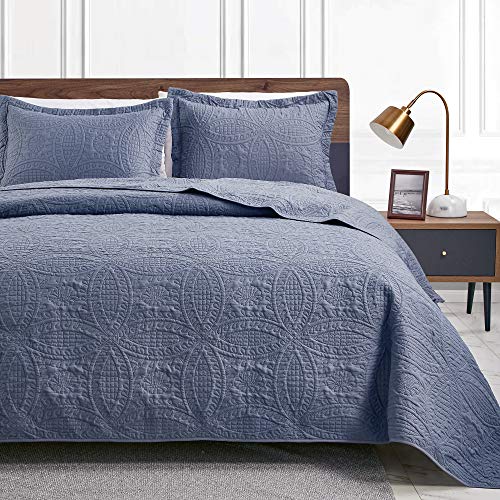
The best quilt sets for lightweight, layered bedroom style are medium-weight cotton or cotton-blend sets with closely spaced stitching, generous dimensions, and two washable shams that can sit beneath or over a duvet.
A quilt set is more than a coordinated bedspread: its construction determines whether it works as a cool-season cover, a decorative top layer, or a practical everyday blanket. The right choice depends on your mattress depth, room temperature, laundry routine, and how much warmth you want to add without the bulk of a comforter.
Our top picks


As an Amazon Associate we earn from qualifying purchases at no extra cost to you. Ratings are shown as listed on Amazon.
Best quilt sets by sleeping situation
| Situation | Best quilt specification | Why it fits | Watch for |
|---|---|---|---|
| Warm sleeper or hot bedroom | 100% cotton, low-loft fill, about 2–4 lb for a queen | Breathable and easy to fold at the foot of the bed | Dense polyester batting can feel less breathable |
| Cool bedroom or winter layering | Medium-loft cotton or cotton-blend quilt, about 4–7 lb for a queen | Adds insulation while remaining flatter than most comforters | A lightweight quilt alone may not replace a cold-weather duvet |
| Kids, pets, or frequent washing | Prewashed cotton or cotton-polyester blend with reinforced edge binding | Handles regular laundering and hides minor creasing | Very loose stitching can catch claws or snag in the washer |
| Small apartment or rental | Reversible quilt with simple geometric stitching | One set provides two looks and stores compactly | Oversized king sets can be difficult to wash in a compact machine |
| Thick mattress or pillow-top bed | Oversized dimensions with at least 20–24 inches of side drop | Reaches below the mattress edge without constant repositioning | Standard bedspreads may look undersized |
Quilt construction: what you are actually buying
Most quilts contain a face fabric, a thin insulating layer, and a backing secured by decorative stitching. The amount and type of fill have a larger effect on warmth and weight than the pattern on the surface.
Low-loft quilts
Low-loft designs use a thin batting layer and are usually the best choice for summer, heated bedrooms, and layering over a duvet. They fold easily and create a tailored appearance, but they provide limited insulation on their own.
Medium-loft quilts
Medium-loft quilts offer the most flexible balance. They can serve as a primary cover in mild weather or sit over sheets and under a duvet when temperatures drop. For a queen-size bed, a practical medium-weight range is approximately 4–7 pounds before packaging, although exact weight varies with fabric and fill.
Channel-stitched and whole-cloth styles
Channel stitching forms parallel rows, while whole-cloth quilts may use larger stitched motifs across a single-color surface. Closely spaced stitching generally keeps the fill evenly distributed, but it can make the quilt feel slightly firmer. Large, widely spaced motifs create a softer drape but allow batting to migrate more easily over time.
Fabric weight and warmth: cotton versus blends
| Fabric type | Typical feel | Warmth and breathability | Durability and care trade-off |
|---|---|---|---|
| 100% cotton | Natural, soft, and increasingly relaxed after washing | Usually breathable; suitable for warm sleepers | Can wrinkle, shrink, or fade if washed and dried aggressively |
| Cotton-polyester blend | Smoother and often lighter than all-cotton fabric | Moderate breathability with dependable warmth | Typically resists wrinkles and shrinkage better |
| Washed cotton | Soft, casual, and slightly crinkled | Good everyday breathability | Minor wear is less visible, but loose weave may snag more easily |
| Velvet or plush reverse | Soft and noticeably warmer against the skin | Less airy; better for cool rooms | May attract lint and create more bulk when layered |
Fabric weight is not the same as fill weight. A heavy outer fabric can make a quilt feel substantial even when the batting is thin. If you want a breathable layer, look for a cotton face and backing, modest loft, and stitching that does not trap excessive air.
Dimensions matter more than the label
“Queen” and “king” are useful starting points, not guarantees of coverage. Mattress thickness, bed height, and whether you want a tucked or untucked look all affect the required size.
| Bed size | Typical mattress width | Useful quilt width for side coverage | Common quilt length to consider |
|---|---|---|---|
| Twin | 38 inches | 65–70 inches | 90–100 inches |
| Full/Double | 54 inches | 80–86 inches | 90–100 inches |
| Queen | 60 inches | 90–96 inches | 92–100 inches |
| King | 76 inches | 106–112 inches | 92–100 inches |
| California king | 72 inches | 102–108 inches | 96–104 inches |
To estimate side drop, subtract your mattress width from the quilt width and divide by two. A 96-inch-wide queen quilt provides an 18-inch drop on each side before accounting for a thick mattress topper. For a 14-inch mattress on a low platform bed, that may be enough. For a 16-inch pillow-top mattress on a tall foundation, choose a wider option or expect the quilt to sit closer to the mattress edge.
Measure the visible height from the top of the mattress to the floor as well. A quilt that reaches the floor may look polished on a bed with concealed legs, but it can drag, collect dust, or catch under a rolling storage drawer. Leave at least 2–4 inches of clearance above the floor when you want an easy-to-clean, movable bed.
Reversible designs and included shams
Reversible quilts are particularly useful when you want to change the room without storing a second cover. The most versatile combinations pair a small geometric stitch pattern with a solid or subtle reverse. High-contrast reverses create a dramatic fold at the foot of the bed; tonal reverses are easier to coordinate with patterned sheets.
Check the sham count before buying. Twin sets commonly include one sham, while full, queen, king, and California king sets often include two. A sham is usually decorative rather than a substitute for a standard sleeping pillowcase, and its dimensions may differ by set. Standard shams are approximately 20 by 26 inches, while king shams are approximately 20 by 36 inches. If your bed has three or four visible pillows, the included pair may not complete the arrangement.
Stitching durability and layering performance
Inspect the stitching pattern and edge finish in the product specifications or close-up images. Smaller stitched sections help prevent fill from shifting into empty corners. Bound edges are generally more resistant to fraying than a simple turned hem, especially when the quilt is pulled across a mattress every day.
- For a duvet layer: choose a thin quilt with a smooth surface so the two covers slide over one another rather than grip.
- For a folded foot layer: choose medium weight and flexible quilting; very stiff batting creates an untidy stack.
- For a tucked hotel-style bed: allow enough width to pass under the mattress without placing excessive tension on the side seams.
- For an adjustable bed: avoid excessive length and heavy quilts that can bunch when the head or foot section rises.
The areas that usually show wear first are the bound corners, the lower edge near the feet, and the fabric around frequently used shams. Washing inside a large mesh bag, avoiding overloading, and following the care label can reduce seam stress. A compact washer may not have enough room for a king quilt to move freely; a large-capacity machine or commercial washer can produce more even cleaning.
How to choose the best quilt set for your bed
- Measure the mattress. Record width, length, and thickness, including any topper.
- Decide the primary role. Select low loft for decoration and summer use, or medium loft for a stand-alone cover in mild weather.
- Set a fabric priority. Choose cotton for breathability, a blend for easier care, or a plush reverse for added warmth.
- Confirm the actual dimensions. Do not rely on twin, queen, or king labels alone.
- Count the shams. Verify whether the set includes one or two and whether they are standard or king size.
- Check the edge and stitch construction. Favor reinforced binding and quilting that keeps sections relatively small.
- Plan the wash routine. Make sure the finished quilt can fit your washer, dryer, and storage space.
What should you spend?
Basic quilt sets commonly cost about $40–$100, mid-range cotton or reversible sets often fall around $100–$250, and premium natural-fiber or intricately stitched sets may cost $250–$600 or more. A higher price does not automatically mean greater warmth. Pay for the dimensions, fabric quality, construction, and care requirements that match your room and routine.
For most bedrooms, the strongest all-purpose choice is a medium-weight, reversible cotton or cotton-blend quilt with reinforced binding, tightly controlled stitching, two correctly sized shams, and enough width to provide at least an 18–24-inch side drop. That combination gives the best balance of breathable comfort, visual flexibility, and reliable performance across seasons.