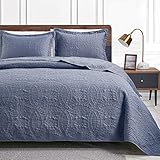
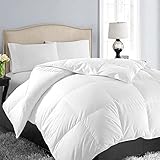
Key takeaways
- Best value: a comforter plus matching shams, especially if you already own sheets.
- Best for a coordinated makeover: a set that adds a bed skirt or decorative pillows in matching or complementary colors.
- Best for practical households: a simple three-piece set with removable, washable pieces rather than heavily embellished accessories.
The best comforter sets for a complete bedroom makeover are the ones that match your bed’s actual dimensions, provide the right warmth for your room, and include enough coordinated pieces to avoid buying separate shams, pillowcases, and decorative accents.
Our top picks


As an Amazon Associate we earn from qualifying purchases at no extra cost to you. Ratings are shown as listed on Amazon.
Best comforter sets by shopping situation
| Shopper’s situation | Best set type | What to look for | Main compromise |
|---|---|---|---|
| Small apartment or guest room | Lightweight, reversible three-piece set | Full/queen sizing, 150–250 GSM fill, compact machine washing | Less warmth and fewer decorative pieces |
| Kids, pets, or frequent washing | Machine-washable microfiber or cotton-blend set | Secure stitching, hidden zipper or envelope shams, medium-dark colors | Some microfiber feels warmer or less breathable than cotton |
| Renter wanting a fast makeover | Reversible set with matching shams and bed skirt | Two usable colors, wrinkle resistance, no special cleaning | A bed skirt may not fit unusual frame heights |
| Cold bedroom or drafty home | Medium- to heavyweight down-alternative set | 300–500 GSM fill, box stitching, generous side drop | More bulk in the washer and dryer |
| Hot sleeper or warm climate | Breathable cotton or lyocell shell with light fill | 100–200 GSM fill, percale-like weave, moisture-managing fabric | May need an additional blanket in winter |
| Luxury appearance on a controlled budget | Oversized quilted or tufted set | Dense stitching, tonal texture, king-size coverage | Decorative quilting can take longer to dry |
What comes in a comforter set?
Set contents vary more than the name suggests. A basic three-piece set usually includes one comforter and two matching pillow shams. Twin and twin XL sets generally include one sham, while full, queen, king, and California king sets commonly include two.
More complete sets may add two or four decorative pillows, a bed skirt, pillowcases, or a fitted sheet. Check the product description carefully: a “seven-piece set” may count four small decorative pillows separately, while another brand may call a comforter, two shams, and four pillowcases a seven-piece set. Pillow inserts are also not always included.
- Best value: a comforter plus matching shams, especially if you already own sheets.
- Best for a coordinated makeover: a set that adds a bed skirt or decorative pillows in matching or complementary colors.
- Best for practical households: a simple three-piece set with removable, washable pieces rather than heavily embellished accessories.
Choose the right size and coverage
Bed labels are not perfectly standardized. A queen comforter can be approximately 86–90 inches wide and 90–94 inches long, while a king can be roughly 104–110 inches wide and 90–100 inches long. Always compare the listed dimensions with your mattress, topper, frame, and preferred drop.
| Bed size | Typical mattress width | Useful comforter width | Typical use |
|---|---|---|---|
| Twin | 38 inches | 66–70 inches | One sleeper, child’s room, narrow guest room |
| Twin XL | 38 inches | 66–70 inches | College or extra-long single bed |
| Full | 54 inches | 80–86 inches | One adult or a compact shared bed |
| Queen | 60 inches | 86–90 inches | Most common primary-bedroom size |
| King | 76 inches | 102–110 inches | Two sleepers wanting generous side coverage |
| California king | 72 inches | 102–110 inches | Longer mattress with slightly less width |
For a 10-by-12-foot bedroom, a queen set usually leaves more visual breathing room than a king, particularly when the bed sits between two nightstands. If your mattress is 14 inches thick and rests on a tall platform, choose an oversized comforter or expect less fabric to hang over the sides. A comforter that reaches the floor can also interfere with drawers, robot vacuums, and doors on low furniture.
Fill weight: warmth without guessing
Fill weight describes how much insulating material is inside the comforter. It is not the same as the total shipping weight, and a higher number is not automatically better. Construction, shell fabric, room temperature, and personal sleep preferences all affect warmth.
- 100–200 GSM: light and suitable for warm rooms, summer use, or hot sleepers.
- 200–300 GSM: versatile medium warmth for many centrally heated bedrooms.
- 300–500 GSM: warmer and loftier for cold rooms, drafty homes, or winter use.
- Two-layer or all-season designs: often combine a light and medium layer with snaps or ties, giving more flexibility than one very heavy comforter.
Down-alternative fill is typically polyester fiber and is usually easier to wash than natural down. Down can provide substantial warmth with less bulk, but it may require more careful laundering and can be unsuitable for shoppers who want a fully synthetic construction. Look for evenly distributed box stitching or channel stitching; large unstitched areas allow fill to migrate and create cold spots.
Fabric feel and durability compared
| Shell fabric | Feel | Advantages | Watch for |
|---|---|---|---|
| Cotton | Soft, familiar, and increasingly comfortable after washing | Breathable and available in smooth sateen or crisp percale weaves | Can wrinkle and may shrink if washed or dried too hot |
| Microfiber polyester | Smooth, light, and sometimes brushed | Usually affordable, wrinkle resistant, and quick drying | Can retain more heat and develop surface pilling over time |
| Cotton-polyester blend | Balanced and generally low maintenance | Combines some breathability with improved wrinkle resistance | Less distinctly cool or crisp than premium cotton |
| Lyocell or similar regenerated fiber | Cool, smooth, and fluid | Comfortable for warm sleepers and often moisture friendly | May need gentler washing and can cost more |
Texture also changes the look of the room. A quilted or tufted comforter adds dimension to plain walls and smooth wood furniture, while a flat reversible design creates a cleaner, more modern appearance. If you have pets, tightly woven smooth fabrics usually collect less hair than loose boucle-style surfaces or raised decorative stitching.
Color choices that stay useful
Choose color according to the room’s fixed elements rather than matching every accessory. Warm beige, ivory, muted sage, dusty blue, charcoal, and soft terracotta are versatile choices that work with wood, upholstered, and metal bed frames. Reversible sets are especially useful in rental bedrooms because turning the comforter over can change the room’s appearance without purchasing new bedding.
- Small or dark room: ivory, pale gray, soft blue, or muted green can keep the bed from looking visually heavy.
- Large neutral room: navy, rust, forest green, or charcoal can create a stronger focal point.
- Children’s room: medium tones and subtle patterns hide everyday marks better than pure white.
- Shared bedroom: reversible solids or restrained geometric patterns are easier to coordinate with different preferences.
Washability and everyday maintenance
Before choosing one of the best comforter sets, confirm that the comforter fits your washing machine. A queen or king comforter rated for home washing may still be too bulky for a compact apartment washer. As a practical guide, a queen comforter often needs a machine with at least about 4.5 cubic feet of capacity, while a bulky king comforter may be better handled by a large-capacity laundromat machine.
Wash according to the care label, use a mild detergent, and avoid overloading the drum. Low heat or air drying is safer for synthetic fill and helps limit clumping. Shake the comforter periodically while it dries. Decorative pillows may be spot-clean only, so treat them as accents rather than the most washable part of the set.
What to inspect before ordering
- Measure the mattress width, length, and thickness, including any topper.
- Compare the comforter’s finished dimensions rather than relying only on “queen” or “king.”
- Check whether shams close with an envelope flap or zipper and whether pillow inserts are included.
- Look for reinforced seams, consistent quilting, and corner ties if you plan to use a duvet insert.
- Confirm the care instructions and the return policy for bedding that arrives compressed.
- Consider storage: a heavyweight set can occupy several cubic feet of closet space once fully lofted.
For most bedrooms, the strongest all-around choice is a medium-weight, machine-washable set with a cotton-blend or smooth microfiber shell, two matching shams, and enough width to cover the mattress and frame comfortably. Select light fill for warm sleepers, heavier fill for cold rooms, and a reversible color scheme when you want the largest visual change from a single purchase.