Key takeaways
- Match output to room volume, not floor area: A 1,000 ft² rating assumes standard ceilings and closed doors. For a typical 150 ft² bedroom, 300–420 ml/h is ample; open-plan spaces and vaulted ceilings need 800 ml/h or a four-gallon reservoir to keep pace overnight.
- Judge the noise floor, not the peak: Every evaporative unit uses a fan. What matters is the lowest usable speed — ideally a smooth, broadband hum under 30 dB. Avoid units whose quiet mode barely moves air, since a stalled wick humidifies nothing.
- Cost the wicks before you buy: Filters are consumables, typically replaced every one to three months in hard-water areas. Two or three replacements can approach the price of the machine, so check availability and multipack pricing first.
- Insist on light discipline: Bright indicator LEDs sit directly in your visual field at bed height. Look for full display blackout, warm or blue-light-free nightlights, and sleep modes that dim automatically rather than just softening.
- Prioritise cleaning access: A humidifier you dread disassembling becomes a biofilm reservoir. Top-fill openings, wide-mouth tanks, dishwasher-safe trays, and auto-dry cycles that run the fan after shutdown are the features that keep maintenance honest.
What's inside
Most people blame the mattress. Somewhere around 3 a.m. in January, you surface with a scratchy throat, a blocked nose, and the particular grogginess that comes from an hour of unnoticed mouth breathing — and you assume the bed is the culprit. More often it’s the air. Forced-air heating routinely drags indoor relative humidity down to 20–25%, well below the 40–50% band where nasal cilia clear efficiently and mucous membranes stay pliable. Dry airways mean more snoring, more micro-arousals, and a sleep architecture that looks fine on paper but leaves you flat by mid-morning.
Evaporative humidifiers solve this differently from the ultrasonic models that dominate store shelves. Instead of atomising water into a visible plume, a fan draws room air through a saturated wick, so moisture leaves as invisible vapour and the mineral content stays behind in the filter — no white dust settling on your nightstand, and no risk of over-saturating a small bedroom, because evaporation naturally slows as the air approaches equilibrium. Below, I’ve assessed six current models on the criteria that actually govern sleep quality: acoustic profile, light emission, refill ergonomics, filter economics, and honest coverage figures.
As an Amazon Associate we earn from qualifying purchases.


How to Choose an Evaporative Humidifier (2026)
- Match output to room volume, not floor area: A 1,000 ft² rating assumes standard ceilings and closed doors. For a typical 150 ft² bedroom, 300–420 ml/h is ample; open-plan spaces and vaulted ceilings need 800 ml/h or a four-gallon reservoir to keep pace overnight.
- Judge the noise floor, not the peak: Every evaporative unit uses a fan. What matters is the lowest usable speed — ideally a smooth, broadband hum under 30 dB. Avoid units whose quiet mode barely moves air, since a stalled wick humidifies nothing.
- Cost the wicks before you buy: Filters are consumables, typically replaced every one to three months in hard-water areas. Two or three replacements can approach the price of the machine, so check availability and multipack pricing first.
- Insist on light discipline: Bright indicator LEDs sit directly in your visual field at bed height. Look for full display blackout, warm or blue-light-free nightlights, and sleep modes that dim automatically rather than just softening.
- Prioritise cleaning access: A humidifier you dread disassembling becomes a biofilm reservoir. Top-fill openings, wide-mouth tanks, dishwasher-safe trays, and auto-dry cycles that run the fan after shutdown are the features that keep maintenance honest.
The Best Evaporative Humidifiers (2026) Reviewed
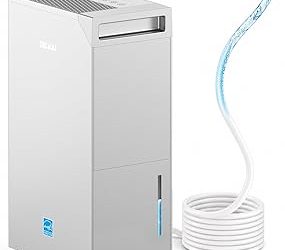
DREO Smart Evaporative Humidifier (10L, 1000 ft²)
The 10-litre reservoir and 800 ml/h ceiling make this the sensible choice for master bedrooms, studios, and anyone tired of nightly refills — a 50-hour runtime means topping up twice a week rather than every morning. Its humidistat holds a target reasonably tightly, which matters more than raw output for stable overnight comfort.
Levoit Evaporative Humidifier for Bedroom & Baby
The separate wireless sensor is the standout: measuring humidity across the room rather than at the outlet stops the unit from throttling early on its own damp microclimate. Blue-light-free nightlight, auto-dry, and Alexa control round out a genuinely nursery-appropriate design.
LAVIEAIR 5L Top-Fill Bedside Humidifier
Purpose-built for the 300 ft² bedroom, with mist-free operation and a top-fill opening you can service with a bedside water bottle. Up to 48 hours per fill makes it a low-friction option for anyone who wants moisture without another chore.
AEOCKY 420 ml/h Mist-Free Humidifier (4.5L)
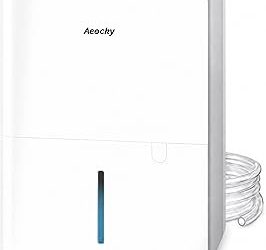
A well-judged set-and-forget unit: auto mode tracks the room, sleep mode drops both fan and lighting, and the self-cleaning cycle dries the wick to discourage mould between uses. The 420 ml/h output is nicely calibrated for single bedrooms and home offices.
Vornado Evap40
The workhorse. Four gallons across dual removable tanks, a mechanical humidistat, and Vornado’s vortex airflow distribute vapour through large rooms rather than pooling it near the base. It’s the least gadget-driven pick here and the most durable-feeling.
Frequently Asked Questions
What humidity level should I target for sleep?
Aim for 40–50%. Below 30% airways dry and static builds; above 60% you invite dust mites and mould. A £10 hygrometer placed away from the unit is the only way to know where you actually sit.
Is evaporative better than ultrasonic for bedrooms?
For most people, yes. Evaporative models are self-limiting, produce no mineral dust, and won’t leave damp patches on bedding. The trade-off is audible fan noise and a filter to replace.
How often do wick filters need changing?
Every one to three months, sooner with hard water. Stiffening, crusting, or a musty smell means replace it — a clogged wick quietly halves your output.
Can I use tap water?
Yes; that’s an advantage of the evaporative design, since minerals are trapped in the wick rather than dispersed. Distilled water simply extends filter life.
Final Thoughts
For large bedrooms and long unattended runtimes, the DREO 10L is the most complete package in this group. Parents and light sleepers should prioritise the Levoit for its remote sensor and blue-light-free nightlight, while the Vornado Evap40 remains the pick for anyone who wants robust, mechanically simple whole-room humidification that will still be running in five years.