Key takeaways
- Understand the mechanism first: These are evaporative coolers. They pull warm air across a wet medium and return it cooler and damper. In dry air (under about 50% relative humidity) the air leaving the unit can feel dramatically cooler; in muggy coastal air, the effect narrows considerably.
- Judge noise character, not just decibels: A steady broadband hum around 40–50 dB is genuinely sleep-friendly and can mask traffic or a snoring partner. What wrecks sleep is variable noise — pump clicks, rattling louvers, or a fan that surges. Always run the unit on its lowest speed overnight.
- Match tank capacity to your timer: A 12–15 hour timer is useless if the reservoir empties in five. Look for dual tanks or 1 gallon and up so you are not refilling mid-sleep-cycle. Ice packs are a short-term boost, not an eight-hour strategy.
- Prioritize airflow height and sweep: Taller towers (38–45 inches) deliver air above mattress level, producing gentle drift rather than a cold jet on your face — which is what causes dry sinuses and stiff shoulders. Wide oscillation (100° plus) suits shared beds; narrow sweep suits single sleepers.
- Check display dimming and cleaning access: A bright LED panel is a light-pollution problem in a bedroom, so a remote with a display-off function matters. Equally important: removable tanks and washable filters, because stagnant water is a mold and allergen source.
What's inside
Sleep physiology is stubborn about one thing: your core temperature has to fall by roughly one to two degrees Fahrenheit before your brain will let you drop into deep sleep. That thermal descent is why a stuffy 78°F bedroom has you flipping the pillow at 2 a.m. Unfortunately, conventional portable AC units demand a window kit, a fat exhaust hose, and a window that slides the right way — a non-starter for casement frames, dorm rooms, converted attics, basement offices, and most rental agreements.
Hoseless units sidestep installation entirely by using evaporative cooling rather than refrigerant. This guide covers where that trade-off genuinely works, what to verify before you buy, and which 2026 models hold up over a full night — assessed on noise character, runtime, airflow geometry, and how they behave in a pitch-dark room.
As an Amazon Associate we earn from qualifying purchases.


How to Choose a Portable Air Conditioner No Hose (2026)
- Understand the mechanism first: These are evaporative coolers. They pull warm air across a wet medium and return it cooler and damper. In dry air (under about 50% relative humidity) the air leaving the unit can feel dramatically cooler; in muggy coastal air, the effect narrows considerably.
- Judge noise character, not just decibels: A steady broadband hum around 40–50 dB is genuinely sleep-friendly and can mask traffic or a snoring partner. What wrecks sleep is variable noise — pump clicks, rattling louvers, or a fan that surges. Always run the unit on its lowest speed overnight.
- Match tank capacity to your timer: A 12–15 hour timer is useless if the reservoir empties in five. Look for dual tanks or 1 gallon and up so you are not refilling mid-sleep-cycle. Ice packs are a short-term boost, not an eight-hour strategy.
- Prioritize airflow height and sweep: Taller towers (38–45 inches) deliver air above mattress level, producing gentle drift rather than a cold jet on your face — which is what causes dry sinuses and stiff shoulders. Wide oscillation (100° plus) suits shared beds; narrow sweep suits single sleepers.
- Check display dimming and cleaning access: A bright LED panel is a light-pollution problem in a bedroom, so a remote with a display-off function matters. Equally important: removable tanks and washable filters, because stagnant water is a mold and allergen source.
The Best Portable Air Conditioners With No Hose (2026), Reviewed
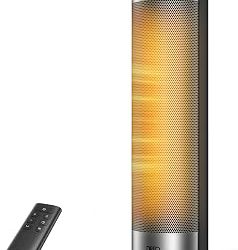
38.6″ Windowless Evaporative Cooler, Black
The 120° oscillation is the widest sweep in this group, which makes it the sensible pick for couples who disagree about airflow. The 12-hour timer covers a standard sleep window, and the black finish visually recedes in a dark room instead of glowing at you.
42″ Swamp Cooler with Aroma and Memory Function
The memory function is quietly the best feature here — it restores your mode and speed so you are not re-programming a control panel at 11 p.m., which is exactly the kind of alerting task that delays sleep onset. The 15-hour timer and 1.1-gallon dual tank handle long nights; treat the aroma pad as optional and skip it if anyone in the room has asthma.
Battery-Compatible Windowless Cooler (DeWalt 20V Max)
AC/DC operation and a 3-gallon reservoir make this the outlier: it works in campers, garages, and during summer outages when a refrigerant unit is simply dead weight. Note the battery is sold separately, and treat the 600 sq ft claim as a dry-climate best case.
45″ Windowless Evaporative Cooler, Milky
The tallest unit here, and that height is a real sleep advantage — air arrives as ambient drift above the bed rather than a stream aimed at your head. The 60° swing is narrower, so position it slightly off-axis from a single sleeper for the most comfortable result.
Dual-Tank Windowless Cooler, 24H Runtime
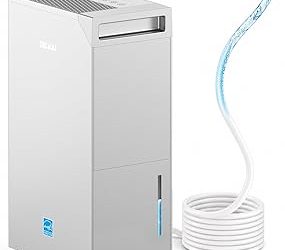
Dual tanks plus a 28-foot remote solve the two things that actually wake people up: running dry and having to get out of bed to change a setting. With 120° oscillation and three speeds, it is the most complete all-rounder on this list.
Frequently Asked Questions
Do hoseless units actually cool a room?
Not in the way a compressor does. They cool the air passing through them rather than extracting heat from the space, so expect meaningful relief within a few feet of the outlet — not a lower thermostat reading. For a bed, that localized cooling is often enough.
Will it make my bedroom too humid?
Adding moisture is the mechanism, so yes, humidity will rise. Keep a cheap hygrometer nearby and stay below roughly 60% relative humidity; above that, cooling efficiency collapses and dust mites thrive. Cracking a door or window gives the moist air somewhere to go.
What bedroom temperature should I aim for?
Most sleep guidance lands between 60°F and 68°F. If your room sits above that and you cannot change it, focus on air movement across exposed skin — moving air accelerates evaporative heat loss from your body and can make a warm room feel workable.
How do I keep the water tank from smelling?
Empty and air-dry the reservoir when the unit is idle, rinse it weekly, and clean the cooling pad or filter on the manufacturer’s schedule. Standing water left for days is what produces musty odors and aerosolized mold spores — a genuine problem for allergy-prone sleepers.
Final Thoughts
For most bedrooms, the dual-tank 24-hour model is the safest bet: it runs a full night unattended and the long-range remote keeps you horizontal. Light sleepers who want airflow overhead rather than in the face should choose the 45″ Milky tower, while the DeWalt 20V-compatible unit remains the only sensible option for garages, campers, and outages.