Key takeaways
- Judge the quiet speed, not the headline CADR: A purifier’s turbo rating is irrelevant at midnight. Look for a sleep or night mode measured at or below roughly 25–30 dB, and size the unit generously so its lowest setting still clears your room several times an hour.
- Demand darkness: AQI screens and status LEDs sit at eye level from a pillow and skew blue — precisely the wavelength that suppresses melatonin. A true display-off function (not merely dimmed) is non-negotiable for a bedroom.
- Target four to five air changes per hour: Divide the manufacturer’s coverage claim by three for a realistic bedroom figure. An oversized unit loafing on low beats a correctly sized one screaming on high.
- Insist on a carbon stage: HEPA media captures particles but ignores gases. New mattresses, foam toppers, painted furniture and laminate flooring off-gas VOCs for months, and only activated carbon addresses that stale, chemical note in a closed room.
- Match the plant to your care bandwidth: A struggling plant is a stress cue, not a sanctuary. Choose species suited to the light your bedroom actually receives, and check toxicity if pets or small children share the space.
What's inside
Most people shopping for bedroom air quality are chasing a symptom rather than a number: the 3 a.m. wake-up with a blocked nose, the dry throat that arrives every February, the sense that eight hours in bed produced about five hours of rest. Sleep fragmentation rarely announces itself. Airborne irritants — dust mite allergen shaken loose from bedding, pollen carried in on hair, fine particulate from a nearby road — trigger micro-arousals brief enough that you never form a memory of them, yet long enough to shred your deep-sleep architecture. Meanwhile the market offers two competing answers: a live plant that promises to “purify” your room, or a machine that promises to do it properly.
This guide treats those as complementary, not interchangeable. Below you’ll find verified-performance purifiers assessed the way a sleep clinician would assess them — by their behaviour at low fan speed, their light output in a dark room, and their long-term filter economics — alongside two houseplants chosen for what they genuinely contribute to a bedroom, which is atmosphere, humidity buffering and a calmer wind-down environment. Every recommendation is weighed for the space it will actually occupy: a nightstand, a corner, a room you sleep in for a third of your life.
As an Amazon Associate we earn from qualifying purchases.



How to Choose a Plants Air Purifier (2026)
- Judge the quiet speed, not the headline CADR: A purifier’s turbo rating is irrelevant at midnight. Look for a sleep or night mode measured at or below roughly 25–30 dB, and size the unit generously so its lowest setting still clears your room several times an hour.
- Demand darkness: AQI screens and status LEDs sit at eye level from a pillow and skew blue — precisely the wavelength that suppresses melatonin. A true display-off function (not merely dimmed) is non-negotiable for a bedroom.
- Target four to five air changes per hour: Divide the manufacturer’s coverage claim by three for a realistic bedroom figure. An oversized unit loafing on low beats a correctly sized one screaming on high.
- Insist on a carbon stage: HEPA media captures particles but ignores gases. New mattresses, foam toppers, painted furniture and laminate flooring off-gas VOCs for months, and only activated carbon addresses that stale, chemical note in a closed room.
- Match the plant to your care bandwidth: A struggling plant is a stress cue, not a sanctuary. Choose species suited to the light your bedroom actually receives, and check toxicity if pets or small children share the space.
The Best Plants Air Purifiers (2026) Reviewed
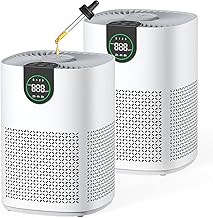
Dreo DR-HAP008 (Dreo 338)
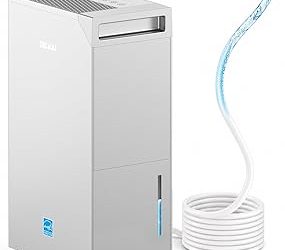
AHAM Verified performance is the credential that separates measured purifiers from marketing ones, and the DR-HAP008 pairs it with a genuinely restrained quiet sleep mode plus a real-time PM2.5 readout for daytime reassurance. Use the scent diffuser sparingly — essential oils introduce VOCs into the very air you’re filtering, and a fragrance-free bedroom generally sleeps better.
KNKA APH4000
Rated to turn over nearly 1,700 square feet in an hour, the APH4000 has enough surplus capacity to sit on its lowest setting all night in a typical bedroom while still hitting a respectable air-change rate. The washable pre-filter is the practical star here: rinsing it monthly keeps the HEPA layer breathing freely, which keeps the fan quiet.
Rattlesnake Calathea
Calathea lancifolia is a prayer plant, folding its patterned leaves upward each evening and lowering them at dawn — a visible circadian ritual that makes a surprisingly effective wind-down cue beside a bed. It wants humidity and indirect light, and it is non-toxic to cats and dogs, which earns it nightstand privileges.
Costa Farms ZZ Plant
The ZZ tolerates low light, irregular watering and general neglect better than almost any houseplant sold, making it the honest choice for a bedroom you mostly occupy after dark. Its rhizomes store water like a camel; the leaves are mildly toxic if chewed, so place it out of reach of pets and toddlers.
WINIX 5510
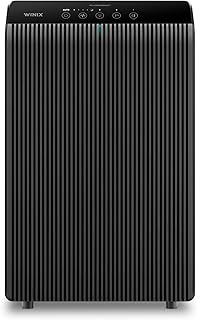
The successor to the much-loved 5500-2 keeps the True HEPA and heavyweight deodorising carbon filter while adding app control — useful for killing indicator lights and dropping the fan speed without leaving the bed. Its auto mode can surge audibly, so light sleepers should lock it to a fixed low setting overnight.
Frequently Asked Questions
Do houseplants really purify indoor air?
Not at any meaningful rate. The famous chamber studies used sealed containers; scaled to a real bedroom with normal ventilation, you would need dozens of plants per square metre to match a modest purifier. Keep plants for the measurable psychological benefit — people consistently report better perceived sleep quality in green rooms — and let the machine handle particulate.
Is it safe to sleep in a room full of plants?
Entirely. The carbon dioxide a few houseplants release overnight is trivially small next to what you exhale yourself. Succulent-type plants such as the ZZ largely open their pores after dark, so they are, if anything, working in your favour while you sleep.
How quiet does a bedroom purifier need to be?
Aim below 30 dB — roughly a whisper. A steady, broadband hum at that level is often helpful, masking traffic and household noise the way a white-noise machine would. What disturbs sleep is variability, so avoid auto mode overnight if you wake easily.
How often should filters be replaced?
Plan on six to twelve months for HEPA media and three to six for carbon in homes with smoke or pets. Vacuum the pre-filter monthly: a clogged intake forces higher fan speeds to compensate, which costs you both energy and silence.
Final Thoughts
For most bedrooms, the Dreo 338 delivers verified filtration with the low-speed manners a sleeper needs, while the WINIX 5510 is the better investment for larger rooms or open-plan sleeping areas where auto mode and app control earn their keep. Add a Costa Farms ZZ Plant to the corner — not for the air it cleans, but for the room it helps you want to be in.