Key takeaways
- Sound rating (sones): Treat this as your primary spec, not a footnote. Anything at or below 1.0 sone reads as a soft background hush; 1.2 sones is still gentle; above 2.0 sones you will hear it through a closed door, which matters enormously if the bathroom shares a wall with a bedroom.
- Airflow (CFM): The old rule of one CFM per square foot works for standard eight-foot ceilings, but add capacity for enclosed showers, soaking tubs or vaulted rooms. Undersizing forces the fan to run longer, which means more noise hours, not fewer.
- Selectable color temperature: A 5CCT fixture lets you set 2700K for a warm, sleep-friendly glow rather than living with harsh daylight white. Warm, low-intensity light after sundown preserves your circadian signaling far better than a cool-toned panel.
- Dimming and automation: Dimmable LEDs, humidity sensors and delay timers do the thinking for you. A humidity-triggered fan exhausts moisture without anyone flipping a switch, then shuts off on its own instead of droning through the night.
- Fit, ducting and certification: Confirm joist spacing, housing depth and duct diameter before ordering, and insist on wet-rated, ETL-listed hardware. Restricting a 110 CFM fan with undersized flex duct will erase its performance advantage entirely.
What's inside
Ventilation is the last thing most people think about during a bathroom remodel and the first thing they resent six months later. A fan that clears steam beautifully but roars like a small aircraft turns a 6 a.m. shower into an alarm clock for the entire household — and a 2 a.m. bathroom trip into a genuine sleep interruption, complete with a blast of 5000K light overhead that shuts down melatonin production at precisely the wrong hour. In my work helping people untangle fragmented sleep, the en suite exhaust fan is a surprisingly frequent culprit, and almost nobody suspects it.
This roundup evaluates bathroom ceiling fans the way a sleep-wellness practitioner would: acoustics first, light quality second, moisture management third, aesthetics last. Below are the units worth installing in 2026, along with a short buyer’s checklist covering sone ratings, CFM sizing, selectable color temperature and automated controls, plus answers to the questions that surface most often mid-renovation.
As an Amazon Associate we earn from qualifying purchases.




How to Choose a Bathroom Ceiling Fan (2026)
- Sound rating (sones): Treat this as your primary spec, not a footnote. Anything at or below 1.0 sone reads as a soft background hush; 1.2 sones is still gentle; above 2.0 sones you will hear it through a closed door, which matters enormously if the bathroom shares a wall with a bedroom.
- Airflow (CFM): The old rule of one CFM per square foot works for standard eight-foot ceilings, but add capacity for enclosed showers, soaking tubs or vaulted rooms. Undersizing forces the fan to run longer, which means more noise hours, not fewer.
- Selectable color temperature: A 5CCT fixture lets you set 2700K for a warm, sleep-friendly glow rather than living with harsh daylight white. Warm, low-intensity light after sundown preserves your circadian signaling far better than a cool-toned panel.
- Dimming and automation: Dimmable LEDs, humidity sensors and delay timers do the thinking for you. A humidity-triggered fan exhausts moisture without anyone flipping a switch, then shuts off on its own instead of droning through the night.
- Fit, ducting and certification: Confirm joist spacing, housing depth and duct diameter before ordering, and insist on wet-rated, ETL-listed hardware. Restricting a 110 CFM fan with undersized flex duct will erase its performance advantage entirely.
The Best Bathroom Ceiling Fans (2026) Reviewed
100 CFM Round Ventilation Fan with Integrated LED
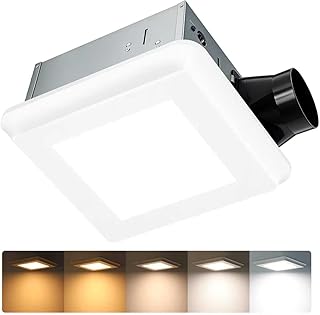
At 1.2 sones with a dimmable 5CCT light, this round ceiling-mount unit is the value pick for a standard 80 to 100 square-foot bathroom, and the circular trim reads as a recessed downlight rather than an appliance. Being wet rated and ETL certified, it can sit directly over a shower where code permits.
Panasonic WhisperFit FV-0511VFL1
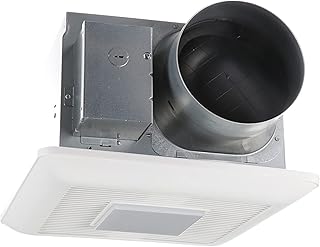
Panasonic’s low-profile housing is designed for shallow ceiling cavities and retrofits, and the installer-selectable 50/80/110 CFM Pick-A-Flow setting means you size airflow to the room instead of guessing at purchase. The dimmable LED and near-silent operation make it my default recommendation for bathrooms attached to a bedroom.
Panasonic WhisperCeiling DC FV-1115VQL1
The DC motor is the quiet-performance benchmark here: it holds airflow steady against duct resistance instead of surrendering to it, so real-world extraction matches the spec sheet. If you want a fan you genuinely cannot hear from bed, this is the one to beat.
Panasonic WhisperGreen Select FV-0511VKSL3K
My overall pick for sleep-conscious households, thanks to dual-speed operation across a 30 to 110 CFM range — it can trickle continuously at a whisper for background ventilation, then step up during a shower. The selectable 5CCT LED and modular sensor plug-ins let you dial in both light and automation precisely.
130 CFM Humidity-Sensing Exhaust Fan with Light
For larger bathrooms, steam showers or rooms with a persistent mildew problem, 130 CFM at 1.0 sone is an unusually good ratio, and the onboard humidity sensor removes moisture management from your to-do list. The adjustable 5CCT light and ETL/FCC certification round out a well-specified package.
Frequently Asked Questions
How many CFM does my bathroom actually need?
For ceilings up to eight feet, match CFM to square footage, then round up. A 90 square-foot bathroom is comfortable at 100 to 110 CFM; enclosed showers and jetted tubs warrant more, which is why Pick-A-Flow models are so useful.
Is a one-sone difference really noticeable?
Yes — sones track perceived loudness fairly linearly, so a 2.0-sone fan sounds roughly twice as loud as a 1.0-sone unit. That gap is the difference between white noise you can sleep through and a sound that pulls you toward wakefulness.
Does a bathroom nightlight help or hurt sleep?
A dim, warm nightlight helps considerably, because it lets you navigate at 3 a.m. without triggering the full alerting response that overhead light produces. Fixtures with a dedicated low-wattage nightlight, such as the Akicon 80 CFM fan with its 3.5W nightlight and 3CCT main LED, handle this elegantly.
How long should the fan run after a shower?
Plan on 20 minutes of post-shower runtime to clear residual humidity from drywall, grout and mirrors. A timer or humidity sensor automates this so the fan never runs longer than necessary.
Final Thoughts
If your bathroom adjoins a bedroom, the Panasonic WhisperGreen Select is the most complete solution on this list — continuous low-speed ventilation, warm selectable light and near-inaudible operation. The WhisperCeiling DC is the choice for anyone prioritizing raw quiet and consistent airflow, while the 130 CFM humidity-sensing model is the smartest buy for large, steam-heavy bathrooms that need aggressive moisture control without the noise penalty.