Key takeaways
- Check your slat gap first: Anything wider than about three inches will let an all-foam mattress settle between the boards, creating pressure ridges and voiding many warranties. Measure before you buy, and add a bunkie board or plywood sheet if the spacing is generous.
- Do the height math: Platform decks sit low, so total bed height is deck plus mattress. Most adults sit and stand most comfortably when the mattress top lands around 24 to 26 inches from the floor — a 14- or 16-inch mattress often gets a low frame into that range.
- Match the core to your body and sleep style: Pocketed-coil hybrids give combination sleepers easier turning, better perimeter stability, and more support for heavier frames. All-foam cores excel at motion damping and near-silent movement, which matters when a partner keeps different hours.
- Prioritize thermal design, not just marketing: Sleep onset depends on shedding roughly a degree of core temperature. Gel-infused and green-tea-infused foams help, but the real advantage of a platform bed is the open air beneath the slats — pair that with a breathable knit cover rather than a dense quilted panel.
- Read the trial terms and certifications: CertiPUR-US foam and fiberglass-free covers are now the baseline, not a bonus. A 365-night trial matters because postural adaptation takes time; give any new mattress at least 30 nights before judging it.
What's inside
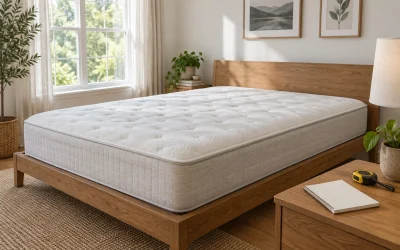
Platform beds solved one problem and quietly created another. By replacing the box spring with a rigid slatted deck, they lowered the bed, cleaned up the lines, and eliminated a component that most people replaced far too rarely. But that deck doesn’t flex, absorb, or forgive. On a traditional foundation, a springy base shared some of the work of contouring to your shoulders and hips; on a platform, the mattress does all of it. Choose the wrong build and you’ll feel every slat by week three, or watch a soft foam core develop shallow washboard ridges that no amount of rotating will fix.
This guide approaches the category from a sleep-physiology standpoint rather than a spec-sheet one: how a mattress manages heat during the overnight core-temperature dip, how it holds the lumbar curve on an unyielding surface, and how well it isolates a partner’s movement so your sleep stages stay intact. The picks below span all-foam and hybrid constructions, from budget full sizes to 16-inch zoned builds, and every one is compatible with standard slatted decks.
As an Amazon Associate we earn from qualifying purchases.


🛒 Best Price Today on Amazon
Prime members get fast, free shipping on everything above, plus member-only deals. New members get a 30-day free trial — cancel anytime.
How to Choose a Platform Bed Mattress (2026)
- Check your slat gap first: Anything wider than about three inches will let an all-foam mattress settle between the boards, creating pressure ridges and voiding many warranties. Measure before you buy, and add a bunkie board or plywood sheet if the spacing is generous.
- Do the height math: Platform decks sit low, so total bed height is deck plus mattress. Most adults sit and stand most comfortably when the mattress top lands around 24 to 26 inches from the floor — a 14- or 16-inch mattress often gets a low frame into that range.
- Match the core to your body and sleep style: Pocketed-coil hybrids give combination sleepers easier turning, better perimeter stability, and more support for heavier frames. All-foam cores excel at motion damping and near-silent movement, which matters when a partner keeps different hours.
- Prioritize thermal design, not just marketing: Sleep onset depends on shedding roughly a degree of core temperature. Gel-infused and green-tea-infused foams help, but the real advantage of a platform bed is the open air beneath the slats — pair that with a breathable knit cover rather than a dense quilted panel.
- Read the trial terms and certifications: CertiPUR-US foam and fiberglass-free covers are now the baseline, not a bonus. A 365-night trial matters because postural adaptation takes time; give any new mattress at least 30 nights before judging it.
The Best Platform Bed Mattresses (2026), Reviewed
EGOHOME 10-Inch Green Tea Gel Memory Foam (Full)
A sensible entry point for guest rooms, teens, and compact bedrooms, this 10-inch full pairs a medium-firm response with green-tea-infused gel foam that keeps surface warmth in check. Keep slat spacing tight — at this profile, deck support does more of the work than it would under a thicker build.
16-Inch Luxury Hybrid with 7-Zone Pocket Springs (Queen)
The most anatomically thoughtful pick here: seven spring zones firm up under the lumbar region while easing off at the shoulders, which helps side sleepers keep a neutral spine without sinking. The 16-inch profile also raises a low platform frame to a genuinely comfortable sit height.
MLILY 12-Inch Green Tea Memory Foam (Queen)
MLILY’s medium feel is a reliable middle path for couples who can’t agree on firmness, and the all-foam core makes it the quietest option on a slatted deck. It’s also a strong daybed and trundle choice, where its clean 12-inch profile won’t overwhelm the frame.
14-Inch Medium Plush Hybrid (Queen)
This one leans plush at the surface while pocketed coils hold the line underneath — a useful combination for lighter side sleepers who need shoulder relief but not a sinking sensation. Motion isolation is unusually good for a coil build, and the cooling cover keeps the plush comfort layer from trapping heat.
12-Inch Hybrid Pillow Top with Edge Support (Queen)
Reinforced perimeters are the underrated feature on platform beds, since there’s no foundation lip to lean on when you sit to dress. This medium-firm hybrid delivers that stability alongside gel foam and pocket springs, in a slim profile suited to taller frames.
Frequently Asked Questions
Do I need a box spring with a platform bed?
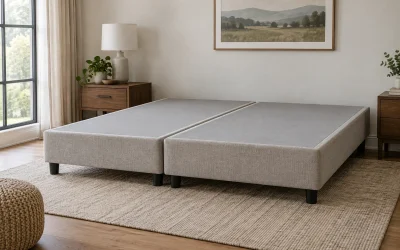
No. Platform frames are self-supporting foundations, and adding a box spring raises the bed awkwardly while doing nothing for comfort. Every mattress here is designed to sit directly on slats.
How far apart should the slats be?
Three inches or less is the safe standard for both foam and hybrid mattresses. Wider gaps allow uneven compression over time, and most manufacturers make this an explicit warranty condition.
Does memory foam sleep hotter on a platform bed?
Generally less so than on a solid base, because slatted decks allow convective airflow underneath. Gel and green-tea infusions handle surface heat, while the open frame beneath handles what the foam releases overnight.
How thick should a platform bed mattress be?
For adults, 12 to 16 inches is the practical range. Ten-inch models are fine for guest rooms and lighter sleepers, but heavier bodies and low-profile frames both benefit from the extra height.
Final Thoughts
If you want the most complete sleep surface, the 16-inch zoned hybrid earns the top spot for its targeted lumbar support and generous height on a low frame. The 14-inch medium plush hybrid is the better call for side sleepers who want cushioning without losing coil stability, while the MLILY 12-inch green tea foam remains the smartest value for couples prioritizing quiet, motion-free nights.