
Key takeaways
- Start with your heaviest drop, not your average workout. If a loaded barbell will ever leave your hands above knee height, you need rubber at least 3/4″ thick under the lifting zone. Foam is not a compromise here; it’s a failure point.
- Check the subfloor before the surface. Concrete slabs need a moisture test — tape a 2′ square of plastic sheeting down for 24 hours and look for condensation. Damp slabs trap water under rubber and grow mildew. Over plywood or joists, thickness also matters for sound transmission to rooms below.
- Measure ceiling height twice. Every inch of flooring is an inch stolen from your overhead press and pull-up clearance. In a basement with 7′ ceilings, an 8 mm roll is a genuinely better choice than 3/4″ mats.
- Budget by zone, not by room. The smartest low-cost builds mix materials: rubber under the rack and platform, foam under the bike, bare slab under storage shelves. Flooring the whole footprint in one premium material is usually wasted money.
- Plan for the smell and the weight. Recycled rubber off-gasses noticeably for two to six weeks — ventilate hard. And a single 4′ x 6′ stall mat runs about 95 pounds, so confirm you can physically get it down a stairwell before ordering four of them.
A 45-pound plate dropped from hip height hits the floor with roughly 900 pounds of peak force spread over a few square inches. That single fact explains why so many home gym floors fail: the foam tile that felt luxurious under a yoga flow gets punched straight through on the first missed deadlift rep. Flooring is the one purchase in a garage or basement gym that has to serve two contradictory masters — it needs to be soft enough to kneel on and dense enough to absorb steel.
The good news is that the two best-value answers have barely changed in a decade: vulcanized rubber for anything with a barbell, and closed-cell EVA foam for everything else. What has changed is the price spread. You can floor a 10′ x 10′ space for under $120 if you buy the right format, or spend $600 on the wrong one and still dent it. Below I’ve broken down six options by what they actually survive, what they cost per square foot, and how long each takes to install with no tools beyond a utility knife and a straightedge.
Our top picks


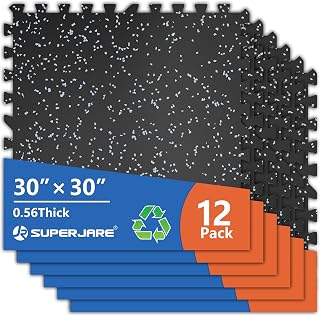

As an Amazon Associate we earn from qualifying purchases at no extra cost to you. Ratings are shown as listed on Amazon.
Quick Comparison
| Pick | Material | Thickness | Handles Dropped Weight? | Rough Cost / sq ft | Install Time (100 sq ft) |
|---|---|---|---|---|---|
| Rubber Stall Mats (4′ x 6′) | Vulcanized rubber | 3/4″ | Yes — plates, bumpers, racks | $1.00 – $1.40 | 30 min (needs two people) |
| Rolled Rubber Flooring | Recycled rubber roll | 8 mm | Moderate — dumbbells, light plates | $2.00 – $3.00 | 60–90 min |
| Extra-Thick EVA Puzzle Tiles | Closed-cell EVA foam | 3/4″ | No | $1.30 – $1.80 | 20 min |
| Budget EVA Puzzle Tiles | Closed-cell EVA foam | 1/2″ | No | $0.60 – $0.90 | 15 min |
| Large Rollout Exercise Mat | Reinforced foam/PVC | 1/4″ – 3/8″ | No | $4.00 – $6.00 | 2 min |
| Rubber Impact Tiles | Interlocking rubber | 1″+ | Yes — heavy drops | $3.50 – $5.00 | 45 min |
How to Choose
- Start with your heaviest drop, not your average workout. If a loaded barbell will ever leave your hands above knee height, you need rubber at least 3/4″ thick under the lifting zone. Foam is not a compromise here; it’s a failure point.
- Check the subfloor before the surface. Concrete slabs need a moisture test — tape a 2′ square of plastic sheeting down for 24 hours and look for condensation. Damp slabs trap water under rubber and grow mildew. Over plywood or joists, thickness also matters for sound transmission to rooms below.
- Measure ceiling height twice. Every inch of flooring is an inch stolen from your overhead press and pull-up clearance. In a basement with 7′ ceilings, an 8 mm roll is a genuinely better choice than 3/4″ mats.
- Budget by zone, not by room. The smartest low-cost builds mix materials: rubber under the rack and platform, foam under the bike, bare slab under storage shelves. Flooring the whole footprint in one premium material is usually wasted money.
- Plan for the smell and the weight. Recycled rubber off-gasses noticeably for two to six weeks — ventilate hard. And a single 4′ x 6′ stall mat runs about 95 pounds, so confirm you can physically get it down a stairwell before ordering four of them.
Top Picks Reviewed
3/4″ Rubber Stall Mats — Best Value for Barbell Training
Sold in farm supply and fitness listings alike, these are the same dense vulcanized mats used in horse stalls, and nothing beats them on dollars-per-durability. A 4′ x 6′ mat covers 24 square feet, weighs roughly 95 pounds, and will absorb repeated bumper plate drops without cratering. Lay them in a brick pattern with the seams staggered and the sheer mass keeps them put — no adhesive needed. Downsides are real: they’re heavy, they smell for the first month, and the factory edges are rarely perfectly square, so expect to trim with a fresh utility blade and a metal straightedge.
8 mm Rolled Rubber — Best for Low Ceilings and Seamless Coverage
Rolled rubber gives you a near-continuous surface with far fewer seams to catch a treadmill wheel or collect dust. At 8 mm it’s thin enough to preserve headroom and light enough for one person to maneuver, while still protecting a slab from dumbbells and kettlebells set down with control. It is not a deadlift platform. Roll it out and let it relax for 48 hours before cutting, otherwise the curl at the ends will fight you.
3/4″ Extra-Thick EVA Puzzle Tiles — Best Comfort per Dollar
For bodyweight circuits, mobility work, and cardio machines, thick EVA foam is the most pleasant surface in this list. Tiles snap together in minutes, come with border strips for clean edges, and cost a fraction of rubber. They also insulate a cold concrete floor noticeably. Treat them as consumables in a lifting space — rack feet and dumbbell corners will emboss them permanently.
1/2″ Budget Puzzle Tiles — Best for a Cheap Starter Space
If you’re outfitting a spare bedroom or a corner of the basement for under $100, these are the entry point. Half-inch foam handles kettlebell swings from a hip hinge, spin bikes, and stretching just fine. They’re also the easiest option to pull up and store when the room reverts to guest duty.
Large Rollout Exercise Mat — Best for Renters and Shared Rooms
A single 6′ x 4′ reinforced mat that unrolls in seconds and rolls back into a closet is the right answer for anyone who can’t dedicate a permanent footprint. The surface grips well enough for barefoot plyometrics and wipes clean without the seam gunk that plagues tiles. It’s the most expensive option per square foot by a wide margin, so buy it for convenience rather than coverage.
1″ Interlocking Rubber Impact Tiles — Best Targeted Upgrade
Rather than flooring a whole garage in premium rubber, buy eight to twelve of these and build a 6′ x 8′ island directly beneath your rack. The extra quarter-inch over stall mats meaningfully quiets drops for anyone with neighbors or a bedroom below, and the interlocking edges stop creep during heavy sets. Pricey by the square foot, sensible by the zone.
Frequently Asked Questions
Can I put rubber flooring straight onto a concrete garage slab?
Yes, provided the slab is dry and reasonably level. Sweep and vacuum thoroughly first — trapped grit will abrade the underside of the mats and telegraph bumps through thinner rolls. Leave a half-inch expansion gap at the walls so seasonal movement doesn’t buckle the seams.
Will foam tiles protect my floor from a dropped dumbbell?
Partially, and only up to a point. A 20-pound dumbbell set down firmly on 3/4″ EVA is fine. The same dumbbell dropped from shoulder height will compress the foam completely and transmit most of that force to whatever is underneath. If you train to failure with heavy dumbbells, put rubber in the drop zone.
How do I stop mats from sliding apart during workouts?
Weight and geometry do most of the work. Stagger seams, run mats perpendicular to your main movement direction, and use the walls as a backstop on two sides. For persistent creep, double-sided carpet tape at the seams or a bead of construction adhesive at the perimeter solves it without gluing the entire floor down.
What’s the best way to clean gym flooring without wrecking it?
Warm water with a pH-neutral cleaner and a microfiber mop. Skip bleach, citrus degreasers, and acetone-based products on rubber — they break down the binders and leave the surface chalky. On EVA, avoid steam mops entirely; the heat softens the foam and permanently distorts the interlocking edges.
Final Thoughts
The most cost-effective home gym floor is almost never one product covering one room. Buy dense rubber for the four or five square yards where steel actually meets ground, use inexpensive foam for the comfort zones, and leave the rest alone until you know how you train in the space. That layered approach typically lands under $250 for a two-car garage bay and outperforms a single-material install costing twice as much — while leaving you free to expand the rubber footprint later as your lifts get heavier.

Write Your Review
No reviews yet. Be the first to share your experience!