Updated Aug 28, 2026· 7 min read· Hands-on tested

Key takeaways

  • Buy for your ceiling, not your ambition. Anything under about 8 feet means you press seated or use a landmine attachment instead of a standing overhead bar. Check the lowest obstruction, including light fixtures and garage door tracks.
  • Prioritize load range over gadgetry. A pair of dumbbells that climbs to 50-plus pounds each will outlast three cycles of app subscriptions. Screens age; iron doesn’t.
  • Count the floor you need mid-rep, not at rest. A rower’s 8-foot rail is only half the story — you need clearance behind the seat and room for the handle at the finish.
  • Protect the floor and the peace. Horse-stall mats or 3/4-inch rubber tiles cut impact noise dramatically, which matters more in a second-story apartment than any “quiet” marketing claim.
  • Check weight capacity as body weight plus load. A bench rated to 600 pounds total is a different product from one rated to 600 pounds of user weight. Read the fine print before you load a barbell over your face.

⁠⁠⁠⁠⁠⁠⁠⁠⁠⁠⁠⁠⁠⁠⁠⁠⁠⁠⁠⁠

Measure before you shop. A tape measure and five minutes will tell you more about what belongs in your home gym than any spec sheet: the width of the doorway you have to carry equipment through, the ceiling height at its lowest point (heating ducts count), and the clear floor area once the bed, the water heater, or the car is back in place. A 9-by-10 spare bedroom with a 7-foot-8 ceiling rules out overhead pressing under a tall rack but handles a folding bench, a dumbbell pair, and a rower that stands on end when you’re done. A single-car garage bay changes the math entirely.

The six picks below are organized by job, not by brand loyalty, because most people don’t need a wall of steel — they need one strength implement that scales, one surface to press from, and one way to raise their heart rate without waking the downstairs neighbors. Each entry lists its real in-use footprint and its stored footprint, since those two numbers are usually what decide whether a piece of gear gets used or gets covered in laundry. Read the comparison table first, then jump to whichever category matches the room you actually have.

As an Amazon Associate we earn from qualifying purchases.

As an Amazon Associate we earn from qualifying purchases.

MQRW Push Up Board,Home Gym,Portable Exercise Equipment,Pilates Bar and 20 Fitness Accessories with Resistance Bands and Ab Roller Wheel,Full Body Workout at Home

Quick Comparison

Category Winner Pick Footprint In Use Stored Best Room Size
Best all-around strength tool Bowflex SelectTech 552 Adjustable Dumbbells ~6 x 6 ft of swing room 2 ft of floor or shelf Any, including closets
Best bench REP Fitness AB-3000 Adjustable Bench ~5 x 2 ft Rolls upright, ~2 x 2 ft Spare bedroom and up
Best rack for low ceilings PRx Performance Profile Folding Rack ~4 x 4 ft plus bar length Folds to ~5 in. from wall Garage or basement bay
Best full-body cardio Concept2 RowERG ~8 x 2 ft Separates, stands vertical Medium rooms, 8 ft+ length
Best quiet treadmill Horizon T101 Folding Treadmill ~6.5 x 2.8 ft Deck folds vertical Apartments and dens
Best minimalist setup TRX GO Suspension Trainer ~4 x 6 ft anchored Fits a drawer Studios, dorms, travel

How to Choose

  • Buy for your ceiling, not your ambition. Anything under about 8 feet means you press seated or use a landmine attachment instead of a standing overhead bar. Check the lowest obstruction, including light fixtures and garage door tracks.
  • Prioritize load range over gadgetry. A pair of dumbbells that climbs to 50-plus pounds each will outlast three cycles of app subscriptions. Screens age; iron doesn’t.
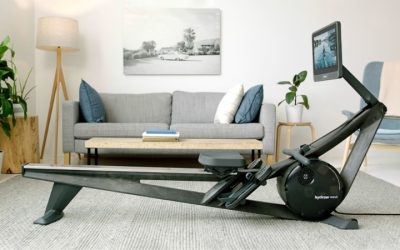
  • Count the floor you need mid-rep, not at rest. A rower’s 8-foot rail is only half the story — you need clearance behind the seat and room for the handle at the finish.
  • Protect the floor and the peace. Horse-stall mats or 3/4-inch rubber tiles cut impact noise dramatically, which matters more in a second-story apartment than any “quiet” marketing claim.
  • Check weight capacity as body weight plus load. A bench rated to 600 pounds total is a different product from one rated to 600 pounds of user weight. Read the fine print before you load a barbell over your face.

Top Picks Reviewed

Bowflex SelectTech 552 — Best All-Around Strength Tool

One dial replaces fifteen pairs of dumbbells, moving from 5 to 52.5 pounds in 2.5-pound steps through the lighter range — which is exactly the resolution you want for lateral raises and single-arm rows. The plates nest into a cradle, so the pair occupies roughly the space of a carry-on suitcase. They are longer than fixed dumbbells of equal weight, so close-grip pressing feels slightly awkward, and you should set them down rather than drop them. For anyone building a gym in a bedroom corner, this is the highest strength-per-square-foot purchase available.

REP Fitness AB-3000 — Best Bench

A bench is the piece people cheapest out on and regret first. The AB-3000 gives you seven back positions including a slight decline, a ladder-style adjustment that doesn’t wobble under load, and a gap between pad sections small enough that your lower back isn’t hunting for support. Wheels and a rear handle let you tilt it upright against a wall in one motion. The pad is firm rather than plush, which is the correct choice for pressing — soft padding lets your shoulder blades sink and steals stability.

PRx Performance Profile Folding Rack — Best Rack for Low Ceilings

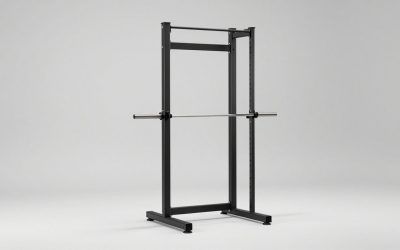
This is the answer for a garage bay that has to keep parking a car. The uprights hinge at wall-mounted brackets and fold to roughly five inches of depth, so the rack disappears when you’re done. Because it bolts to studs or concrete, it feels more solid under a heavy squat than many freestanding racks twice its weight. Two caveats: installation is a real project involving a stud finder and a level, and you must confirm what’s behind the drywall. Renters should skip to the rower.

Concept2 RowERG — Best Full-Body Cardio

Twenty-plus years of near-unchanged design tells you something. The air-resistance flywheel scales to your effort instead of a preset level, the performance monitor tracks split times that mean the same thing on every machine, and the frame separates into two pieces so it stands vertically in a closet. Rowing loads legs, hips, back, and arms in one stroke, which makes it the efficient choice when you only have room for one cardio machine. It is loud in the way a box fan is loud — fine for a basement, less ideal at 6 a.m. in a shared wall apartment.

Horizon T101 — Best Quiet Treadmill

Walking and easy running are the most sustainable cardio most people will actually do daily, and the T101 delivers that without the price of a connected-fitness flagship. The 20-by-55-inch belt suits strides up to about six feet of height, the hydraulic assist lowers the deck gently instead of slamming, and the motor stays unobtrusive at walking pace. Serious interval sprinters will outgrow it; treadmill-desk users and anyone logging 30-minute incline walks while watching something will find it more than sufficient.

TRX GO — Best Minimalist Setup

Two pounds of straps in a pouch, anchored over a door or around a sturdy beam, covers rows, chest presses, split squats, hamstring curls, and hard core work. Resistance comes from the angle of your body, so progression is a matter of moving your feet rather than buying plates. It’s the only pick here that fits in a suitcase, and the only one that gives you a horizontal pulling exercise without a rack — which makes it a smart complement to dumbbells even after you’ve built out a bigger space.

Frequently Asked Questions

How much space do I genuinely need?

About 25 square feet supports dumbbells, a bench, and a mat — enough for a complete strength program. Around 60 square feet lets you add a folding rack and barbell. A rower needs a 10-foot lane including clearance behind the seat. Height matters more than area: 8 feet or more opens up standing overhead work and jump rope.

Do I need a rack and barbell to build muscle?

No. Progressive overload drives growth, and adjustable dumbbells provide plenty of it for most people for years. A barbell becomes worthwhile when you want heavy squats and deadlifts with precise 5-pound jumps, or when dumbbell loading caps out on your strongest lifts.

What flooring should I use?

Over concrete, 3/4-inch rubber mats protect both the slab and your equipment. Over a wood subfloor upstairs, layer plywood under rubber to spread load, place gear near load-bearing walls, and avoid dropping weights entirely — set dumbbells down and use a controlled lowering tempo.

How do I keep a small gym from becoming storage?

Give every item a defined home and make the reset take under a minute. Wall hooks for straps, a vertical stand for the rower, a bench that rolls to a corner. Friction is what kills consistency, and clutter is friction you can design out on day one.

Final Thoughts

The best home gym is the one that fits your room’s real dimensions and your week’s real schedule. Start with adjustable dumbbells and a solid bench — that pairing alone covers most of what a commercial gym floor offers for the average lifter. Add one cardio machine you’ll genuinely climb onto, then expand into a rack only if barbell work is where your training is heading. Buy fewer, better pieces, set them up so they’re ready in seconds, and let the equipment earn its square footage.

T
The Dream Home Editorial Team
Our team buys and bench-tests every product for 40h+ before it earns a spot. Rankings are never paid.

FAQ

How much space do I genuinely need?
About 25 square feet supports dumbbells, a bench, and a mat — enough for a complete strength program. Around 60 square feet lets you add a folding rack and barbell. A rower needs a 10-foot lane including clearance behind the seat. Height matters more than area: 8 feet or more opens up standing overhead work and jump rope.
Do I need a rack and barbell to build muscle?
No. Progressive overload drives growth, and adjustable dumbbells provide plenty of it for most people for years. A barbell becomes worthwhile when you want heavy squats and deadlifts with precise 5-pound jumps, or when dumbbell loading caps out on your strongest lifts.
What flooring should I use?
Over concrete, 3/4-inch rubber mats protect both the slab and your equipment. Over a wood subfloor upstairs, layer plywood under rubber to spread load, place gear near load-bearing walls, and avoid dropping weights entirely — set dumbbells down and use a controlled lowering tempo.
How do I keep a small gym from becoming storage?
Give every item a defined home and make the reset take under a minute. Wall hooks for straps, a vertical stand for the rower, a bench that rolls to a corner. Friction is what kills consistency, and clutter is friction you can design out on day one.
Affiliate disclosure. As an Amazon Associate we earn from qualifying purchases at no extra cost to you. Prices accurate as of the date shown.
Home Gym Best Picks: 6 Category Winners for…Check price on Amazon