Key takeaways
- Roommates place beds head-to-head or in an L-shape to create two separate zones.
- Beds sit perpendicular to the wall with only the side touching, leaving the head end open.
- The bed is raised on adjustable pegs or blocks to fit storage underneath, putting the mattress higher than a wall-leaning headboard can reach.
- Radiators, windows or built-in desks occupy the wall behind the bed.
If your dorm bed is not against a wall, the headboard has to support itself, so choose one of three types: a freestanding headboard on its own legs, a clamp-on headboard that attaches to the dorm frame without drilling, or a mattress-anchored headboard held in place by the weight of the mattress on a flat panel. All three work for a standard twin XL bed, which is 39 x 80 inches, and none requires nails in a dorm wall.
Which one suits you depends mostly on bed height. Dorm beds are often raised or lofted, and a headboard that looks right at 18 inches of mattress height is useless at 36 inches.
Our top picks


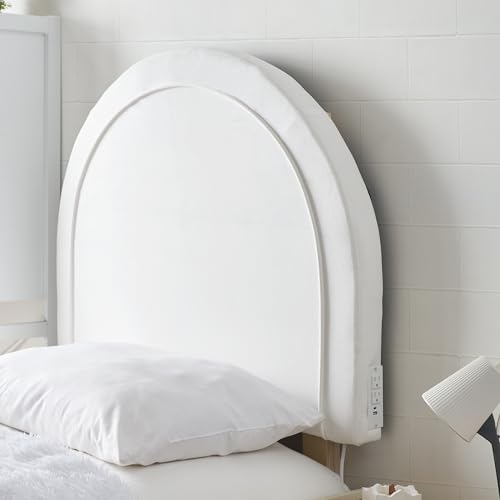

As an Amazon Associate we earn from qualifying purchases at no extra cost to you. Ratings are shown as listed on Amazon.
Why Dorm Beds End Up Away From the Wall
- Roommates place beds head-to-head or in an L-shape to create two separate zones.
- Beds sit perpendicular to the wall with only the side touching, leaving the head end open.
- The bed is raised on adjustable pegs or blocks to fit storage underneath, putting the mattress higher than a wall-leaning headboard can reach.
- Radiators, windows or built-in desks occupy the wall behind the bed.
Know Your Bed Height First
Measure from the floor to the top of the mattress. Most adjustable dorm frames offer several deck heights, and the right headboard style changes with each.
| Bed setting | Mattress top from floor | Headboard height needed (floor to top) | Best headboard type |
|---|---|---|---|
| Low (no risers) | 18-24 in | 44-52 in | Freestanding or mattress-anchored |
| Raised for under-bed bins | 26-32 in | 52-58 in | Freestanding tall, or clamp-on |
| High (desk or dresser underneath) | 36-48 in | Not practical from the floor | Clamp-on panel or bolster pillow |
| Lofted or bunked | 55 in and above | Not practical | Bolster or backrest pillow only |
A comfortable sitting headboard should rise about 20 to 26 inches above the top of the mattress, enough to lean against with a pillow behind your back.
Option 1: Freestanding Headboards
A freestanding headboard has its own legs or a weighted base and stands on the floor at the head of the bed. It is the most furniture-like option.
- Width: 39 to 41 inches for twin XL; a twin headboard (also 39 inches wide) fits the width, since twin and twin XL differ only in length.
- Stability: without a wall behind it, look for wide feet or a base that extends 6 inches or more front to back. Thin legs alone will tip when you lean back.
- Finished back: because the back is visible from the room, choose one upholstered or finished on both sides.
- Typical price: $80 to $250.
A practical alternative is a low bookcase, about 36 to 48 inches tall and 10 to 12 inches deep, placed at the head of the bed. It works as a headboard, a nightstand and a room divider between roommates. Use a unit with a finished back and keep heavy items on the lower shelves so it does not tip.
Option 2: Clamp-On Headboards
Many dorm frames are steel or wood with a fixed end panel, but few have headboard bolt holes. A lightweight headboard can still be attached without tools that damage furniture:
- Padded panel with straps: an upholstered panel with hook-and-loop or buckle straps wraps around the existing end panel of the frame. This is the simplest choice for high beds.
- C-clamp or pipe-clamp mounting: two adjustable clamps hold a plywood or foam panel to the frame end. Pad the clamp jaws with felt to avoid scratching university furniture.
- Heavy-duty zip ties: a budget fix for lightweight foam panels; cut them carefully at move-out.
Clamp-on headboards should weigh under about 15 pounds so they do not stress the frame end, and they work best when they extend 18 to 24 inches above the mattress.
Option 3: Mattress-Anchored Headboards
These headboards have a flat board or fabric flap that slides under the mattress, with the upright padded section standing at the head end. The mattress weight holds it in place.
- No tools, no clamps and nothing touching the walls, which makes them popular with renters and students.
- They suit low and mid-height beds where the mattress sits on a solid deck or tight slats.
- Expect some wobble if you lean back hard; they are better for sitting up to read than for heavy leaning.
- On lofted beds with safety rails, the panel may conflict with the rail position.
Option 4: Bolsters and Backrest Pillows
For high and lofted beds, a large backrest pillow or a 39-inch bolster tied to the bed’s end rail gives most of the comfort of a headboard with no weight or tipping risk. It is also the easiest to pack at the end of the year.
Comparison at a Glance
| Type | Works on raised beds? | Stability when leaning | Weight | Move-out effort | Typical price |
|---|---|---|---|---|---|
| Freestanding headboard | Up to about 32 in mattress height | Good with wide feet | 15-40 lb | Medium | $80-$250 |
| Low bookcase as headboard | Up to about 28 in mattress height | Good if loaded low | 25-50 lb | Medium to high | $50-$150 |
| Strap or clamp-on panel | Yes | Fair to good | 5-15 lb | Low | $40-$120 |
| Mattress-anchored | Low to mid only | Fair | 8-20 lb | Low | $50-$150 |
| Backrest pillow or bolster | Yes, including lofted | Soft | 3-6 lb | Very low | $25-$80 |
Dorm Rules and Safety
- Housing rules: many residence halls ban nails, screws and some adhesives on walls and furniture. Clamp-on, strap and freestanding options avoid this issue.
- Fire safety: some campuses restrict fabric décor and require flame-resistant materials. Check your housing guide before buying an upholstered or fabric headboard.
- Do not remove safety rails on lofted beds to fit a headboard.
- Tipping: a freestanding headboard or bookcase not against a wall should be wider at the base than at the top, and should never be climbed on.
Moving In and Out
Dorm moves happen fast. Flat-pack headboards that assemble with a few bolts fit in a car trunk, while fully upholstered one-piece panels around 40 x 50 inches may not fit in smaller cars. Mattress-anchored and strap-on types fold or roll and are the easiest to store over the summer.
Quick Recommendations
- Bed at standard height in the middle of the room: freestanding upholstered headboard with wide feet, finished on both sides.
- Beds head-to-head with a roommate: a low double-sided bookcase between them.
- Raised bed with storage underneath: a strap-on padded panel.
- Lofted or bunked bed: a backrest pillow or bolster tied to the rail.