Key takeaways
- No stated height for the ridges. If the seller only lists width and depth, you cannot match it to your shoulders.
- A single height with no insert marketed for all sleep positions. No one shape suits back, side, and stomach sleepers equally.
- Claims of medical cures or clinical results without any detail. A pillow supports posture; it does not treat conditions.
- Extremely light weight under 2 pounds for a queen size, which signals low-density foam that will flatten within a year.
- Return policies that exclude opened items; every contour pillow needs at least a week of testing.
What's inside
The most common mistake with a contour memory foam pillow is buying it by price and shape alone, sleeping on it for two nights, deciding it feels weird, and shoving it in the closet. The second most common mistake is buying one that is the wrong height for your shoulders and blaming the concept rather than the measurement. Contour pillows work when the raised ridge matches the gap between your neck and the mattress. When it does not, no amount of cooling gel or ergonomic marketing will make it comfortable.
This guide covers what actually changes the outcome. Prices are ranges; the pillows mentioned are examples of each tier rather than recommendations.
As an Amazon Associate we earn from qualifying purchases at no extra cost to you. Product prices and availability are accurate as of the date shown and are subject to change.


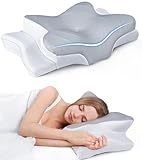

Decide These 3 Things First
Your sleep position. Back sleepers want a lower ridge of 3 to 4 inches and a center dip for the head. Side sleepers need a taller edge of 4 to 6 inches. Combination sleepers should look for a pillow with two different ridge heights so they can flip it, or one with a removable insert.
Your shoulder-to-neck distance. Stand straight and measure from the side of your neck to the outside edge of your shoulder. That number, minus about half an inch for foam compression, is the ridge height you want on the side you sleep on.
Whether you run hot. Memory foam holds heat. If you already flip your pillow to the cool side at night, prioritize ventilated foam or a gel layer over any other feature.
Size
Standard contour pillows are roughly 20 to 24 inches wide and 12 to 15 inches deep, which is smaller than a standard 20 x 26 inch bed pillow. Queen-labeled contour pillows like the Royal Therapy Memory Foam Pillow at 24 x 14 x 5 inches or the UTTU Cervical Pillow at 23.6 x 13.8 inches give an extra few inches of width, which matters if you shift side to side. Height is the critical dimension: most are 4 to 5.5 inches on the tall ridge and 3 to 4.5 inches on the low ridge. If a listing does not state both heights, assume the pillow is not designed for two positions.
Material
Three foam types show up in this category. Standard polyurethane memory foam is the cheapest, densest, and warmest; it is what you get at $20 to $30. Gel-infused memory foam adds a cooling additive or a gel layer on top and runs $30 to $50; it feels cooler for the first 20 to 30 minutes and then equalizes. Ventilated or open-cell foam has channels or holes molded through it and breathes better all night, usually at $40 to $70. Look for a CertiPUR-US label, which means the foam has been tested for certain chemical emissions. Higher density foam holds shape longer but feels firmer.
Construction
The cheapest pillows are a single molded block with a knit cover. The next step is a two-piece design with a removable base insert, which is what allows models like the Ultra Pain Relief Cooling Pillow to drop roughly 1 inch in height. The UTTU design uses a sandwich construction with a removable middle layer, listed at 5.2 inches full height and 4.5 inches with the layer removed. That 0.7 inch difference sounds small but is the gap between a pillow that works for a 5 foot 4 inch side sleeper and one that does not. Also check for a shoulder cutout on the front edge and side wings on the ends; both help side sleepers keep the shoulder from rolling forward.
Comfort and Performance
Expect an adjustment period of 3 to 14 nights. Firmness is medium to medium-firm, and the foam softens as it warms to body temperature. Weight is 2 to 4 pounds. A well-matched contour pillow should leave your ear, shoulder, and hip in a line when lying on your side, and your chin level rather than tucked or tilted back when on your back. If your chin tucks toward your chest on your back, the ridge is too tall for that position.
Price Tiers
Budget, $20 to $30. Single-block gel memory foam, fixed height, one knit cover. The Cervical Pillow for Neck Pain Relief in blue at $24.67 represents this tier. Fine if you already know your ideal height.
Mid-range, $30 to $50. Adjustable height via a removable insert, cooling cover, sometimes two covers. The Ultra Pain Relief Cooling Pillow at $39.98 and the UTTU Cervical Pillow at $48.99 sit here. This is where most first-time buyers should shop.
Premium, $50 to $80. Higher-density foam, ventilated construction, longer trial periods, and queen-size widths. The Royal Therapy Memory Foam Pillow at $59.98 is an example. Worth it if you have tried a mid-range pillow, know it works, and want it to last longer.
Warranty and Trial
Most contour pillows carry a 30 to 100 night trial and a 1 to 3 year warranty against foam collapse. The trial period matters more than the warranty because the adjustment period alone eats the first two weeks. Read the return conditions; some sellers require the original packaging, which is a vacuum-sealed bag you cannot recreate at home.
Delivery and Setup
Contour pillows ship compressed and rolled. Unroll, remove the plastic, and give the foam 24 to 72 hours to reach full height. A mild chemical smell is normal for the first one to three days; airing the pillow near an open window clears it faster. Do not put memory foam in a washing machine or dryer. Wash only the cover, and spot clean the foam with a damp cloth if needed.
Spec Checklist
| Spec | Budget | Mid | Premium |
|---|---|---|---|
| Price | $20 to $30 | $30 to $50 | $50 to $80 |
| Width x depth | 20 to 22 x 12 to 13 in | 23 to 24 x 13 to 14 in | 24 to 26 x 14 to 15 in |
| Ridge heights | Fixed, one or two heights | Two heights plus removable insert | Two heights, insert, sometimes layered |
| Foam type | Standard or gel-infused | Gel-infused or ventilated | Ventilated high-density |
| Cover | One polyester knit | Cooling knit, sometimes two covers | Cooling knit plus inner liner |
| Weight | 2 to 2.5 lbs | 2.5 to 3.5 lbs | 3 to 4 lbs |
| Certification | Often none listed | CertiPUR-US common | CertiPUR-US standard |
| Trial and warranty | Retailer return window | 30 to 100 nights, 1 to 2 years | 100 nights, 2 to 3 years |
Red Flags
- No stated height for the ridges. If the seller only lists width and depth, you cannot match it to your shoulders.
- A single height with no insert marketed for all sleep positions. No one shape suits back, side, and stomach sleepers equally.
- Claims of medical cures or clinical results without any detail. A pillow supports posture; it does not treat conditions.
- Extremely light weight under 2 pounds for a queen size, which signals low-density foam that will flatten within a year.
- Return policies that exclude opened items; every contour pillow needs at least a week of testing.
FAQ
Which way does a contour pillow go?
The taller ridge goes toward the foot of the bed for back sleepers so the neck rests on it and the head sinks into the dip. Side sleepers often flip it so the taller edge is under the ear. Check the seller’s diagram; some designs reverse this.
How long does a memory foam contour pillow last?
Two to four years with nightly use. When the ridge no longer rebounds within a few seconds after you press it, the foam has lost its support and should be replaced.
Can I use a regular pillowcase?
A standard case is too long and too loose for a 24 x 14 inch block, so it bunches. Most pillows include a fitted cover. Buy a second one from the same maker if you want a spare for wash day.
Is a contour pillow good for neck pain in 2026 if I have never used one?
It is a reasonable first step for stiffness from poor pillow height, and the mid-range adjustable tier is the safest place to start. If pain includes numbness, tingling, or does not improve after a month, see a clinician rather than buying another pillow.