Key takeaways
- Blade speed range: Metal wants slow. Look for variable speed starting near 130 FPM for steel and climbing above 400 FPM for aluminum, brass, and wood. A single-speed woodworking bandsaw will burn blades on ferrous stock, no matter how the listing is worded.
- Throat and cutting capacity: Capacity is two numbers — how thick a piece the blade can pass through, and how far the workpiece can reach past the frame. A 5″ capacity handles most tube and solid bar; a 23″ throat is what you need for cutting shapes out of plate.
- Vertical-only vs. dual-position: Horizontal/vertical convertibles clamp stock in a vise and drop the head for hands-free straight cuts, then flip vertical for freehand contours. If you mostly chop bar stock to length, that gravity-fed horizontal mode saves real time.
- Blade guides and table rigidity: Carbide guides hold the blade square under load and outlast the stamped-steel guides on entry-level machines. A tilting table that locks positively is worth more than a few extra amps of motor.
- Noise, power, and footprint: Induction motors on 115/230V run quieter and smoother than universal motors; check whether a machine needs a 220V circuit before it arrives. Benchtop units can be stored; a full stand-mounted saw claims its floor space permanently.
What's inside
Cutting metal at home has a way of exposing every weakness in a cheap saw. An abrasive chop saw throws sparks across the garage and leaves a burr you’ll spend ten minutes filing. An angle grinder wanders. A hacksaw works, technically, until you hit 1/4″ wall square tube and your shoulder gives out first. The buyers who end up shopping for a vertical band saw are usually the ones who have tried all three and decided they want a clean, quiet, repeatable cut — square edges, minimal heat, and no shower of hot debris landing on a half-finished walnut tabletop three feet away.
That last point matters more than most spec sheets admit. If your metalworking happens in the same space where you build furniture, sleep, or simply want to work past 9 p.m. without irritating the household, blade speed control and vibration damping are buying criteria, not luxuries. This guide covers the vertical band saws worth owning in 2026 for mild steel, aluminum, brass, and the occasional pass through wood or PVC — from a portable unit you can carry to the workpiece up to a full industrial machine with a blade welder. Below you’ll find what to prioritize, honest notes on each model, and answers to the questions that come up after the box is opened.
As an Amazon Associate we earn from qualifying purchases.


🛒 Best Price Today on Amazon
Prime members get fast, free shipping on everything above, plus member-only deals. New members get a 30-day free trial — cancel anytime.
How to Choose a Vertical Band Saw For Metal Cutting (2026)
- Blade speed range: Metal wants slow. Look for variable speed starting near 130 FPM for steel and climbing above 400 FPM for aluminum, brass, and wood. A single-speed woodworking bandsaw will burn blades on ferrous stock, no matter how the listing is worded.
- Throat and cutting capacity: Capacity is two numbers — how thick a piece the blade can pass through, and how far the workpiece can reach past the frame. A 5″ capacity handles most tube and solid bar; a 23″ throat is what you need for cutting shapes out of plate.
- Vertical-only vs. dual-position: Horizontal/vertical convertibles clamp stock in a vise and drop the head for hands-free straight cuts, then flip vertical for freehand contours. If you mostly chop bar stock to length, that gravity-fed horizontal mode saves real time.
- Blade guides and table rigidity: Carbide guides hold the blade square under load and outlast the stamped-steel guides on entry-level machines. A tilting table that locks positively is worth more than a few extra amps of motor.
- Noise, power, and footprint: Induction motors on 115/230V run quieter and smoother than universal motors; check whether a machine needs a 220V circuit before it arrives. Benchtop units can be stored; a full stand-mounted saw claims its floor space permanently.
The Best Vertical Band Saw For Metal Cutting (2026)s Reviewed
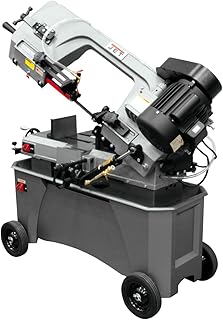
JET 7″ x 12″ Deluxe Horizontal/Vertical Band Saw (HVBS-712D)
The 3/4 HP motor and 7″ x 12″ capacity put this in a different class than benchtop machines — it swallows structural tube and thick round bar without complaint, then converts to vertical for contour work. It’s the pick if you want one saw to serve a home shop for a decade.
KAKA Industrial VS-2313 23″ Vertical Band Saw
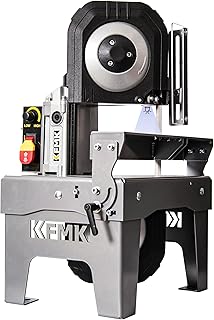
A genuine industrial vertical saw, with a 23″ throat, carbide guides, tilting table, and an onboard blade welder that lets you make internal cutouts and repair blades in-house. Overkill for hobby brackets; exactly right if you cut plate profiles regularly and have 220V available.
WEN BA4664 Metal Band Saw with Stand
WEN’s stand-mounted saw is the value benchmark: a rigid enough frame, sensible metal-appropriate speeds, and a stand included rather than sold as an upsell. Expect to upgrade the blade early, which is true of nearly everything at this price.
JET 5″ x 6″ Horizontal/Vertical Band Saw (HVBS-56)
The smaller JET trades capacity for footprint and a friendlier price while keeping the build quality and dual-position versatility of its bigger sibling. For 1″ to 2″ stock in a crowded garage, it’s the sweet spot.
Table Top Bandsaw, 5″ Capacity, 137–472 FPM Variable Speed
A 10-amp benchtop unit with a liftable worktable and a speed range that genuinely covers steel through PVC — the practical choice for someone cutting metal occasionally alongside other work. Bolt it down to tame vibration and it cuts far above its price.
Frequently Asked Questions
How many teeth per inch should the blade have?
Keep at least three teeth in the material at all times. Thin-wall tube needs 14–24 TPI; solid bar and thick sections cut better at 10–14 TPI. Too few teeth strips them off; too many packs the gullets and burns.
Do I need cutting fluid?
Not for occasional work, but a stick wax or light misting of fluid on steel and aluminum dramatically extends blade life and improves finish. Aluminum especially likes lubrication — it welds itself into the teeth when run dry.
Can I cut wood on a metal-cutting band saw?
Yes, if the saw offers higher speeds and you fit a wood blade. Understand that metal saws run slow by design, so cuts in thick timber will feel sluggish compared to a dedicated woodworking bandsaw.
Is a portable band saw enough?
A portable like the VEVOR handheld with removable base is excellent for cutting installed material, long stock, and jobsite work. It’s less precise for repeat parts than a fixed vertical machine, so many shops eventually own both.
Final Thoughts
For most home shops, the JET HVBS-712D is the saw that ends the search — capacity, quality, and dual-position flexibility in one machine. If your budget is tighter, the WEN BA4664 delivers most of the everyday capability with a stand included, while the KAKA VS-2313 is the right answer only when plate profiling and a blade welder are part of the job.