Key takeaways
- Rip capacity over blade size: Furniture means plywood. A 32-inch rip capacity lets you cut a 4×8 sheet in half cleanly; anything under 25 inches will have you wrestling panels on a circular saw first. This single spec separates the DEWALT DWE7491RS from most of the field.
- Fence quality: The fence is the saw. If it deflects or won’t hold parallel to the blade, every joint you cut will be slightly off and every case you build will rack. Rack-and-pinion fences, found on the SKIL TS6307 and DEWALT saws, hold square far better than single-point clamp designs.
- Stand and mobility: A rolling stand isn’t a luxury if your shop is also where the car lives. Foldable rolling stands let you set up in 30 seconds and reclaim the floor afterward — a real factor in whether you actually finish projects.
- Noise and vibration: Universal motors scream around 100 dB. Worm-drive designs like the SPT99-11 run lower and smoother, which matters if you work evenings in a house with kids or shift workers asleep upstairs. Hearing protection is non-negotiable either way.
- Safety features you’ll actually keep on: Look for a riving knife rather than just a splitter, plus an accessible blade guard and a push stick that stores on the saw. Fatigue causes accidents; the more convenient the safeguard, the more likely it stays installed at 9 p.m.
What's inside
Most DIYers don’t buy a table saw because they want a table saw. They buy one because the bed frame they want costs $1,800, the nightstand doesn’t come in the right width, and the closet shelving that would finally get laundry off the floor doesn’t exist in any catalog. I’ve spent years looking at how bedrooms actually function versus how they’re sold, and the pattern is consistent: the rooms that support good rest are the ones built around the person, not the showroom. That almost always means cutting your own material.
The problem is that the saw aisle is engineered to confuse you. Rip capacity, fence squareness, motor type, stand design, blade diameter — every spec sounds important and none of it is explained in plain terms. This guide narrows the field to six saws that genuinely suit home woodworkers building furniture in a garage or spare room, with attention to the things that matter for that work specifically: accuracy on wide panels, portability when the space doubles as parking, and noise levels you can live with when the shop shares a wall with a sleeping household.
As an Amazon Associate we earn from qualifying purchases.



How to Choose a Table Saw For Diyers (2026)
- Rip capacity over blade size: Furniture means plywood. A 32-inch rip capacity lets you cut a 4×8 sheet in half cleanly; anything under 25 inches will have you wrestling panels on a circular saw first. This single spec separates the DEWALT DWE7491RS from most of the field.
- Fence quality: The fence is the saw. If it deflects or won’t hold parallel to the blade, every joint you cut will be slightly off and every case you build will rack. Rack-and-pinion fences, found on the SKIL TS6307 and DEWALT saws, hold square far better than single-point clamp designs.
- Stand and mobility: A rolling stand isn’t a luxury if your shop is also where the car lives. Foldable rolling stands let you set up in 30 seconds and reclaim the floor afterward — a real factor in whether you actually finish projects.
- Noise and vibration: Universal motors scream around 100 dB. Worm-drive designs like the SPT99-11 run lower and smoother, which matters if you work evenings in a house with kids or shift workers asleep upstairs. Hearing protection is non-negotiable either way.
- Safety features you’ll actually keep on: Look for a riving knife rather than just a splitter, plus an accessible blade guard and a push stick that stores on the saw. Fatigue causes accidents; the more convenient the safeguard, the more likely it stays installed at 9 p.m.
The Best Table Saw For Diyers (2026)s Reviewed
DEWALT DWE7491RS 10-Inch with Rolling Stand
This is the saw I’d point almost any furniture-building DIYer toward: the 32½-inch rip capacity handles full sheet goods, the rack-and-pinion fence stays genuinely square, and the folding rolling stand makes a shared garage workable. It’s heavier and pricier than the rest, and worth both.
SKIL TS6307-00 15 Amp 10-Inch Jobsite Saw
The best value in the group by a clear margin, with a smooth rack-and-pinion fence and a folding stand that punches above its price. Rip capacity is narrower than the DEWALT’s, so plan on breaking down sheets with a track or circular saw first.
DEWALT DWE7485 8¼-Inch Compact
Choose this if storage space is your real constraint — it’s light enough to lift onto a bench single-handed and still cuts accurately with a quality thin-kerf blade. The 8¼-inch blade limits depth of cut, which rules out thick hardwood slabs but handles typical ¾-inch furniture stock fine.
SKIL SPT99-11 Worm Drive with Stand
The worm-drive gearing delivers noticeably more torque and a quieter, smoother cut than comparable universal-motor saws, so it won’t bog in dense hardwood. It’s the pick for anyone doing serious volume or working in a noise-sensitive home.
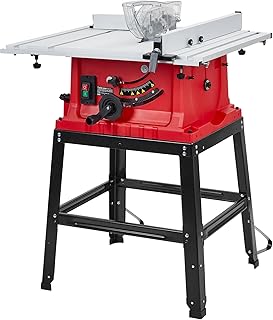
36 x 25-Inch 5000 RPM Table Saw with Stand and Cover
The generous 36 x 25-inch tabletop supports wide workpieces better than most portable saws, and the included cover is a thoughtful touch for dusty garages. Fence tolerances aren’t in DEWALT territory, so verify squareness before every critical cut.
Frequently Asked Questions
Can I build a bed frame with a portable table saw?
Yes. A queen frame is mostly straight rips and crosscuts in dimensional lumber and plywood, all within reach of any saw here. The limiting factor is support for long boards, so add outfeed and side support.
Is 10 inches necessary, or will 8¼ do?
For ¾-inch and 1-inch stock, 8¼ inches is plenty. Ten-inch saws matter when you’re cutting 2x material at 45 degrees or resawing thicker hardwood.
How loud are these, and can I use one at night?
Expect 95–105 dB at the operator’s ear — roughly a chainsaw. Even the quieter worm-drive saw will carry through walls, so treat cutting as a daytime task and save sanding and assembly for evenings.
What should I buy alongside the saw?
A quality 40–60 tooth blade, a crosscut sled, push blocks, hearing and eye protection, and a shop vac connection. The stock blade on nearly every saw is the weakest part of the package.
Final Thoughts
If you’re building furniture and have the space, the DEWALT DWE7491RS is the clear choice for its sheet-goods rip capacity and dependable fence. Budget-conscious builders should look hard at the SKIL TS6307-00, which gives up capacity but very little accuracy, while the SKIL SPT99-11 is the pick for hardwood work and quieter operation in a home shop.