Key takeaways
- Voltage and circuit reality: A standard 120V unit caps out near 1500W, which is genuinely enough for a single-bay space that’s insulated. Uninsulated two- and three-car garages need 240V hardwired output — check what your panel and outlets actually offer before you buy, not after.
- Match wattage to square footage: Budget roughly 10 watts per square foot for insulated space and closer to 20 for bare block or an uninsulated door. Undersizing means a heater that runs constantly and never satisfies; oversizing wastes energy cycling.
- Heating method: Forced-air and ceramic fan units warm the whole volume of air, which suits enclosed garages. Infrared and radiant models heat objects and people directly — better for drafty bays, open doors, or a workbench you occupy for an hour at a time.
- Noise, especially near sleeping areas: Fan-driven heaters typically land in the 50–60 dB range, comparable to conversation. If the garage shares a wall with a bedroom, favor radiant or infrared designs, which run essentially silent and won’t add a low-frequency hum to your sleep environment.
- Safety and placement: Look for tip-over cutoff, overheat protection, and an all-metal housing in workshop conditions. Ceiling-mounted units free up floor space and keep heating elements away from sawdust, solvents, and stored fuel — a meaningful consideration in any garage.
What's inside
Most people shopping for a garage heater are chasing warm fingertips, not better sleep — yet the two are quietly linked. An unheated garage tucked beneath a bedroom or sharing a wall with one behaves like a cold sink, pulling heat through shared drywall and joists all night long. That’s the sort of slow, uneven chill that fragments sleep without ever fully waking you: you surface at 3 a.m., tug the duvet higher, and wonder why you feel unrested at seven. Add the frustration of a workshop too frigid to use after dinner, and the garage becomes a room you avoid and a comfort problem you inherit upstairs.
This guide approaches garage heating the way I’d approach any bedroom-adjacent comfort issue: steady output, predictable thermostat behavior, and — critically — a noise profile that won’t intrude on light sleep stages if the unit runs into the evening. Below you’ll find the units worth your money in 2026, a short buying framework covering voltage, coverage area, mounting style, and sound, plus straightforward answers to the questions that come up most often once the box is open.
As an Amazon Associate we earn from qualifying purchases.


🛒 Best Price Today on Amazon
Prime members get fast, free shipping on everything above, plus member-only deals. New members get a 30-day free trial — cancel anytime.
How to Choose a/an Space Heater Garage (2026)
- Voltage and circuit reality: A standard 120V unit caps out near 1500W, which is genuinely enough for a single-bay space that’s insulated. Uninsulated two- and three-car garages need 240V hardwired output — check what your panel and outlets actually offer before you buy, not after.
- Match wattage to square footage: Budget roughly 10 watts per square foot for insulated space and closer to 20 for bare block or an uninsulated door. Undersizing means a heater that runs constantly and never satisfies; oversizing wastes energy cycling.
- Heating method: Forced-air and ceramic fan units warm the whole volume of air, which suits enclosed garages. Infrared and radiant models heat objects and people directly — better for drafty bays, open doors, or a workbench you occupy for an hour at a time.
- Noise, especially near sleeping areas: Fan-driven heaters typically land in the 50–60 dB range, comparable to conversation. If the garage shares a wall with a bedroom, favor radiant or infrared designs, which run essentially silent and won’t add a low-frequency hum to your sleep environment.
- Safety and placement: Look for tip-over cutoff, overheat protection, and an all-metal housing in workshop conditions. Ceiling-mounted units free up floor space and keep heating elements away from sawdust, solvents, and stored fuel — a meaningful consideration in any garage.
The Best Space Heater Garage (2026)s Reviewed
NewAir 240V Electric Garage Heater
This is the choice when a 120V plug-in simply can’t keep up — the 240V industrial output handles large, poorly insulated bays, sheds, and warehouse corners without endless cycling. It requires the right circuit, so confirm your electrical situation first, but the payoff is a garage that holds temperature rather than merely taking the edge off.
Dr. Infrared Portable Indoor/Outdoor Heater
Infrared output makes this the standout for anyone whose garage shares structure with a bedroom: it warms bodies and surfaces directly with no fan noise to carry through walls at night. The remote is genuinely useful, though note it ships without a thermostat, so you’re managing output manually.
Dura Heat EUH1465 Forced Air Heater
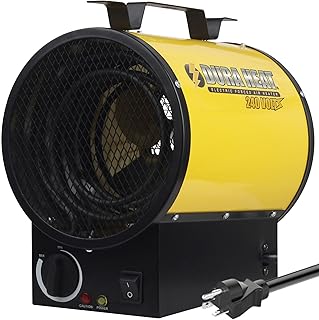
A tidy, well-executed 5,120 BTU ceramic unit with a pivoting base and a real thermostat, rated for around 250 square feet — ideal for a single bay, greenhouse, or workshop nook. Safety shut-off and a steel body mean it tolerates the knocks a garage inevitably delivers.
Comfort Zone 1500W Milkhouse Utility Heater
The classic all-metal milkhouse format endures because it works: two heat settings, an adjustable thermostat, fan-only mode, and a housing that shrugs off shop abuse. It’s the sensible default for a moderately insulated single-car garage on a standard outlet.
Shinic Ceiling-Mounted Radiant Heaters (2-Pack)
Mounting overhead solves two problems at once — reclaimed floor space and heating elements kept clear of dust and clutter. With 1500W/750W settings, 90-degree rotation, and five modes across two units, you can direct warmth precisely where you work; the single-unit Shinic version covers smaller bays at lower cost.
Frequently Asked Questions
Will a garage heater actually improve my sleep?
Indirectly, yes, if your bedroom sits above or beside the garage. Stabilizing that cold cavity reduces overnight temperature drift through shared surfaces, and steadier ambient temperature supports fewer nighttime awakenings.
Can I safely leave a garage heater running overnight?
Unattended overnight operation isn’t recommended for portable units. If you need continuous warmth, choose a hardwired or ceiling-mounted model with a thermostat, keep it clear of flammables, and confirm the manufacturer permits unattended use.
Do I need 240V, or is 1500W enough?
A 1500W unit suits insulated spaces up to roughly 150–250 square feet. Anything larger, or uninsulated, will outrun it — that’s where 240V becomes necessary rather than optional.
Which type is quietest?
Radiant and infrared heaters, since they have no blower. Any fan-forced model will produce steady broadband noise, which is fine in a detached garage and less ideal beside a bedroom wall.
Final Thoughts
For most single-bay garages, the Comfort Zone milkhouse heater delivers reliable thermostat-controlled warmth at a sensible price, while the Dura Heat EUH1465 is the better pick if you want ceramic heat with a pivoting base for a workbench area. If your garage borders a bedroom — or you simply want warmth without a blower running in the background — the Dr. Infrared model is the one I’d put on the list first.