Key takeaways
- Power source honesty: Electric models like the 500W Lerat only work where there’s an outlet — campground hookups, RVs, or a large battery bank. Running 500W off a portable power station drains roughly 500Wh per hour, so a 1,000Wh unit gives you two hours, not a night. Off-grid tent camping means propane.
- Output matched to enclosed volume: A 3,800 BTU radiant heater suits a two-person backpacking tent or ice shanty; 9,000 BTU is right for a 6-person tent, canvas wall tent, or garage bay. Oversizing an enclosed space creates stifling heat, condensation on the walls, and faster oxygen consumption.
- Non-negotiable safety cutoffs: Insist on both tip-over shutoff and, on propane units, a low-oxygen sensor (ODS). Radiant propane heaters produce carbon monoxide; an ODS is your backstop, not your permission slip. Pair any combustion heater with a battery CO alarm placed at head height near your sleeping area.
- Runtime and fuel logistics: A 1 lb canister runs a small radiant heater roughly 5–6 hours on low. Models with a foldable or reinforced tank holder let you connect a 20 lb tank via hose for multi-night trips — far cheaper per hour and far fewer empties rattling in your gear bin.
- Sleep-specific behavior: Look for a genuinely usable low setting and a control valve you can adjust half-asleep in the dark. The goal is a stable, mild 62–66°F, not a blast of heat that has you kicking off your bag at midnight.
What's inside
Cold sleep is broken sleep. Once ambient temperature drops below roughly 60°F, your body starts spending energy defending its core instead of cycling cleanly through deep and REM stages — which is why so many campers crawl out of the tent at 6 a.m. feeling like they never slept at all. Add a damp sleeping bag, a thin pad, and a 20-degree overnight swing, and you get the classic pattern I hear from clients constantly: asleep by ten, awake and shivering by two, staring at the tent ceiling until sunrise. The instinct is to buy a heater. That instinct is half right.
The other half is understanding that a camping heater is a sleep tool, not just a warmth tool — and the wrong one either sits useless without shore power or introduces a combustion risk you shouldn’t be sleeping next to. This guide sorts the options into two honest categories: 500W electric units for powered campsites, RVs, and van builds, and radiant propane heaters for off-grid tents, ice shanties, and hunting blinds. I’ll cover output versus enclosed space, tip-over and oxygen-depletion cutoffs, runtime math, and the ventilation rules that make the difference between a warm night and a genuinely dangerous one.
As an Amazon Associate we earn from qualifying purchases.



🛒 Best Price Today on Amazon
Prime members get fast, free shipping on everything above, plus member-only deals. New members get a 30-day free trial — cancel anytime.
How to Choose a Space Heater For Camping (2026)
- Power source honesty: Electric models like the 500W Lerat only work where there’s an outlet — campground hookups, RVs, or a large battery bank. Running 500W off a portable power station drains roughly 500Wh per hour, so a 1,000Wh unit gives you two hours, not a night. Off-grid tent camping means propane.
- Output matched to enclosed volume: A 3,800 BTU radiant heater suits a two-person backpacking tent or ice shanty; 9,000 BTU is right for a 6-person tent, canvas wall tent, or garage bay. Oversizing an enclosed space creates stifling heat, condensation on the walls, and faster oxygen consumption.
- Non-negotiable safety cutoffs: Insist on both tip-over shutoff and, on propane units, a low-oxygen sensor (ODS). Radiant propane heaters produce carbon monoxide; an ODS is your backstop, not your permission slip. Pair any combustion heater with a battery CO alarm placed at head height near your sleeping area.
- Runtime and fuel logistics: A 1 lb canister runs a small radiant heater roughly 5–6 hours on low. Models with a foldable or reinforced tank holder let you connect a 20 lb tank via hose for multi-night trips — far cheaper per hour and far fewer empties rattling in your gear bin.
- Sleep-specific behavior: Look for a genuinely usable low setting and a control valve you can adjust half-asleep in the dark. The goal is a stable, mild 62–66°F, not a blast of heat that has you kicking off your bag at midnight.
The Best Space Heaters For Camping (2026), Reviewed
Mr. Heater 9,000 BTU Portable Buddy
The benchmark radiant propane heater for larger tents, wall tents, and ice houses, with a swivel regulator, ODS, and tip-over shutoff built in. Run it on low with a cracked vent and a CO alarm nearby — it holds temperature well enough that you can shut it off entirely before sleep and still wake in a comfortably warm shell.
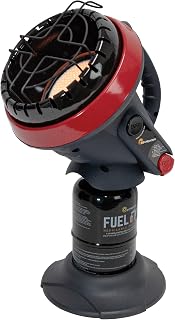
Mr. Heater 3,800 BTU Little Buddy
The smarter pick for small tents, blinds, and shanties where 9,000 BTU would be overkill. It sits on a 1 lb canister with a stable low profile, and its modest output means slower oxygen draw and less interior condensation — a real advantage for overnight comfort.
Portable Propane Heater with Foldable Tank Holder
A cordless radiant unit with a manual control valve and folding tank stand, aimed at campers who want 20 lb tank compatibility without hauling a bulky cabinet heater. The adjustable valve gives you finer low-end control than many competitors, which matters when you’re dialing in pre-sleep warmth.
Cordless Propane Heater for Ventilated Tents
Essentially the same radiant platform tuned for fast warm-up in ventilated tents, patios, and hiking basecamps. Best used as a pre-bed heat burst: run it 20 minutes to take the chill off your bag and pad, then shut it down and sleep on stored warmth.
Propane Camping Heater with Reinforced Base
The reinforced base and tank holder make this the most stable of the budget propane group — worth prioritizing if you camp on uneven ground or share a tent with kids or dogs. Stability isn’t a luxury feature on a combustion heater; it’s the whole ballgame.
Lerat 500W Portable Mini Heater
Not a tent heater, but excellent for powered campsites, RVs, camper vans, and truck-cap setups where you have AC. At 500W it’s gentle, quiet, ceramic-safe with overheat and tip-over protection, and won’t trip a 15-amp campground pedestal alongside other draws.
Frequently Asked Questions
Can I run a propane heater inside a tent while I sleep?
Manufacturers advise against unattended and sleeping use, and I agree. The safer protocol is to heat the tent before bed, shut the heater off, and rely on insulation. If you do run one, you need continuous cross-ventilation and a working CO alarm — every year, campers die from doing this wrong.
Which matters more for warm sleep: the heater or my sleeping pad?
The pad, almost always. Most heat loss while sleeping goes downward into the ground through compressed insulation. An R-value 5+ pad will do more for your night than any heater, and it works while you’re asleep with zero risk.Will a portable power station run an electric heater overnight?
Realistically, no. A 500W unit consumes about 500Wh per hour, so even a 2,000Wh station gives you roughly four hours at full draw. Use electric heaters where you have shore power and treat batteries as a short-term supplement.
Why do I wake up with a damp tent when using a heater?
Propane combustion releases water vapor, and warm air holds more moisture until it hits cold tent fabric and condenses. Increase ventilation, run lower output, and shut the heater down before sleep to keep your bag dry — damp insulation loses loft and warmth fast.
Final Thoughts
For most tent campers, the Mr. Heater 9,000 BTU Portable Buddy is the safest, best-built choice for larger shelters, while the 3,800 BTU Little Buddy is the smarter match for small tents and ice shanties where restraint beats raw output. If you camp with hookups or sleep in a van or RV, the Lerat 500W mini heater delivers quiet, combustion-free warmth with none of the ventilation homework — and remember that the real foundation of a warm night is an insulated pad, a dry bag, and a heater you turn off before you close your eyes.