Key takeaways
- Compare rackmount power conditioners with voltage displays for AV racks, by amp rating, outlet count, meter type and protection, with no battery.
The real decision with a rack power conditioner is not whether it cleans up power, but whether its meter tells you what the wall is doing. A numeric voltmeter, a segmented bar meter and a combined volt and amp display answer different questions, and the amp rating decides which racks the unit can legally and safely feed. Buyers also need to separate conditioning from backup: none of the units in this guide carries a battery, so none of them keeps a rack running through an outage.
This guide is for home theater owners with an AV rack, for home studio users protecting interfaces and monitors, and for media and network racks where a visible voltage reading helps spot a sagging circuit. Every pick below is a pure rackmount conditioner with a front voltage display, chosen from the product names and specifications on its Amazon page. If you need battery runtime instead, that is a rack UPS, which is a different product covered separately.
Quick Picks
As an Amazon Associate we earn from qualifying purchases
| Product | Best for | Key spec from title |
|---|---|---|
| Furman M-8Dx Merit Series Power Conditioner | Home studio racks that want a plain numeric reading | 15 Amp, 9 outlets, pullout lights, digital voltmeter |
| Furman PL-PLUS C Power Conditioner | AV racks that need a voltage range check from across the room | 15 Amp, 9 outlets, segmented LED voltmeter, isolated outlet banks |
| Furman PL-PLUS DMC Power Conditioner | Racks where current draw matters as much as voltage | 15 Amp, 9 outlets, digital voltmeter and ammeter |
| Pyle PCO875 Power Sequencer Conditioner | Home theater racks that must power up in order | 13 Amp, 2000W, 10 outlets, voltage readout, sequencer |
| Furman PL-PRO DMC Power Conditioner | Heavy racks wired for a 20 amp circuit | 20 Amp, 9 outlets, digital voltmeter and ammeter, USB outlet |
How to Choose
Pick the meter style you will actually read
A three-digit numeric voltmeter gives an exact incoming voltage, which suits fault finding: a reading that sits low every evening points at the circuit, not the gear. A segmented LED bar meter trades precision for distance, showing at a glance whether voltage sits in a safe band, which works in a dark theater room. A combined voltmeter and ammeter adds current draw, so you can watch a power amplifier pull the total toward the breaker limit during loud scenes. Decide which question you ask most often, exact voltage, safe range, or total load, and let that choose the display.
Match the amp rating to the circuit, not the rack
Most home racks run on a 15 amp branch circuit, and four of the five units here are rated to match it. The Furman PL-PRO DMC is a 20 amp model, and a 20 amp conditioner belongs only on a circuit and outlet wired for 20 amps; plugging it into an ordinary 15 amp receptacle through an adapter defeats the rating. Add up the draw of amplifiers first, because a single multichannel amp can take more than every source component combined. Sequenced turn-on, as on the Pyle PCO875, also softens the inrush when several amplifiers start together.
Separate conditioning from battery backup
A conditioner filters noise, suppresses surges and, on the Furman Classic models here, shuts the outlets down when voltage moves far outside a safe range. What it never does is keep equipment running when the power fails, because there is no battery inside. If a recorder, NAS or network switch must ride through an outage, you need a rack UPS in addition to, or instead of, a conditioner. Buyers who conflate the two end up protected against spikes but still lose the recording the first time the lights go out, so settle this question before comparing meters.
Count outlets and check how they are grouped
Rear outlet count runs from nine total outlets on the Furman models to ten on the Pyle sequencer, but grouping matters as much as the count. Isolated outlet banks on the PL-PLUS C and PL-PLUS DMC keep a noisy digital source away from sensitive analog gear plugged into the next bank. Wide spacing for wall wart transformers decides whether a small power brick blocks its neighbour. Front convenience outlets suit a charger or a service laptop, while sequenced rear outlets on the PCO875 bring amplifiers up last and down first, which is the order a theater rack wants.
The 5 Best Options
Furman M-8Dx Merit Series Power Conditioner

This is the straightforward pick for a home studio or media rack that wants an exact voltage number without paying for current metering. Its title states the essentials plainly: a 15 amp rating, nine outlets with wall wart spacing, pullout lights and a digital voltmeter, so the front panel shows incoming voltage as a number you can log or quote to an electrician. The pullout lights suit racks tucked into a closet or under a desk, and the Merit Series positioning makes it the entry point in this guide for buyers stepping up from a plain power strip.
Specs
- Rating: 15 Amp
- Outlets: 9 total, with wall wart spacing
- Display: digital voltmeter
- Lights: pullout rack lights
- Series: Merit Series power conditioning
Best for: Home studio and media racks that want a numeric voltage reading and rack lights
Watch out for: The meter reports voltage only, so it cannot show how close the load is to the 15 amp limit
ASIN: B00145EVJ6
Furman PL-PLUS C Power Conditioner
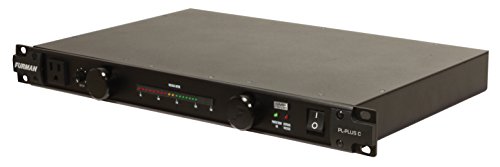
Choose the PL-PLUS C when the rack sits across the room and you need to judge voltage at a distance. Its listing describes a segmented LED voltmeter that monitors and displays incoming line voltage, a format that reads as a position in a range rather than a precise number. The same listing names isolated outlet banks, dual retractable LED lights and a 15 amp rating across nine outlets, plus Furman SMP protection. That mix suits an AV rack where a receiver, streamer and game console share one conditioner and the display gets checked from the sofa, not the rack door.
Specs
- Rating: 15 Amp
- Outlets: 9 total, in isolated outlet banks
- Display: segmented LED voltmeter showing incoming line voltage
- Lights: dual retractable LED lights
- Protection: SMP surge and spike protection, LiFT filtering named in the listing title details
Best for: AV racks that need a voltage range check from across a dark room
Watch out for: A segmented meter shows a band rather than an exact figure, so it is weaker for logging precise sags
ASIN: B001JJB2GM
Furman PL-PLUS DMC Power Conditioner

The PL-PLUS DMC is the 15 amp pick for owners who watch load as closely as voltage. Its title pairs a voltmeter with an ammeter, and the listing describes a large digital meter that displays line voltage and true RMS current draw, with a discrete dimmer button for the display. Nine outlets, a 15 amp rating and the same Classic Series protection family as the PL-PLUS C make it the natural step up when a power amplifier joins the rack and the question changes from is the voltage safe to how much headroom is left before the breaker complains.
Specs
- Rating: 15 Amp
- Outlets: 9 total
- Display: large digital voltmeter and ammeter, showing line voltage and true RMS current draw
- Control: discrete dimmer button for the meter
- Lights: pullout lights
Best for: Theater and studio racks with a power amplifier whose draw needs watching
Watch out for: The ammeter shows total draw for the unit, not a separate reading per outlet
ASIN: B001JJ8WQK
Pyle PCO875 Power Sequencer Conditioner

The PCO875 answers a different problem: order. Its Amazon title describes a 10 outlet power sequencer conditioner rated at 13 amps and 2000W, built as a rack mount digital power supply controller with a voltage readout and surge protection, aimed at home theater and stage or studio use. Sequencing brings rear outlets up in steps instead of all at once, which spares breakers and speakers when amplifiers and sources start together. For a theater rack that pops or trips when everything wakes on one switch, that behaviour, plus a front voltage readout, is the reason to pick it over a plain conditioner.
Specs
- Rating: 13 Amp, 2000W
- Outlets: 10 total
- Display: voltage readout on a digital controller front panel
- Function: power sequencer conditioner with surge protection
- Use case named in title: home theater, stage and studio racks
Best for: Home theater racks that need sequenced power-up and a front voltage readout
Watch out for: The 13 amp ceiling is lower than the 15 amp Furman models, so total amplifier load needs checking first
ASIN: B081T4HSKD
Furman PL-PRO DMC Power Conditioner

The PL-PRO DMC is the heavy-duty option, built around a 20 amp rating for racks that were wired to use it. Its listing describes a large digital voltmeter and ammeter displaying line voltage and true RMS current draw, nine total outlets with eight on the rear panel and one front convenience outlet, and a rear BNC connector for a gooseneck lamp, alongside SMP protection, LiFT filtering and Extreme Voltage Shutdown. A USB outlet appears in its product title. This is the conditioner for a rack with multiple power amplifiers on a dedicated 20 amp circuit, where both the voltage and the draw deserve a permanent front panel display.
Specs
- Rating: 20 Amp
- Outlets: 9 total, 8 rear panel and 1 front panel convenience outlet
- Display: large digital voltmeter and ammeter, showing line voltage and true RMS current draw
- Protection: SMP surge protection, LiFT filtering, Extreme Voltage Shutdown
- Extra: rear panel BNC connector for a gooseneck lamp, USB outlet named in title
Best for: Amplifier-heavy racks installed on a dedicated 20 amp circuit
Watch out for: It needs a 20 amp circuit and receptacle; it is the wrong buy for a standard 15 amp outlet
ASIN: B001JJSP30
Which One Fits Your Situation
Your Rack Lives in a Home Studio Closet
Pick the Furman M-8Dx. A numeric voltmeter gives you a figure you can note when a hum or dropout appears, and the pullout lights help when the rack sits in a dark closet. Its 15 amp rating and nine outlets cover a typical interface, monitor controller and outboard setup without the cost of current metering you may never use.
Your Theater Rack Wakes Up All at Once
Choose the Pyle PCO875 when the breaker or the speakers complain at switch-on. Sequenced outlets start the rack in steps, the voltage readout confirms what the wall is supplying, and the 10 outlet count fits a receiver, sources and a streaming box. Just confirm the combined draw stays under its 13 amp rating before ordering.
You Added a Power Amplifier and Worry About Load
Take the Furman PL-PLUS DMC. The ammeter half of its display shows true RMS current draw for the whole rack, so you can see how close loud passages push you toward the limit. It keeps the familiar 15 amp rating and nine outlets, which makes it a straight swap for a basic conditioner in most theater and studio racks.
Your Rack Was Wired With a Dedicated 20 Amp Circuit
The Furman PL-PRO DMC is the only pick here that uses that circuit properly. Its 20 amp rating, combined voltmeter and ammeter, and Extreme Voltage Shutdown suit a rack built around serious amplification. If your receptacle is a standard 15 amp type, step back to the PL-PLUS DMC instead of adapting this unit down.
Common Mistakes
- Buying a conditioner expecting battery backup, then losing a recording or a download when the power fails, because a conditioner has no battery.
- Ordering the 20 amp PL-PRO DMC for a normal 15 amp wall outlet and planning to adapt the plug, which defeats the rating the unit was built around.
- Choosing a segmented bar meter when the real goal is logging exact voltage sags for an electrician, a job that needs the numeric display on the M-8Dx or the DMC models.
- Adding up outlet counts without adding up amplifier draw, so a 13 amp sequencer or a 15 amp conditioner ends up feeding more load than it is rated for.
- Plugging a high-current amplifier into a filtered bank meant for sources without checking the listing, instead of following the outlet grouping the maker describes.
Frequently Asked Questions
Does a rack power conditioner keep my gear running in an outage?
No. A conditioner filters noise, suppresses surges and may shut outlets down when voltage becomes unsafe, but it contains no battery. Equipment connected to one goes off the moment power fails. Keeping a rack alive through an outage requires a UPS, which is a separate product category with its own sizing rules for watts and runtime.
What voltage should the display normally show?
On a standard North American circuit the reading should sit close to the nominal supply the listing is built for, and the useful habit is watching how far it moves. A display that dips when an air conditioner or amplifier starts is showing circuit load, while a reading that stays far from normal at rest is a reason to have the circuit checked rather than to replace the conditioner.
Is a voltmeter or a combined volt and amp meter better?
It depends on the question you bring to the rack. A voltmeter alone answers whether incoming power is sagging or swelling, which covers most fault finding. A combined meter also shows total current draw, which matters once amplifiers enter the rack and the breaker limit becomes a real concern. Buyers with sources only rarely need the ammeter; amplifier owners use it constantly.
Can I plug a 20 amp conditioner into a 15 amp outlet with an adapter?
That defeats the point of the rating. A 20 amp model such as the PL-PRO DMC is built for a circuit, breaker and receptacle wired for 20 amps, and its plug is shaped to enforce that. If the rack room only has 15 amp receptacles, choose one of the 15 amp models in this guide and keep the total draw within that limit instead.
More from Amazon
Programs that pair well with the guide above. Offers and eligibility are set by Amazon and may change.
Collect the home and kitchen items you want in one registry that guests can shop from.
Create a wedding registrySet up recurring deliveries of everyday items on eligible products. Terms and savings are set by Amazon.
Explore Subscribe & SaveFree shipping on eligible items, Prime Video and more. Eligible new members can start with a free trial.
Start a Prime free trialAudiobooks and podcasts to listen to on the go. Eligible new members can start with a free trial.
Try Audible freeAs an Amazon Associate we earn from qualifying purchases.