Key takeaways
- Usable pressure beats headline PSI: Paint is happiest between roughly 1,200 and 1,900 PSI at the nozzle. A 2,500 or 3,000 PSI machine is fine for vehicles provided you dial it back with a wider tip and keep the wand a foot or more from the panel.
- Flow rate does the rinsing: Gallons per minute clears loosened dirt; PSI only breaks it free. At 1.2 GPM you’ll rinse a sedan patiently. At 2.0 GPM and above, a lifted truck stops feeling like a project.
- Decide how you’ll apply soap: An onboard detergent tank is effortless for weekly maintenance washes. A dedicated foam cannon produces the thick, clinging lather that lets grit slide off before a mitt ever touches the paint.
- Weigh the noise against your schedule: Corded electric units sit near 75–80 dB, brushless models a touch lower and steadier. Gas engines run 90 dB and up — genuinely disruptive through a closed bedroom window if anyone in the house sleeps late or works nights.
- Check reach, stability, and storage: A 25-foot hose covers most single-bay driveways; 35 feet spares you from dragging the unit around an RV. Anti-tip geometry and tidy onboard hose storage matter more than spec sheets suggest, especially on sloped concrete.
What's inside
Most of the paint damage I see on driveways doesn’t come from neglect — it comes from enthusiasm. A wand held too close, a red zero-degree tip pressed into service “just for the bug splatter,” a machine chosen because of the largest number printed on the carton. Automotive clear coat is only a few thousandths of an inch thick, and the line between lifting road film and hazing a fender is usually a matter of nozzle angle and standoff distance rather than raw horsepower.
There’s a second variable buyers almost never weigh: when the machine will actually run. My work centers on household rhythms and rest, and car washing lands squarely in the soft edges of the day — before the commute, after dinner, early Saturday while the street is still asleep. A gas engine idling at ninety-something decibels at 7 a.m. is a neighborhood event; a brushless electric unit is closer to a running dishwasher. This guide covers pressure and flow, nozzle and foam options, noise, and which of 2026’s strongest vehicle-friendly washers fits which garage.
As an Amazon Associate we earn from qualifying purchases.


How to Choose a Pressure Washer For Vehicles (2026)
- Usable pressure beats headline PSI: Paint is happiest between roughly 1,200 and 1,900 PSI at the nozzle. A 2,500 or 3,000 PSI machine is fine for vehicles provided you dial it back with a wider tip and keep the wand a foot or more from the panel.
- Flow rate does the rinsing: Gallons per minute clears loosened dirt; PSI only breaks it free. At 1.2 GPM you’ll rinse a sedan patiently. At 2.0 GPM and above, a lifted truck stops feeling like a project.
- Decide how you’ll apply soap: An onboard detergent tank is effortless for weekly maintenance washes. A dedicated foam cannon produces the thick, clinging lather that lets grit slide off before a mitt ever touches the paint.
- Weigh the noise against your schedule: Corded electric units sit near 75–80 dB, brushless models a touch lower and steadier. Gas engines run 90 dB and up — genuinely disruptive through a closed bedroom window if anyone in the house sleeps late or works nights.
- Check reach, stability, and storage: A 25-foot hose covers most single-bay driveways; 35 feet spares you from dragging the unit around an RV. Anti-tip geometry and tidy onboard hose storage matter more than spec sheets suggest, especially on sloped concrete.
The Best Pressure Washers For Vehicles (2026), Reviewed
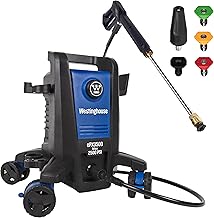
Westinghouse ePX3500
The most sensible all-rounder here: 2,500 max PSI and 1.76 GPM is a genuinely well-matched pairing for cars, and the onboard soap tank removes the friction that stops people from washing regularly. Anti-tipping construction and a pro-style steel wand give it a solidity that cheaper electrics lack — just stay on the 25- and 40-degree nozzles for painted surfaces.
Greenworks 3000 PSI Brushless
Pick this if you’re washing a truck, a van, or three vehicles in a row. The brushless motor holds output steadily through long sessions, runs noticeably calmer than brushed equivalents, and 2.0 GPM makes rinsing large panels quick rather than tedious.
Greenworks 2100 PSI
The gentlest option in the lineup and the easiest to live with in a townhouse or shared driveway — light, compact, and forgiving of an inexperienced hand. At 1.2 GPM you’ll take longer to rinse, but you’d struggle to damage a finish with it.
Quick-Connect Power Washer with Foam Cannon
Sold with four quick-connect nozzles and a foam cannon in the box, this is the value route to a proper two-bucket-style contactless wash. The cannon output is the real draw: thick foam, long dwell time, far less swirl-inducing scrubbing afterward.
DeWalt DXPW3300-S
Serious gas power at 3,300 PSI and 2.4 GPM with an AAA axial cam pump — overkill for a commuter car, ideal if the same machine also handles a horse trailer, a fleet of work trucks, or a long driveway. Use only the wide tips on paint, and save it for daylight hours.
Frequently Asked Questions
What PSI is safe for car paint?
Aim for 1,200–1,900 PSI delivered through a 25- or 40-degree nozzle, held at least 12 inches from the surface. Never use a zero-degree tip on a vehicle, and keep extra distance around trim, badges, and film wraps.
Do I need gas, or is electric enough?
Electric is the better vehicle tool for almost everyone: quieter, lighter, instant-start, no fuel storage. Gas makes sense — the DeWalt DXPW3300-S or the professional-grade Simpson ALH3425 with its Honda GX200 and triplex pump — when vehicles are only part of a much larger cleaning workload.
Is a foam cannon better than an onboard soap tank?
For pre-wash, yes. A cannon meters detergent into the high-pressure stream and produces clinging foam that lifts grit before contact. Onboard tanks are more convenient but deliver thinner, faster-draining suds.
Can I wash the car early without disturbing anyone?
With a corded electric unit, reasonably — most register around the level of household appliance noise and won’t carry far through closed windows. Even so, I’d hold off until after 8 a.m. on weekends; low-frequency motor hum travels further than people expect, and it’s an easy way to fray a neighbor’s morning.
Final Thoughts
For most households, the Westinghouse ePX3500 is the balanced choice — enough pressure, sane flow, and a soap tank that keeps the routine effortless. Step up to the Greenworks 3000 PSI Brushless if you’re regularly cleaning a truck or SUV, and choose the Greenworks 2100 PSI when space, budget, and quiet operation matter more than speed.