Key takeaways
- Interior height, not just exterior: A 71″ or 75″ cabinet sounds generous, but shelf spacing decides whether cereal boxes and blender jars fit standing up. Look for four or more adjustable shelves rather than fixed ones, and confirm the tallest bay clears at least 14″.
- Steel versus engineered wood: Metal cabinets shrug off humidity, wipe clean, and won’t sag under canned goods, which makes them ideal near dishwashers or in basements. Wood-look laminate reads warmer in a dining room but needs care around moisture and heavy loads.
- Door behavior: Doors are the part you touch a dozen times a day. Magnetic catches and soft, damped hinges keep a late-night snack run from waking the house; loose hinges and rattling thin panels do the opposite.
- Depth against your walkway: Most tall pantries run 12″–16″ deep. In a galley kitchen, anything past 15″ starts eating clearance, so measure your traffic path before your wall space.
- Anchoring and load rating: Any cabinet over five feet should be wall-anchored, full stop, especially with children or pets around. Check the per-shelf weight rating too — 30 lb per shelf is workable, 50 lb is comfortable.
What's inside
Most kitchens don’t run out of space so much as they run out of order. Boxes of pasta migrate to the counter, backup paper towels colonize the coat closet, and the 9 p.m. hunt for the cinnamon turns into a twenty-minute rummage under bright overhead light — exactly the kind of low-grade friction that keeps a household wired well past the point it should be winding down. As someone who spends most days advising people on their evenings, I’ve come to see kitchen storage as a sleep-adjacent problem: a room you can close down cleanly is a room that stops asking for your attention.
A freestanding pantry cabinet is the cheapest fix for that, short of a renovation. It gives dry goods, small appliances, and overflow a defined home behind doors, which shortens the nightly tidy-up and cuts the visual noise that keeps your brain in task mode. Below, I’ve assessed six tall pantry cabinets on the details that actually matter over years of use — shelf adjustability, door alignment, real usable depth, assembly sanity, and how quietly they operate — so you can pick one and stop thinking about it.
As an Amazon Associate we earn from qualifying purchases.


🛒 Best Price Today on Amazon
Prime members get fast, free shipping on everything above, plus member-only deals. New members get a 30-day free trial — cancel anytime.
How to Choose a Pantry Cabinet (2026)
- Interior height, not just exterior: A 71″ or 75″ cabinet sounds generous, but shelf spacing decides whether cereal boxes and blender jars fit standing up. Look for four or more adjustable shelves rather than fixed ones, and confirm the tallest bay clears at least 14″.
- Steel versus engineered wood: Metal cabinets shrug off humidity, wipe clean, and won’t sag under canned goods, which makes them ideal near dishwashers or in basements. Wood-look laminate reads warmer in a dining room but needs care around moisture and heavy loads.
- Door behavior: Doors are the part you touch a dozen times a day. Magnetic catches and soft, damped hinges keep a late-night snack run from waking the house; loose hinges and rattling thin panels do the opposite.
- Depth against your walkway: Most tall pantries run 12″–16″ deep. In a galley kitchen, anything past 15″ starts eating clearance, so measure your traffic path before your wall space.
- Anchoring and load rating: Any cabinet over five feet should be wall-anchored, full stop, especially with children or pets around. Check the per-shelf weight rating too — 30 lb per shelf is workable, 50 lb is comfortable.
The Best Pantry Cabinet (2026)s Reviewed
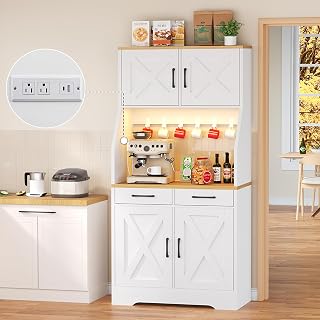
75″ Tall Farmhouse Pantry Cabinet with 2 Doors and 5 Shelves
At 75″ with five shelves, this is the most storage-per-footprint option here, and the all-metal build means it stays square even when the lower shelves are loaded with cases of sparkling water. The white finish disappears against most kitchen walls, which is precisely what you want from a piece this tall.
Steeloong 71″ Metal Pantry Cabinet with 4 Adjustable Shelves
The four adjustable shelves are the selling point — you can reconfigure around tall appliances without wasting a full tier of headroom. Brass-tone handles keep it from reading as office furniture, and the steel doors close with a solid, quiet catch.
GAIOUS 71″ Tall Metal Storage Cabinet
A clean, unfussy five-tier steel cabinet that assembles faster than most and holds its alignment well over time. It’s the one I’d point to for a laundry room, pantry corner, or home office where durability matters more than styling.
MHOM 71″ Farmhouse Pantry Cabinet with 4 Doors
The four-door layout means you’re only ever opening half the cabinet at once, which keeps contents out of sight and makes the upper section a natural home for rarely used items. Shaker-style fronts give it enough presence to live in a dining room rather than hide in a utility space.
Housoul 71″ Kitchen Pantry Cabinet, Oak
The oak finish is the standout — warm, matte, and convincingly grained, so it functions as furniture instead of storage. Adjustable shelving and a stable four-door frame make it a genuine alternative to built-ins in open-plan rooms where the cabinet is always in view.
Frequently Asked Questions
Do I really need to anchor a pantry cabinet to the wall?
Yes. Tall, narrow cabinets become top-heavy the moment you load upper shelves, and every model here ships with an anti-tip bracket for that reason. It takes five minutes and one stud.
Metal or wood — which lasts longer?
Powder-coated steel wins on longevity, moisture resistance, and load capacity. Choose wood-look laminate when the cabinet sits in a living or dining space and appearance is doing half the job.
Will a freestanding pantry look out of place next to built-in cabinets?
Rarely, if you match undertone rather than exact color and keep the door style simple. Placing it on a perpendicular wall, instead of flush in a run of cabinetry, also reads as intentional.
How do I keep a tall pantry from becoming a black hole?
Reserve the two shelves at eye level for daily items, put backstock up high, and use shallow bins on lower tiers so nothing hides at the back. A pantry you can scan in one glance is one you’ll actually reset each night.
Final Thoughts
If you want maximum capacity for the smallest footprint, the 75″ five-shelf farmhouse cabinet is the straightforward pick; the Steeloong 71″ is the better choice when you need flexible shelf spacing around tall appliances. For rooms where the cabinet is part of the décor rather than tucked away, the Housoul oak four-door earns its place — and whichever you choose, a kitchen that closes cleanly at night is worth far more than the shelf space alone.