Key takeaways
- Reader accuracy over reader speed: Marketing copy loves sub-second unlock times, but the number that matters is first-attempt success when your hand is dry, cold, or half-asleep. Look for units that store multiple prints per finger and let you enroll the same thumb from several angles.
- Redundant entry paths: Batteries die and sensors get grimy. A safe should offer at least two backups — a keypad code plus a mechanical override key stored somewhere other than the bedroom — so a dead cell never becomes a lockout.
- Silent operation: Beeps, voice prompts, and spring-loaded doors are useful in daylight and counterproductive at 2 a.m. A true silent mode that disables audio confirmation protects both your tactical position and your partner’s sleep cycle.
- Anchoring and steel gauge: A small safe that isn’t bolted down is a portable box. Prioritize pre-drilled mounting holes, an included security cable, and a pry-resistant door lip — the door seam fails long before the walls do.
- Footprint and mounting style: Measure your drawer interior or under-frame clearance before buying. Drop-down and drawer-mounted designs conceal better; countertop clock-style units trade concealment for one-motion access.
What's inside
Anyone who has spent a night listening to an unfamiliar noise downstairs knows how quickly rest turns into vigilance. From a sleep-wellness standpoint, that vigilance is the real thief — fragmented sleep architecture, elevated cortisol at 3 a.m., and a bedroom that stops feeling like a place of recovery. For households that keep a firearm for protection, the nightstand becomes the pressure point where two needs collide: the need to know a weapon is genuinely inaccessible to a curious child or an unauthorized hand, and the need to trust that it can be reached without fumbling in the dark.
A well-built bedside safe resolves that tension instead of splitting the difference. This guide looks at the nightstand-scale models worth considering in 2026 — biometric readers that actually recognize a sleep-clumsy thumb, silent-mode openings that don’t jolt a partner awake, mounting hardware that defeats a grab-and-run, and the interior lighting and charging touches that let one piece of furniture do the work of three. Below you’ll find our current picks, followed by the criteria we used and honest notes on where each model earns its place.
As an Amazon Associate we earn from qualifying purchases.




🛒 Best Price Today on Amazon
Prime members get fast, free shipping on everything above, plus member-only deals. New members get a 30-day free trial — cancel anytime.
How to Choose a Nightstand Gun Safes (2026)
- Reader accuracy over reader speed: Marketing copy loves sub-second unlock times, but the number that matters is first-attempt success when your hand is dry, cold, or half-asleep. Look for units that store multiple prints per finger and let you enroll the same thumb from several angles.
- Redundant entry paths: Batteries die and sensors get grimy. A safe should offer at least two backups — a keypad code plus a mechanical override key stored somewhere other than the bedroom — so a dead cell never becomes a lockout.
- Silent operation: Beeps, voice prompts, and spring-loaded doors are useful in daylight and counterproductive at 2 a.m. A true silent mode that disables audio confirmation protects both your tactical position and your partner’s sleep cycle.
- Anchoring and steel gauge: A small safe that isn’t bolted down is a portable box. Prioritize pre-drilled mounting holes, an included security cable, and a pry-resistant door lip — the door seam fails long before the walls do.
- Footprint and mounting style: Measure your drawer interior or under-frame clearance before buying. Drop-down and drawer-mounted designs conceal better; countertop clock-style units trade concealment for one-motion access.
The Best Nightstand Gun Safes (2026)s Reviewed
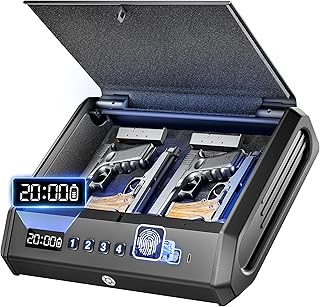
FTOP Biometric Clock Safe with Wireless Charging
This is the most bedroom-native design in the group: it reads as an alarm clock, charges a phone and watch on top, and reports temperature and humidity — a genuine benefit since ambient moisture is what degrades stored ammunition and finishes. Access is one motion from a pillow-side position, though the trade-off is visibility, so pair it with firm anchoring.
Quick Access Biometric Bedside Drop-Down Safe
Mounted under a bed frame or shelf, the drop-down door delivers the fastest realistic reach of any format here, with fingerprint, passcode, and key entry covering every failure mode. It’s the pick for anyone who wants concealment and speed without surrendering nightstand surface area.
Large Biometric Safe with Internal Light and Silent Mode
Storage for 100 fingerprint sets makes this practical for a household where two or three adults need authorized access, and the interior LED plus silent unlock is a genuinely well-judged combination for nighttime use. The larger cavity also accommodates a full-size pistol with a mounted light attached, which many compact boxes cannot.
BILLCONCH Biometric Safe with USB Charging
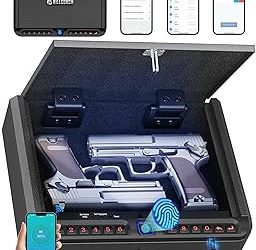
A clean, no-nonsense build with fingerprint, PIN, and key redundancy, plus interior lighting and a USB port that lets it double as your bedside charging point. It fits standard drawers comfortably and is the most straightforward recommendation for a first-time buyer.
Quick Access Fingerprint Safe with LCD Display
The LCD readout is more useful than it sounds — battery status and lock state at a glance mean you’re never guessing whether the unit is ready. Three access methods and a drawer-friendly profile make it a strong crossover pick for car use as well.
Frequently Asked Questions
Do biometric safes work reliably in the dark?
Capacitive fingerprint sensors don’t depend on light, so darkness itself isn’t the issue — dry or cold skin is. Enroll each finger multiple times and re-enroll seasonally if you notice hesitation.
How should I anchor a safe inside a nightstand?
Bolt through the drawer bottom or cabinet floor into the frame where possible, and use the included cable as a secondary tether to a bed rail or wall stud. Anchoring is the single largest security upgrade you can make.
Will a bedside safe disturb my sleep?
Choose a model with a true silent mode and either disable or dim any always-on display. Persistent LEDs in the blue-white range suppress melatonin, so tape over or reduce indicator lights that stay lit overnight.
How often do the batteries need attention?
Most AA-powered units run six to twelve months depending on open frequency and lighting use. Set a recurring calendar reminder rather than waiting for a low-battery warning, and keep the backup key outside the bedroom.
Final Thoughts
If concealment and reach matter most, the Quick Access Biometric Bedside drop-down safe is the strongest overall choice; households needing multiple authorized users and room for a larger pistol should look at the Large Biometric Safe with internal light and silent mode; and anyone who wants the safe to disappear into a functional bedside object will appreciate the FTOP clock safe with wireless charging. Whichever you choose, anchor it properly and test your access routine while genuinely tired — that’s the only rehearsal that counts.