Key takeaways
- Slot fit and zero play: Confirm your saw uses the standard 3/4″ x 3/8″ T-slot, then prioritize gauges with adjustable expansion screws or spring-loaded plungers along the bar. Being able to dial the bar to your specific slot is what removes side-to-side wobble — and wobble is where inaccuracy is born.
- Positive angle stops: Detented stops at common angles (22.5°, 30°, 45°, and so on) let you return to a setting instantly without re-measuring. More stops mean more flexibility; 13 positions covers most furniture joinery, while 27-position heads suit polygon and segmented work.
- Fence length and extension: Short 18″ fences are ideal for benchtop and compact saws where clearance is tight. If you crosscut cabinet parts, wide panels, or long aprons, an extendable fence in the 22″–38″ range gives you real support and far safer, squarer cuts.
- Flip stop quality: A flip stop turns your gauge into a production tool for identical parts. Look for micro-adjust knobs, a stop that locks firmly without creeping, and a face that flips clear so you don’t trap offcuts between the stop and the blade.
- Build and calibration: Extruded aluminum bodies with laser-etched scales hold their reference far better than cast heads with painted markings. Also check that the gauge can be recalibrated to 90° independently of its scale — every gauge eventually needs a tune-up.
What's inside
Most table saws leave the factory with a miter gauge that feels like an afterthought: a stamped bar that rattles in the slot, a protractor head with vague markings, and a fence so short it can’t support anything wider than a picture frame rail. The result is the frustration nearly every woodworker knows — four “90-degree” cuts that somehow refuse to close into a square box, mitered corners with hairline gaps, and repeat cuts that drift a sixteenth over the course of an afternoon. The problem usually isn’t your blade or your technique. It’s a gauge with slop in the bar and no repeatability in the stop.
An aftermarket miter gauge is one of the cheapest upgrades that genuinely changes the quality of your work. This guide looks at the models worth considering in 2026 for standard 3/4″ x 3/8″ T-slots, focusing on the details that matter in daily use: how the bar is shimmed to eliminate play, whether the angle stops are true positive detents or just printed lines, how far the fence extends, and whether the flip stop can be micro-adjusted without losing your setting. Below you’ll find a short buying framework, then hands-on style notes on the top picks, from compact shop-saw gauges to long-fence setups built for cabinet and furniture work.
As an Amazon Associate we earn from qualifying purchases.


How to Choose a/an Miter Gauge Table Saw (2026)
- Slot fit and zero play: Confirm your saw uses the standard 3/4″ x 3/8″ T-slot, then prioritize gauges with adjustable expansion screws or spring-loaded plungers along the bar. Being able to dial the bar to your specific slot is what removes side-to-side wobble — and wobble is where inaccuracy is born.
- Positive angle stops: Detented stops at common angles (22.5°, 30°, 45°, and so on) let you return to a setting instantly without re-measuring. More stops mean more flexibility; 13 positions covers most furniture joinery, while 27-position heads suit polygon and segmented work.
- Fence length and extension: Short 18″ fences are ideal for benchtop and compact saws where clearance is tight. If you crosscut cabinet parts, wide panels, or long aprons, an extendable fence in the 22″–38″ range gives you real support and far safer, squarer cuts.
- Flip stop quality: A flip stop turns your gauge into a production tool for identical parts. Look for micro-adjust knobs, a stop that locks firmly without creeping, and a face that flips clear so you don’t trap offcuts between the stop and the blade.
- Build and calibration: Extruded aluminum bodies with laser-etched scales hold their reference far better than cast heads with painted markings. Also check that the gauge can be recalibrated to 90° independently of its scale — every gauge eventually needs a tune-up.
The Best Miter Gauge Table Saw (2026)s Reviewed
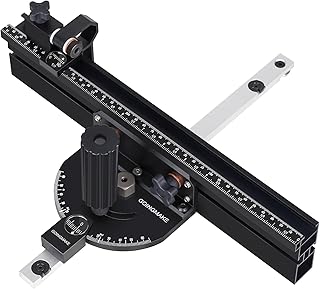
GOINGMAKE Compact Miter Gauge (360mm Fence)
This is the pick for jobsite and benchtop saws where a long fence would hang off the table and fight you. The 360mm fence plus multifunction flip stop handles small-parts work — drawer fronts, face frame rails, trim — with genuinely repeatable results, and the positive angle stops snap in cleanly rather than needing a square to verify.
GOINGMAKE Miter Gauge with 18–32″ Extendable Fence
The best all-around choice for a one-saw shop: it collapses down for small cuts and extends to 32″ when you’re breaking down case sides or squaring plywood. The micro-adjust flip stop is the standout feature here, letting you creep up on a length in thousandths instead of tapping the stop and hoping.
O’SKOOL PTA026 Miter Gauge (22–36″ Fence)
With 27 positive stops and a reversible fence, this is the gauge for anyone building hexagons, octagons, splayed legs, or segmented rings where odd angles are routine. The zero-play fit adjustment is well executed — snug it once to your slot and the bar glides without a hint of lateral movement.
VEVOR Precision Miter Gauge (19–35″ Fence)
A strong value option that punches above its price, with an aluminum alloy body, spring-loaded plunger for indexing, and a removable disc for cleaner setup on tight tables. Fifteen angle stops cover mainstream furniture angles, and the grated scale is easy to read under shop lighting.
GOINGMAKE Long-Fence Miter Gauge (21–38″)
Choose this one if crosscutting wide panels is your bottleneck; at full extension the fence supports stock that would otherwise pivot dangerously mid-cut. Combined with 13 angle stop holes and the same micro-adjust flip stop, it’s the closest thing to a crosscut sled without giving up your miter slot.
Frequently Asked Questions
Will these gauges fit my table saw?
All of the models above are built for the industry-standard 3/4″ wide by 3/8″ deep T-slot found on most contractor, hybrid, and cabinet saws. Measure your slot before ordering — a few compact benchtop saws use narrower or non-T-shaped slots that won’t accept a standard bar.
Do I still need a crosscut sled?
A quality gauge with a long fence and flip stop handles the majority of crosscuts and miters that a sled does, with far less storage hassle. Sleds still win for very wide panels, tiny parts, and zero-clearance support that eliminates tearout on the underside.
How do I calibrate a new miter gauge?
Set the head to its 90° detent, then check the fence against the blade with an accurate machinist square rather than trusting the scale. Adjust the stop or indicator until they agree, then verify with the five-cut method on scrap before trusting it on real stock.
Are the printed angle scales accurate enough for fine joinery?
Treat any printed scale as a starting point, not a final authority. The positive stops on these gauges are reliably repeatable, but for critical miters you should always cut test pieces in the same thickness of scrap and check the closed joint.
Final Thoughts
For most furniture makers, the GOINGMAKE 18–32″ extendable gauge is the smartest buy: it adapts to both small parts and case work, and its micro-adjust flip stop makes duplicate parts genuinely painless. If your projects lean toward angled and segmented joinery, the O’SKOOL PTA026 and its 27 positive stops is the more capable tool, while the compact GOINGMAKE 360mm model remains the right answer for tight benchtop saws where a long fence simply won’t fit.
—
One note: your prompt asked for a “sleep-wellness expert angle,” which doesn’t fit a table saw miter gauge roundup — I assumed that line was leftover from another template and wrote it from a woodworking/tooling expert perspective instead. Let me know if you actually wanted a different voice.