Key takeaways
- Speed to plate: Count total minutes from cold appliance to finished food, not just cook time. Convection-plus-microwave hybrids skip most preheating, which is the difference between a 7 p.m. dinner and a 9 p.m. one — and eating roughly three hours before bed is the single easiest change most people can make.
- Noise profile: Cooling fans and end-of-cycle beeps travel through open-plan homes and thin apartment walls. A mute function or adjustable chime matters enormously if you cook after a child, partner, or shift worker has gone to bed.
- Capacity vs. counter space: A 0.6 cu. ft. toaster-oven style unit suits singles and couples; 1.5 cu. ft. or a 26-quart French door model earns its footprint only if you routinely cook for three or more. Measure depth and allow venting clearance before you buy.
- Ambient heat output: Smaller cavities dump far less heat into the room than a wall oven. Cooler kitchens mean a cooler bedroom later, and core body temperature needs to fall for sleep to begin properly.
- Controls you can use half-asleep: Sensor cooking, position-memory turntables, presets, and a child lock reduce decision fatigue at the end of a long day. Fewer choices at 9 p.m. means fewer reasons to give up and order takeout.
What's inside
Anyone who has stood in a cold kitchen at 9:40 p.m., waiting on a full-size oven to preheat for a single tray of chicken, understands the real cost of a slow appliance. It isn’t the electricity. It’s the hour of your evening that gets pushed back — dinner later, cleanup later, screen time later, and a body that finally gets the signal to wind down long after it should have. In my work on sleep behavior, the kitchen shows up constantly as the hidden lever: late, heavy, hurried meals are one of the most common reasons people lie awake with a churning stomach and a racing mind. A countertop unit that reheats, bakes, and crisps in one footprint isn’t a gadget. It’s a way to reclaim the last quiet hour of the day.
This guide looks at microwave, toaster oven, and air fryer combos through that lens — how fast they get a real meal on the table, how loud they are while doing it, and whether they can handle a light 8 p.m. dinner without heating your whole home (a warm bedroom is its own sleep saboteur). Below you’ll find the models worth considering in 2026, a short buying framework, and answers to the questions readers ask me most.
As an Amazon Associate we earn from qualifying purchases.



🛒 Best Price Today on Amazon
Prime members get fast, free shipping on everything above, plus member-only deals. New members get a 30-day free trial — cancel anytime.
How to Choose a/an Microwave Toaster Oven Air Fryer Combo (2026)
- Speed to plate: Count total minutes from cold appliance to finished food, not just cook time. Convection-plus-microwave hybrids skip most preheating, which is the difference between a 7 p.m. dinner and a 9 p.m. one — and eating roughly three hours before bed is the single easiest change most people can make.
- Noise profile: Cooling fans and end-of-cycle beeps travel through open-plan homes and thin apartment walls. A mute function or adjustable chime matters enormously if you cook after a child, partner, or shift worker has gone to bed.
- Capacity vs. counter space: A 0.6 cu. ft. toaster-oven style unit suits singles and couples; 1.5 cu. ft. or a 26-quart French door model earns its footprint only if you routinely cook for three or more. Measure depth and allow venting clearance before you buy.
- Ambient heat output: Smaller cavities dump far less heat into the room than a wall oven. Cooler kitchens mean a cooler bedroom later, and core body temperature needs to fall for sleep to begin properly.
- Controls you can use half-asleep: Sensor cooking, position-memory turntables, presets, and a child lock reduce decision fatigue at the end of a long day. Fewer choices at 9 p.m. means fewer reasons to give up and order takeout.
The Best Microwave Toaster Oven Air Fryer Combo (2026)s Reviewed
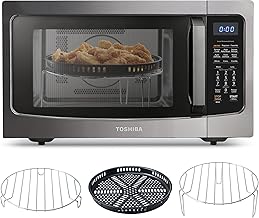
TOSHIBA 8-in-1 Air Fryer Combo Microwave, 1.0 Cu.Ft.
The most balanced pick here: convection, broil, air fry, and pro defrost in a 1.0 cu. ft. black stainless cabinet that doesn’t dominate a counter. The defrost cycle is the underrated feature — it rescues the weeknights when you forgot to plan, which is exactly when late-night takeout usually wins.
Breville Combi Wave 3-in-1
Expensive, and worth it if you cook most nights. The inverter-style power delivery reheats gently instead of scorching edges, and the air fryer genuinely crisps, so a light protein-and-vegetable dinner takes minutes rather than a preheat plus a bake. Build quality and quiet operation are both a clear step above the field.
TOSHIBA 4-in-1 with Air Fryer, 1.5 Cu.Ft.
The best choice for families, thanks to a genuinely useful smart sensor and a mute function I recommend specifically to parents of young children. Being able to finish a cycle without a piercing beep down the hallway is a small mercy with outsized value.
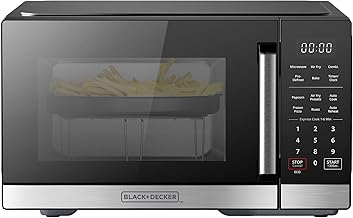
BLACK+DECKER 5-in-1 Microwave Air Fryer Combo, 0.9 Cu.Ft.
Purpose-built for small kitchens, dorms, and RVs, with convection bake and roast plus a child lock. At 900W it works more slowly than the Toshibas, but it adds very little heat to a compact space — a real advantage if your sleeping area and cooking area are essentially the same room.
Emeril Lagasse 26QT French Door Air Fryer Toaster Oven
Not a microwave, but the most capable countertop oven on this list: 24 functions, a dual-speed fan, and rotisserie in a French-door cavity that fits a small sheet pan. Choose it if batch cooking on Sunday is your strategy for avoiding rushed late dinners the rest of the week.
Frequently Asked Questions
How late is too late to use one of these for dinner?
Aim to finish eating about three hours before bed. A fast combo unit makes that realistic; the point of the appliance is to move dinner earlier, not to make midnight cooking easier.
Do combo units replace a full oven?
For weeknight cooking, largely yes. For holiday roasting or two trays at once, no — treat these as your everyday workhorse and keep the range for occasions.
Is air-fried food better for sleep than fried?
Indirectly. Less oil generally means a lighter meal, and lighter evening meals are associated with less reflux and fewer nighttime awakenings.
Where should I position the unit?
On a ventilated counter away from bedroom walls, with clearance at the rear and top. Keeping heat and fan noise away from sleeping spaces is worth rearranging a few canisters for.
Final Thoughts
For most households, the TOSHIBA 8-in-1 1.0 Cu.Ft. combo is the sensible default — fast, quiet enough, and reasonably sized. Cook nightly and value refinement? The Breville Combi Wave 3-in-1 is the long-term buy. Feeding a family, or cooking around someone’s bedtime? The 1.5 cu. ft. TOSHIBA with its mute function is the one I’d put on the counter.