Key takeaways
- Working height, not ladder height: Your safe reach is roughly the ladder’s height plus your shoulder reach, minus the top two rungs you shouldn’t stand on. For eight-to-nine-foot ceilings, a six-foot step ladder is the sweet spot; for gutters, soffits, and second-story windows, plan on 12 to 17 feet of extension.
- Duty rating with real margin: The rating covers you plus tools, paint, and a curtain rod. A 300-pound Type IA or 330-pound aluminum rating gives most homeowners genuine headroom rather than a number they’re quietly flirting with.
- Material matched to the task: Fiberglass is non-conductive and the only defensible choice near wiring, junction boxes, or panel work. Aluminum is lighter and easier to carry solo, which matters more than people expect when the ladder lives in a basement.
- Stability hardware: Stabilizer bars, wide flared feet, and locking hinges are what separate a ladder you trust from one you brace against with your hip. Wheels are a genuine convenience on longer telescoping models that are otherwise awkward to reposition.
- Storage reality: Measure your actual storage spot before buying. A telescoping ladder that collapses to roughly three feet fits in a coat closet or an SUV cargo area; a rigid 14-footer needs garage wall space and a plan for mounting it.
What's inside
As a sleep-wellness practitioner, I spend most of my working hours talking about circadian rhythm, room temperature, and light exposure — and a surprising amount of it talking about ladders. The reason is simple: almost every meaningful upgrade to a bedroom happens above shoulder height. Blackout curtain rods, dimmable fixtures, ceiling fans, smoke detectors that chirp at 3:07 a.m., the dusty return vent quietly degrading your air quality. Homeowners who don’t own a stable, appropriately sized ladder tend to postpone all of it indefinitely, then compensate by balancing on a dining chair or the arm of a sofa. That’s how a wellness project becomes an emergency-room visit.
There’s a second, less obvious cost. Unfinished household tasks are one of the most reliable triggers of bedtime rumination — the mind’s habit of rehearsing open loops the moment the lights go out. A ladder is an unglamorous piece of equipment that closes those loops. This guide looks at six homeowner-grade ladders through a practical lens: how stable they feel underfoot, how honestly they handle stairs and uneven ground, how much closet space they surrender, and whether they’re pleasant enough to use that you’ll actually finish the job instead of deferring it another season.
As an Amazon Associate we earn from qualifying purchases.




How to Choose a Ladder For Homeowner (2026)
- Working height, not ladder height: Your safe reach is roughly the ladder’s height plus your shoulder reach, minus the top two rungs you shouldn’t stand on. For eight-to-nine-foot ceilings, a six-foot step ladder is the sweet spot; for gutters, soffits, and second-story windows, plan on 12 to 17 feet of extension.
- Duty rating with real margin: The rating covers you plus tools, paint, and a curtain rod. A 300-pound Type IA or 330-pound aluminum rating gives most homeowners genuine headroom rather than a number they’re quietly flirting with.
- Material matched to the task: Fiberglass is non-conductive and the only defensible choice near wiring, junction boxes, or panel work. Aluminum is lighter and easier to carry solo, which matters more than people expect when the ladder lives in a basement.
- Stability hardware: Stabilizer bars, wide flared feet, and locking hinges are what separate a ladder you trust from one you brace against with your hip. Wheels are a genuine convenience on longer telescoping models that are otherwise awkward to reposition.
- Storage reality: Measure your actual storage spot before buying. A telescoping ladder that collapses to roughly three feet fits in a coat closet or an SUV cargo area; a rigid 14-footer needs garage wall space and a plan for mounting it.
The Best Ladder For Homeowner (2026)s Reviewed
SocTone 12.5FT Telescoping Ladder with Stabilizers
This is the ladder I’d suggest to a homeowner who needs outdoor reach but has no room to store it, collapsing to a size you can slide behind a door and carry with one hand. The stabilizer bar and 330-pound rating make it steady enough for gutter clearing and RV roof access, and the rung-by-rung locks let you extend only as far as the job requires.
LANBITOU 14FT A-Frame Multi-Position Ladder
The standout feature is genuine versatility: A-frame, extension, and staircase configurations from a single unit, which is exactly what you want when one weekend involves a stairwell light fixture and the next involves a roofline. Anti-slip rungs and a locking hinge system keep it confident in the awkward asymmetric positions where cheaper multi-ladders start to feel vague.
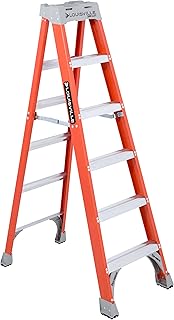
Louisville Ladder 6-Foot Fiberglass Step Ladder (FS1506)
If you buy only one ladder, buy this one. It’s a Type IA fiberglass workhorse rated to 300 pounds, non-conductive for fixture and detector work, and rigid in a way that telescoping designs simply can’t replicate — the difference is immediately obvious when you’re reaching overhead with both hands occupied.
5-Step Folding Ladder for Home Use
Wide anti-slip steps and a 330-pound capacity make this the most comfortable option for extended indoor tasks like painting a bedroom ceiling or hanging heavy blackout drapery. It folds flat for pantry or utility-closet storage and is light enough that a single person can carry it upstairs without negotiation.
Telescoping A-Frame Ladder, 17FT with Stabilizer Bar & Wheels
Seventeen feet is real second-story access, and the stabilizer bar plus integrated wheels solve the two usual complaints about tall multi-position ladders: side-to-side sway and the misery of repositioning. Best suited to homeowners with steep roofs, tall trees, or exterior work they’d otherwise be outsourcing.
Frequently Asked Questions
What ladder height do I need for an eight-foot ceiling?
A six-foot step ladder is ideal. It puts your hands comfortably at ceiling level while standing on the third or fourth step, with no temptation to climb onto the top cap.
Are telescoping ladders as safe as traditional ones?
Reputable telescoping models with certified duty ratings are safe when fully locked and set on firm, level ground. Always confirm every rung has clicked into place, and prefer models with stabilizer bars for outdoor use.
Why choose fiberglass over aluminum?
Fiberglass doesn’t conduct electricity, making it the correct choice for any work near wiring, light fixtures, or electrical panels. Choose aluminum when weight and portability matter more than electrical safety.
Can I use a ladder on a staircase?
Only a multi-position ladder with independently adjustable legs is designed for this. Never prop a standard step ladder across stair treads — the uneven footing is a common cause of household falls.
Final Thoughts
For most homeowners, the Louisville 6-Foot Fiberglass Step Ladder is the essential first purchase — safe near electrical work and rigid enough to trust for years of indoor projects. Pair it with the SocTone 12.5FT Telescoping Ladder if storage is tight, or step up to the LANBITOU 14FT Multi-Position Ladder if stairwells and rooflines are part of your regular maintenance rhythm. Whichever you choose, the goal is the same: fewer deferred tasks, fewer improvised chair-stacking experiments, and a quieter mind at bedtime.