Key takeaways
- Contact point, not just height: Decide first whether you want a standoff arm that presses against siding or a roof hook that grips the ridge. Standoffs suit single-storey work on flat walls; ridge hooks with wheels are better if you need to roll the ladder up a pitched roof and lock it over the peak.
- Working height versus rung height: Your feet should never go above the fourth rung from the top, and your gutter line should be reachable at chest height. A 20-foot telescoping ladder realistically services a two-storey gutter; a 16.5-foot A-frame is a single-storey tool.
- Weight rating with a margin: A 330 lb capacity sounds generous until you add a body, boots, a scoop, a bucket of wet leaf sludge, and a cordless blower. Treat the rating as a ceiling, not a target.
- Locking mechanism quality: On telescoping designs, auto-lock rungs and positive-feel hinge locks are the whole product. Cheap detents that need coaxing are the single most common cause of the pinched fingers and sudden drops that make these ladders unpopular.
- Storage reality: Measure your garage, car boot, or RV bay before buying. A ladder that collapses to roughly a metre gets used every season; a 24-foot fixed extension ladder hanging awkwardly from ceiling hooks tends to get avoided.
What's inside
Few household chores get postponed as reliably as gutter cleaning, and few cause as much quiet, low-grade worry once autumn rain arrives. There is a particular kind of restlessness that comes from listening to water sheet off a blocked downspout at 2 a.m. and wondering what it is doing to the fascia board. As someone who spends most of my professional life talking about what keeps people awake, I can tell you that unresolved home maintenance ranks surprisingly high on the list — and that the fix is usually a single afternoon with the right equipment. The wrong equipment, on the other hand, is how people end up in an emergency room, which is a far worse sleep disruptor.
The core problem is that a standard extension ladder is designed to lean against a flat wall, and a gutter is not a flat wall. Rest a ladder directly on aluminum guttering and you crush it, shift your contact point, and introduce sideways movement exactly where you least want it. This guide covers two solutions to that problem: stabilizer and standoff attachments that transfer your ladder’s weight past the gutter onto the wall or roof ridge, and self-contained telescoping ladders that arrive with stabilizer bars already engineered in. Below you will find how to choose between them, honest notes on five specific models, and answers to the questions homeowners ask most.
As an Amazon Associate we earn from qualifying purchases.



How to Choose a Ladder For Gutter Cleaning (2026)
- Contact point, not just height: Decide first whether you want a standoff arm that presses against siding or a roof hook that grips the ridge. Standoffs suit single-storey work on flat walls; ridge hooks with wheels are better if you need to roll the ladder up a pitched roof and lock it over the peak.
- Working height versus rung height: Your feet should never go above the fourth rung from the top, and your gutter line should be reachable at chest height. A 20-foot telescoping ladder realistically services a two-storey gutter; a 16.5-foot A-frame is a single-storey tool.
- Weight rating with a margin: A 330 lb capacity sounds generous until you add a body, boots, a scoop, a bucket of wet leaf sludge, and a cordless blower. Treat the rating as a ceiling, not a target.
- Locking mechanism quality: On telescoping designs, auto-lock rungs and positive-feel hinge locks are the whole product. Cheap detents that need coaxing are the single most common cause of the pinched fingers and sudden drops that make these ladders unpopular.
- Storage reality: Measure your garage, car boot, or RV bay before buying. A ladder that collapses to roughly a metre gets used every season; a 24-foot fixed extension ladder hanging awkwardly from ceiling hooks tends to get avoided.
The Best Ladder For Gutter Cleaning (2026)s Reviewed
Ladder Roof Hook with Wheel for Roof Ridge
This is the most versatile attachment here because the wheels let you push the ladder up the slope and then hook it securely over the ridge, converting an extension ladder into a proper roof ladder. Ideal if your gutter work is really roof work, though it demands a pitch you are genuinely comfortable being on.
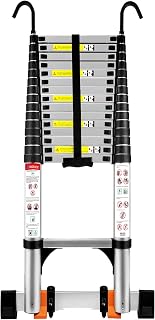
Telescoping Ladder with Hooks, 20.3 FT
The most complete single purchase for a two-storey house, pairing real reach with an integrated stabilizer, wheels, and auto-lock rungs. Extend and retract it slowly and deliberately the first few times; once the rhythm is learned, it is a genuinely convenient ladder to own.
Telescoping A-Frame Ladder, 16.5 FT with Stabilizer Bar
The A-frame mode is the differentiator, letting you work free-standing over a driveway or patio where nothing solid exists to lean against. Best suited to bungalows, conservatory gutters, and interior jobs rather than tall two-storey elevations.
Multi-Position Telescoping Ladder with Wheels, 17 FT
Five configurations mean this covers gutters, stairwells, and scaffold-style plank work from one storage footprint, which is why it earns its keep for general DIY households. Verify every hinge lock has clicked fully home before loading it — the convenience is only as good as that habit.
Heavy Duty Steel Ladder Stabilizer with Anti-Slip Rubber Feet
A straightforward, steel-built standoff for anyone who already owns a sound extension ladder and simply needs to stop crushing the guttering. The rubber feet protect siding and resist lateral slip, and the widened stance noticeably reduces the ladder’s tendency to twist as you reach sideways.
Frequently Asked Questions
Do I really need a stabilizer, or can I just avoid leaning on the gutter?
You need one. Without a standoff you are either resting on the gutter itself or overreaching from a ladder set too far back, and both compromises significantly raise your risk of a fall.
Are telescoping ladders safe for regular use?
Reputable models with auto-lock rungs and a 300 lb-plus rating are safe when fully extended and correctly locked. Never use one partially extended unless the design explicitly allows it, and inspect the rungs for grit before each use.
What angle should the ladder sit at?
Roughly 75 degrees — one unit out from the wall for every four units of height. Feet on firm, level ground, and never on soft turf after rain.
How often should gutters be cleared?
Twice yearly for most homes, and after heavy leaf fall if you have mature trees. Regular short sessions are far safer than one annual battle with compacted debris.
Final Thoughts
If you want one purchase that solves the problem outright, the Telescoping Ladder with Hooks, 20.3 FT delivers the reach and built-in stability most houses require. Homeowners with a serviceable extension ladder already should simply add the Heavy Duty Steel Ladder Stabilizer, while anyone working on a genuinely pitched roof will appreciate the Ladder Roof Hook with Wheel. Choose properly, clear the gutters before the wet season, and enjoy the rain as background noise rather than a reason to lie awake.