Key takeaways
- Capacity with headroom: Treat the stated rating as a ceiling, not a target. For two adults who intend to nap rather than perch, look for 450 lbs or more — the extra margin keeps fabric taut and steel quiet.
- Length and lay angle: A nine-foot stand lets a gathered-end hammock hang near 30 degrees, which is what allows you to lie diagonally and get almost flat. Short frames force a deep U, and a deep U compresses the shoulders.
- Spreader bar or gathered end: Hardwood spreader bars hold the bed open and make entry easy — better for reading, side-by-side lounging, and anyone with mobility limits. Gathered ends cradle more securely and are the safer bet for genuine sleep.
- Light control: Daytime rest comes easiest when your eyes are shaded but your skin still reads ambient daylight. A canopy handles this cleanly; without one, plan around a tree line, umbrella, or eye mask.
- Setup and mobility: Tool-free hardware and a carry bag decide whether the hammock follows the shade at 3 p.m. or stays put and goes unused. Weigh frame heft honestly against how often you will move it.
What's inside
Most people shop for a hammock the way they shop for a throw pillow — by color, by vibe, by how it will photograph on the patio. Then the first real nap happens and the problems surface: a frame that creaks with every shift, a curve so deep it folds the spine into a banana, or a weight rating that quietly rules out a second person. For an hour or two at a time, a hammock is a sleep surface, and it deserves roughly the scrutiny you would give a mattress.
This guide evaluates freestanding hammocks through a rest-quality lens: how the frame controls sag, whether the lay is flat enough to protect your lower back, how much shade you can get over your eyes, and what it takes to move the setup when the sun shifts. Below are the models worth your attention in 2026, plus a short framework for matching one to your body, your yard, and the kind of rest you are actually after.
As an Amazon Associate we earn from qualifying purchases.


🛒 Best Price Today on Amazon
Prime members get fast, free shipping on everything above, plus member-only deals. New members get a 30-day free trial — cancel anytime.
How to Choose a Hammock With Stand (2026)
- Capacity with headroom: Treat the stated rating as a ceiling, not a target. For two adults who intend to nap rather than perch, look for 450 lbs or more — the extra margin keeps fabric taut and steel quiet.
- Length and lay angle: A nine-foot stand lets a gathered-end hammock hang near 30 degrees, which is what allows you to lie diagonally and get almost flat. Short frames force a deep U, and a deep U compresses the shoulders.
- Spreader bar or gathered end: Hardwood spreader bars hold the bed open and make entry easy — better for reading, side-by-side lounging, and anyone with mobility limits. Gathered ends cradle more securely and are the safer bet for genuine sleep.
- Light control: Daytime rest comes easiest when your eyes are shaded but your skin still reads ambient daylight. A canopy handles this cleanly; without one, plan around a tree line, umbrella, or eye mask.
- Setup and mobility: Tool-free hardware and a carry bag decide whether the hammock follows the shade at 3 p.m. or stays put and goes unused. Weigh frame heft honestly against how often you will move it.
The Best Hammocks With Stands (2026), Reviewed
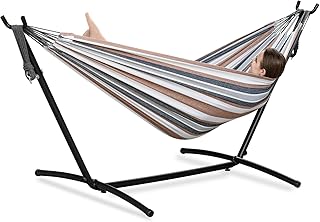
Double Hammock with Stand, 450 lbs (Coffee)
A 450-pound rating across a nine-foot heavy-duty steel frame delivers the stability profile I want in a two-person nap setup, while the space-saving footprint suits narrow patios and balconies. The muted coffee finish also earns its keep indoors, where a loud stripe tends to read as camping gear in a living room.
ANAGOO Double Hammock with Stand, 500 lbs
The 500-pound capacity is the highest in this group, and the included balance strap is the detail that matters most: it curbs the side-to-side tipping that jolts light sleepers awake right as they drift off. Tool-free assembly gets it usable within minutes of unboxing.
Lucania Portable Hammock with Stand and Canopy
The canopy makes this the strongest option for real daytime sleep, shading the eyes without sealing you off from moving air. Its 290-pound limit marks it as a solo hammock, and the foldable frame packs down for camping and travel.
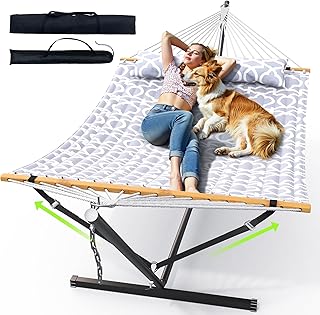
Two Person Hammock with Stand, 475 lbs (Blue Pattern)
The hardwood spreader bar keeps the bed flat and open — the right call if you have a stiff back or dislike the enclosed feel of a gathered hammock. Its pillow is substantial enough to hold the neck neutral rather than chin-to-chest.
Double Hammock with Stand Included (Blue Stripes)
A straightforward pairing of hammock, stand, and oversized pillow for buyers who want one box and no decisions. Best suited to casual afternoon rest rather than nightly sleep, and it shifts easily between deck and lawn.
Frequently Asked Questions
Is it healthy to sleep in a hammock overnight?
For most adults, occasional overnight hammock sleep is fine as long as you lie diagonally so the spine stays close to neutral. Anyone with existing back, hip, or shoulder issues should keep sessions short and check with a clinician before making it routine.
Does rocking actually help you fall asleep faster?
Small sleep-lab studies suggest slow, gentle rocking shortens sleep onset and deepens slow-wave sleep by nudging brain rhythms through the vestibular system. The effect relies on steady, low-amplitude motion — one more argument for a stand that does not wobble.
How much space does a hammock with stand need?
Budget ten to eleven feet of length for a nine-foot frame, plus roughly four feet of width and a couple of feet of clearance at each end for entry and swing. Measure first; the footprint catches people out more often than the weight does.
Can I leave the stand outdoors year-round?
Powder-coated steel handles the seasons reasonably well, but fabric does not. Bring the hammock in after use and cover or store the frame through winter and long wet spells — UV and standing moisture age both far faster than daily use.
Final Thoughts
If restorative sleep is the goal, the ANAGOO 500 lbs model is the most reassuring platform here, combining high capacity with motion that stays smooth rather than jittery. The Lucania with canopy is the pick for anyone who naps in open sun, while the 450 lbs Coffee stand is the best-looking compromise for a compact patio that migrates indoors come winter.