Key takeaways
- Match the height to the job, not the budget: Reach height is roughly your ladder’s top standing platform plus about four feet. A three- or four-step stool handles closets, wardrobes and pantry shelves; an 8-foot working height covers most ceiling fixtures and smoke detectors; only go to 14–19 feet if you genuinely work outdoors.
- Treat the weight rating as a safety margin, not a limit: Add your body weight plus tools, paint, or a bulky bedding bag. Ratings of 300 lbs (Type IA) and up give you headroom, and the 660–900 lbs steel stools are reassuringly overbuilt for indoor use.
- Check folded depth before you check anything else: A ladder you have to wrestle out of the garage won’t get used. Slim profiles around 3–4 inches slide behind a door, into a wardrobe gap, or under a platform bed — which is the whole point of foldable.
- Prioritise locking mechanisms and a handrail: Positive safety locks that click audibly, plus a grab rail or handhold, matter more than any spec sheet number. Most household ladder injuries come from mis-stepping or a frame that shifts, not from exceeding capacity.
- Look at pedal width and foot grip: Wide, anti-slip pedals let you stand comfortably for several minutes without foot fatigue — essential for fiddly jobs like fitting curtain track or rewiring a fixture. Rubber non-marring feet protect hardwood and keep the base planted.
What's inside
Most people don’t buy a ladder until something forces the issue: the smoke-detector chirp at 2 a.m., the winter duvet stranded on the top shelf of the closet, the light fixture above the stairwell that has been dim for a year. I spend my working life on sleep environments, and I’ve lost count of how many bedrooms I’ve walked into where the real obstacle to better rest wasn’t the mattress — it was the storage the homeowner couldn’t safely reach. Blackout curtains stay in the box. Seasonal bedding lives on the floor. The bulb that’s too blue for evenings never gets swapped for a warm one. Clutter and unfinished jobs are quietly corrosive to the wind-down process, and a wobbly kitchen chair is not the fix.
This guide is written for that reality. Below you’ll find the foldable ladders I’d actually recommend for a home in 2026 — models that store flat in a closet or under a bed frame, hold real weight without flexing, and lock positively so you’re not bracing yourself every time you shift your feet. I’ve weighted the picks toward indoor practicality first (closets, pantries, ceiling fixtures, bedroom shelving) and then toward the multi-position aluminium designs worth owning if you also handle gutters, roof access, or stairwell work yourself.
As an Amazon Associate we earn from qualifying purchases.




🛒 Best Price Today on Amazon
Prime members get fast, free shipping on everything above, plus member-only deals. New members get a 30-day free trial — cancel anytime.
How to Choose a Foldable Ladder (2026)
- Match the height to the job, not the budget: Reach height is roughly your ladder’s top standing platform plus about four feet. A three- or four-step stool handles closets, wardrobes and pantry shelves; an 8-foot working height covers most ceiling fixtures and smoke detectors; only go to 14–19 feet if you genuinely work outdoors.
- Treat the weight rating as a safety margin, not a limit: Add your body weight plus tools, paint, or a bulky bedding bag. Ratings of 300 lbs (Type IA) and up give you headroom, and the 660–900 lbs steel stools are reassuringly overbuilt for indoor use.
- Check folded depth before you check anything else: A ladder you have to wrestle out of the garage won’t get used. Slim profiles around 3–4 inches slide behind a door, into a wardrobe gap, or under a platform bed — which is the whole point of foldable.
- Prioritise locking mechanisms and a handrail: Positive safety locks that click audibly, plus a grab rail or handhold, matter more than any spec sheet number. Most household ladder injuries come from mis-stepping or a frame that shifts, not from exceeding capacity.
- Look at pedal width and foot grip: Wide, anti-slip pedals let you stand comfortably for several minutes without foot fatigue — essential for fiddly jobs like fitting curtain track or rewiring a fixture. Rubber non-marring feet protect hardwood and keep the base planted.
The Best Foldable Ladders (2026) Reviewed
Little Giant Velocity 18 ft with Leg Levelers
This is the reference-grade choice: a Type IA multi-position aluminium ladder that converts between A-frame, extension, staircase and 90-degree configurations, with integrated leg levelers that solve uneven driveways and garden beds. It’s an investment and it’s heavy, but if you maintain your own home end to end, it replaces three separate ladders.
Bryner 19.6 ft 7-in-1 Telescoping Ladder
Bryner’s 7-in-1 design offers similar versatility to premium multi-position ladders at a considerably lower entry point, with a 330 lb rating and telescoping sections that collapse into a manageable bundle. Take the time to learn the locking hinges properly — used deliberately, it’s a genuinely capable outdoor and stairwell ladder.
LANBITOU 4-Step A-Frame Extension Ladder, 14 ft
The sweet spot for most houses: it works as a stable four-step A-frame for indoor jobs, then extends to 14 feet for gutters or a roof edge, and folds down small enough for a hall cupboard. Anti-slip feet and multi-position hinges make it the most useful single ladder here for a mixed indoor-outdoor workload.
5-Step Heavy Duty Steel Ladder with Handrail & Tool Tray
Five steel steps, a 660 lb capacity, a folding handrail and a tool tray — this is the one I’d put in a utility room or garage for painting, ceiling work and library shelving. Its 3.74-inch folded depth is the standout detail, letting a substantial ladder disappear into a narrow gap.
KINGRACK 4 Step Folding Ladder
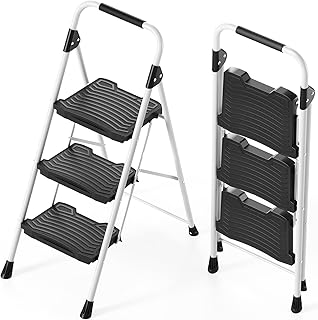
The best everyday household pick: light enough to carry one-handed between rooms, rated to 800 lbs, with wide non-skid pedals, a handrail and a positive safety lock. In clean white it looks at home in a kitchen or bedroom rather than something you need to hide.
Frequently Asked Questions
What ladder height do I actually need indoors?
For standard 8-foot ceilings, a three- or four-step stool reaches fixtures and smoke detectors comfortably. With 9- or 10-foot ceilings, or a stairwell landing, step up to a five-step model or a multi-position ladder.
Is aluminium or steel better for a foldable ladder?
Aluminium wins on weight and is the standard for tall telescoping and multi-position ladders. Steel is heavier but feels rock-solid underfoot and typically carries higher capacity ratings, which suits a stool that lives indoors and rarely moves far.
Can I store a foldable ladder in a bedroom?
Yes, and slim-folding steel stools around 4 inches deep are made for it — behind a door, in a wardrobe, or flat under a bed frame. Keep it out of your visual field from the bed; a calm, uncluttered sightline genuinely supports easier sleep onset.
How often should I inspect a folding ladder?
Give it a quick look before each use: check that locks engage fully, feet are intact, and no rivets or hinges are loose. Retire any ladder with a bent rail, cracked step, or a lock that no longer clicks decisively.
Final Thoughts
If you want one ladder that handles everything, the Little Giant Velocity is the durable, properly engineered answer, with the LANBITOU 4-Step A-Frame offering most of that flexibility for far less. For pure indoor use — reaching the seasonal bedding, changing a bulb to something warmer in the evening, finally hanging those blackout curtains — the KINGRACK 4 Step is the ladder you’ll actually reach for, and that’s the one that ends up improving your home, and your rest, the most.