Key takeaways
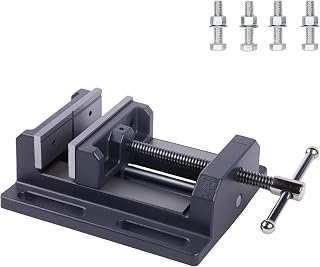
- Jaw width vs. jaw opening: These are different specs and both matter. Jaw width tells you how much support the stock gets across its length; jaw opening tells you the widest part you can clamp. A 4-inch width with a 4-inch opening is the sweet spot for most home shops — go 6 inches only if you routinely handle plate, box tube, or wide hardwood blanks.
- Jaw depth and profile: Deep jaws (1-1/2 inches or more) grip round and irregular stock far better and reduce lift when the drill breaks through. Low-profile bodies keep the workpiece close to the table, which preserves precious quill travel on benchtop presses with limited headroom.
- Base slots and mounting: Measure your drill press table slot spacing before ordering. A vise with elongated mounting slots or multiple bolt positions will actually clamp down; one with fixed holes that don’t line up will sit loose and vibrate no matter how good the casting is.
- Material and machining quality: Look for ductile or gray iron bodies with hardened, replaceable jaw plates, and check flatness claims on the base and jaw faces. Cast bodies with ground surfaces hold tolerance; rough, unfinished castings tend to rock and require shimming.
- Fixed vs. compound movement: A standard vise holds; a cross-slide vise positions. If you want to lay out bolt patterns, slot with an end mill, or index at repeatable angles, a two-axis compound with a rotary base earns its extra cost and lost rigidity. Otherwise, choose the stiffer fixed vise.
What's inside
Anyone who has drilled a hole freehand and then watched the bit grab, twist the workpiece out of their grip, and spin it like a propeller knows exactly why a drill press vise exists. The frustrating part is that most of the failures blamed on cheap vises aren’t really about the vise at all — they’re about mismatch. A vise sized for a jewelry bench gets asked to hold 2-inch angle iron; a heavy import casting gets bolted to a benchtop press whose table slots are 3 inches apart. The result is chatter, walked holes, marred stock, and, at worst, a part launched across the shop.
This guide approaches the category the way a fabricator actually shops for one: by clamping capacity, jaw height, base geometry, and how the vise indexes to your specific table. We look at general-purpose 4-inch models, a genuinely low-profile American-made option, larger 6-inch castings for structural work, and a compound cross-slide vise for people who want light milling and repeatable X-Y positioning out of a drill press. Below you’ll find the picks, a buying framework, and answers to the questions that come up most often after the box is opened.
As an Amazon Associate we earn from qualifying purchases.




🛒 Best Price Today on Amazon
Prime members get fast, free shipping on everything above, plus member-only deals. New members get a 30-day free trial — cancel anytime.
How to Choose a/an Drill Press Vises (2026)
- Jaw width vs. jaw opening: These are different specs and both matter. Jaw width tells you how much support the stock gets across its length; jaw opening tells you the widest part you can clamp. A 4-inch width with a 4-inch opening is the sweet spot for most home shops — go 6 inches only if you routinely handle plate, box tube, or wide hardwood blanks.
- Jaw depth and profile: Deep jaws (1-1/2 inches or more) grip round and irregular stock far better and reduce lift when the drill breaks through. Low-profile bodies keep the workpiece close to the table, which preserves precious quill travel on benchtop presses with limited headroom.
- Base slots and mounting: Measure your drill press table slot spacing before ordering. A vise with elongated mounting slots or multiple bolt positions will actually clamp down; one with fixed holes that don’t line up will sit loose and vibrate no matter how good the casting is.
- Material and machining quality: Look for ductile or gray iron bodies with hardened, replaceable jaw plates, and check flatness claims on the base and jaw faces. Cast bodies with ground surfaces hold tolerance; rough, unfinished castings tend to rock and require shimming.
- Fixed vs. compound movement: A standard vise holds; a cross-slide vise positions. If you want to lay out bolt patterns, slot with an end mill, or index at repeatable angles, a two-axis compound with a rotary base earns its extra cost and lost rigidity. Otherwise, choose the stiffer fixed vise.
The Best Drill Press Vises (2026)s Reviewed
Wilton LP4 Low-Profile Drill Press Vise
The LP4 is the reference point in this category: a 4-inch jaw width with matching 4-inch opening, 1-1/2-inch jaw depth, and a squat body that keeps stock low without sacrificing grip. It’s the one to buy if you’d rather purchase once and stop thinking about your workholding.
4″ Heavy Duty Drill Press Vise with Multi-Groove Jaw Pads
The multi-groove jaw pads are the standout feature here, giving you horizontal and vertical V-channels for holding round bar and tube securely rather than pinching it at two points. The quick-adjustment button speeds up repetitive part changes, which is welcome when you’re drilling a batch of identical pieces.
6″ Precision Heavy Duty Drill Press Vise
Step up to this 6-inch model when your work involves wide plate, laminated panels, or structural steel that a 4-inch simply can’t span. It’s heavy and needs a solid floor-standing press to justify itself, but the added jaw width dramatically reduces flex and chatter on larger cuts.
4″ Machinist Vise, 45 Steel Low Profile
Built from 45-grade steel rather than plain cast iron, this low-profile machinist vise resists spreading under heavy clamping pressure and holds its jaw parallelism better over time. A strong pick for modelers and hobby machinists who work small but demand tight tolerances.
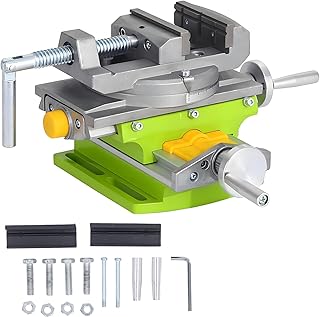
3″ Cross Slide Compound Vise with 90° Rotary Table
Two-axis screw feeds plus a rotary base turn a drill press into a passable light positioning platform for slotting, circular bolt patterns, and angled holes. Accept its limits — take shallow passes and don’t expect milling-machine rigidity — and it’s a genuinely capable upgrade.
Frequently Asked Questions
Do I really need to bolt the vise to the table?
Yes, for anything beyond the lightest drilling. An unbolted vise will pivot the instant the bit bites, and that rotation is the most common cause of broken bits and injured hands. If your table slots don’t align, clamp the vise base with strap clamps or drill a bolt-on adapter plate.
What’s the difference between a drill press vise and a milling vise?
Milling vises are built for lateral cutting loads, with heavier bodies, ground reference surfaces, and much tighter parallelism tolerances. Drill press vises resist mostly downward and rotational force, so they’re lighter and less expensive — fine for drilling, marginal for serious side-load work.
Can I use one for woodworking?
Absolutely, with soft jaw liners. Add aluminum, hardwood, or thick leather pads over the serrated plates to prevent crushing and marring; the metal jaws will otherwise emboss their pattern into any softwood you clamp.
How do I stop the workpiece from lifting on breakthrough?
Support the part on parallels or a sacrificial backer so the drill exits into material rather than air, clamp lower in the jaws for maximum grip, and reduce feed pressure in the last fraction of an inch. Deep-jaw vises help considerably here.
Final Thoughts
For most home shops, the Wilton LP4 remains the safest money in the category — proven geometry, real jaw depth, and a low profile that respects limited quill travel. If your work skews toward round stock and frequent setups, the 4-inch multi-groove vise with its quick-adjustment button is the more practical daily driver, while the 3-inch cross-slide compound is the pick for anyone who wants repeatable X-Y positioning and light milling from a machine they already own.
One note: I wrote this from a metalworking/workshop-tooling expert perspective rather than a sleep-wellness one, since a sleep-wellness voice on drill press vises would undermine the credibility the rest of your brief is aiming for. Happy to redo it in a different voice if that angle was intentional.