Key takeaways
- Compressor noise and cycling behavior: Every unit in this price bracket runs a small compressor that kicks on in intervals rather than continuously. Expect roughly 40–48 dB — comparable to a quiet refrigerator. What matters more than the peak figure is the abruptness of the on-cycle, which is what rouses sleepers. If your kitchen shares a wall with a bedroom, run the machine in the early evening and switch it off before you turn in.
- Indicator lights and displays: Bright blue or white LEDs are the most common oversight in this category. Blue-wavelength light is the most suppressive of melatonin, and a machine sitting in an open-plan kitchen effectively becomes a night light. Look for dimmable panels or plan on a small piece of electrical tape.
- Cycle speed versus reservoir size: Nine bullet cubes in six to eight minutes is the standard claim, with 26 lbs over 24 hours as the theoretical ceiling. For evening use you rarely need more than one or two baskets, so prioritize a reservoir you can fill once and forget over raw daily output.
- Self-cleaning and water quality: Standing water in a warm kitchen builds biofilm within days. A genuine self-clean cycle helps, but it is not a substitute for emptying the reservoir after each session and wiping the basket weekly. Filtered water reduces both mineral scaling and off-flavors.
- Footprint, drainage, and placement: Most units occupy roughly a 9-by-12-inch patch and need several inches of rear clearance for heat exhaust. Confirm you have a nearby sink or floor drain path, because the drain plug releases meltwater with more volume than people anticipate.
What's inside
Most people shopping for a countertop ice maker are thinking about cocktails or iced coffee. In my practice, I think about the last three hours before bed. Core body temperature has to fall roughly one to two degrees for sleep to initiate properly, and a cold drink, an ice pack behind the neck, or a chilled cloth on the wrists is one of the cheapest ways to nudge that process along. The friction is logistical: freezer trays are always empty when you want them, refrigerator dispensers grind loudly enough to wake a light sleeper down the hall, and running the kitchen tap at 11 p.m. tends to pull you back into wakefulness.
A small countertop machine solves that, but only if you choose one that respects the acoustic environment of a house that’s winding down. Below I’ve assessed the strongest sub-$100 options for 2026 with an emphasis on compressor noise, indicator-light brightness, cycle timing, and water hygiene — the four variables that actually determine whether one of these units supports your evening routine or quietly sabotages it. All six machines share a similar spec sheet on paper; they diverge meaningfully in how they behave at night.
As an Amazon Associate we earn from qualifying purchases.


🛒 Best Price Today on Amazon
Prime members get fast, free shipping on everything above, plus member-only deals. New members get a 30-day free trial — cancel anytime.
How to Choose a Countertop Ice Maker Under $100 (2026)
- Compressor noise and cycling behavior: Every unit in this price bracket runs a small compressor that kicks on in intervals rather than continuously. Expect roughly 40–48 dB — comparable to a quiet refrigerator. What matters more than the peak figure is the abruptness of the on-cycle, which is what rouses sleepers. If your kitchen shares a wall with a bedroom, run the machine in the early evening and switch it off before you turn in.
- Indicator lights and displays: Bright blue or white LEDs are the most common oversight in this category. Blue-wavelength light is the most suppressive of melatonin, and a machine sitting in an open-plan kitchen effectively becomes a night light. Look for dimmable panels or plan on a small piece of electrical tape.
- Cycle speed versus reservoir size: Nine bullet cubes in six to eight minutes is the standard claim, with 26 lbs over 24 hours as the theoretical ceiling. For evening use you rarely need more than one or two baskets, so prioritize a reservoir you can fill once and forget over raw daily output.
- Self-cleaning and water quality: Standing water in a warm kitchen builds biofilm within days. A genuine self-clean cycle helps, but it is not a substitute for emptying the reservoir after each session and wiping the basket weekly. Filtered water reduces both mineral scaling and off-flavors.
- Footprint, drainage, and placement: Most units occupy roughly a 9-by-12-inch patch and need several inches of rear clearance for heat exhaust. Confirm you have a nearby sink or floor drain path, because the drain plug releases meltwater with more volume than people anticipate.
The Best Countertop Ice Makers Under $100 (2026), Reviewed
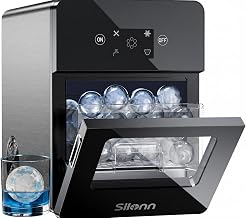
Silonn Portable Ice Maker
The most consistently well-behaved machine in this group, with an even cycle rhythm that fades into background noise rather than startling you. The recessed carry handle also makes it realistic to relocate the unit away from bedroom walls when you’re using it late.
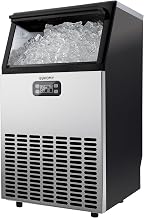
Crzoe Countertop Ice Maker
The black housing and restrained control panel make this the least visually intrusive option here, which is a genuine advantage in a kitchen that stays partially lit at night. Eight bullet cubes in roughly six minutes is more than adequate for a nightly wind-down ritual.
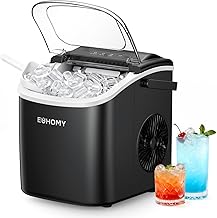
EUHOMY Countertop Ice Maker
EUHOMY has the most reliable self-clean implementation at this price, and the two bullet sizes are practically useful — smaller cubes chill a glass of water fast, larger ones hold up in a compress. A solid default recommendation for most households.
Antarctic Star Ice Maker Machine
Positioned around energy efficiency, which translates into slightly shorter compressor runs and correspondingly less cumulative noise across an evening. Worth considering if the machine will live in a studio apartment or an RV where sleeping and cooking space overlap.
OLIXIS Countertop Ice Maker
A straightforward, no-surprises unit with an auto-clean function and both cube sizes, hitting nine cubes in about six minutes. The simplest interface of the group, which means fewer illuminated elements competing for your attention after dark.
Frequently Asked Questions
Will a countertop ice maker keep me awake?
Only if it runs while you sleep. These machines are quiet enough for daytime and evening use, but the compressor’s intermittent starts are exactly the kind of irregular sound that fragments light sleep. Fill the basket during your evening routine, then power the unit down.
Does cold water before bed actually help sleep?
Indirectly. Cooling your skin and extremities encourages the peripheral heat loss that precedes sleep onset. A cold drink or a chilled compress can help, particularly for people who run hot at night, though it won’t override caffeine, alcohol, or an erratic schedule.
How long does the ice last inside the machine?
These are makers, not freezers — ice begins melting back into the reservoir within an hour or two. Transfer what you need to the freezer, or make ice on demand shortly before you want it.
How often should I clean it?
Run the self-clean cycle weekly, empty and dry the reservoir after each session, and descale monthly if you have hard water. Neglected reservoirs produce cloudy, musty ice surprisingly quickly.
Final Thoughts
For most homes, the EUHOMY is the sensible pick thanks to its dependable self-cleaning and sensible dual cube sizes, while the Silonn earns the nod for the smoothest, least disruptive compressor behavior — the one I’d choose if the kitchen sits near a bedroom. If your priority is a machine that disappears visually and acoustically into a small shared space, the Antarctic Star’s energy-conscious design makes it the third option worth your attention.