Key takeaways
- Measure clearance before capacity: Add your lower vehicle’s roof height, the runway or platform thickness, and the upper vehicle’s total height. A 10-foot ceiling is comfortable for two sedans; storing a truck or SUV on top realistically wants 12 feet or more.
- Verify your slab, not your ambition: Four-post lifts spread load across four plates and are the friendliest to older concrete, while two-post and scissor designs concentrate force. Four inches of 3,000 PSI concrete is the common baseline — core-sample or consult a contractor if the pour is unknown.
- Match the design to the actual job: Four-post lifts are drive-on parking structures that excel at long-term storage. Two-post and portable scissor lifts leave wheels hanging free for suspension and brake work but are not designed to hold a car aloft for months.
- Respect the noise footprint: Hydraulic power units are brief but genuinely loud, and structure-borne vibration travels through a shared slab into bedrooms above. Plan on daytime use, isolate the pump with rubber mounting pads, and keep the unit off any wall backing a sleeping area.
- Check power and safety hardware: Confirm 110V versus 220V against your panel, and insist on multi-position mechanical locks, secondary slack-cable safeties, and a documented warranty. Locks — not hydraulic pressure — are what hold the vehicle overnight.
What's inside
Most home garages hit the same wall: one bay, two vehicles, and a project car or seasonal convertible that ends up parked outside under a tarp. Stacking vertically is the only honest fix, but the decision is intimidating — you are bolting a multi-ton machine to a slab, often directly beneath the bedrooms where your family sleeps. Buyers worry about ceiling clearance, concrete thickness, whether the pump will shriek at 11 p.m., and whether a “portable” lift is genuinely movable or just heavy on casters.
This guide approaches the problem from a habitability standpoint as much as a mechanical one: how tall the lift actually stands with a truck on it, how much slab it needs, how loud the power unit is when the garage shares a wall or floor with living space, and how each design behaves during long-term storage rather than quick service jobs. Below you will find the models worth shortlisting for 2026, a selection framework, and answers to the questions that come up after the freight truck leaves.
As an Amazon Associate we earn from qualifying purchases.



🛒 Best Price Today on Amazon
Prime members get fast, free shipping on everything above, plus member-only deals. New members get a 30-day free trial — cancel anytime.
How to Choose a Car Storage Lifts For Home Garage (2026)
- Measure clearance before capacity: Add your lower vehicle’s roof height, the runway or platform thickness, and the upper vehicle’s total height. A 10-foot ceiling is comfortable for two sedans; storing a truck or SUV on top realistically wants 12 feet or more.
- Verify your slab, not your ambition: Four-post lifts spread load across four plates and are the friendliest to older concrete, while two-post and scissor designs concentrate force. Four inches of 3,000 PSI concrete is the common baseline — core-sample or consult a contractor if the pour is unknown.
- Match the design to the actual job: Four-post lifts are drive-on parking structures that excel at long-term storage. Two-post and portable scissor lifts leave wheels hanging free for suspension and brake work but are not designed to hold a car aloft for months.
- Respect the noise footprint: Hydraulic power units are brief but genuinely loud, and structure-borne vibration travels through a shared slab into bedrooms above. Plan on daytime use, isolate the pump with rubber mounting pads, and keep the unit off any wall backing a sleeping area.
- Check power and safety hardware: Confirm 110V versus 220V against your panel, and insist on multi-position mechanical locks, secondary slack-cable safeties, and a documented warranty. Locks — not hydraulic pressure — are what hold the vehicle overnight.
The Best Car Storage Lifts For Home Garage (2026)s Reviewed
KATOOL 9500 lb Four-Post Car Lift
This is the well-rounded home-garage benchmark: 9,500 pounds of capacity, an 84-inch maximum height, and a 110V, 3.0 HP unit that runs off a standard circuit without an electrician. The included caster kit, oil drip tray, and jack tray mean it functions as both a parking deck and a service platform out of the box.
XK 4-Post Portable Parking Lift, 8,000 lb
Built around genuine mobility, the XK rolls on integrated wheels so you can reposition it seasonally or clear the bay entirely for a project. Capacity is ample for most trucks and SUVs, and the 110V pump keeps installation requirements refreshingly modest for a lift of this footprint.
11,000 lb Extra-Tall & Wide Four-Post Lift
Choose this one if your upper vehicle is a dually, a lifted pickup, or anything with an unusually wide track — the extended runway spacing solves problems narrower lifts create. The 84-inch lift height and 3.0 HP hydraulic system provide real headroom underneath, and the 12-month warranty covers the shake-out period.
VEVOR Portable Car Lift, 5,000 lb
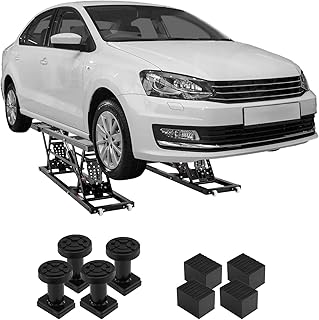
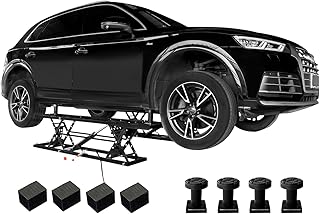
A low-profile scissor design with extended-length plates, this is the pragmatic choice for garages with standard ceilings where full stacking is off the table. At 25.6 inches of travel and 120V power it is a maintenance and detailing tool first, and it stores flat against a wall when idle.
Portable Two-Post Car Lift, 8,000 lb
With adjustable height to 51.3 inches and a 220V electric lock system, this lift delivers the open-wheel access that four-post designs cannot, making it the better companion for suspension and brake work. Budget for the dedicated 220V circuit, and treat it as a service lift rather than a long-term storage solution.
Frequently Asked Questions
How much ceiling height do I really need?
For two average sedans, roughly 10 feet works. Add height for SUVs and trucks — many owners find 12 to 13 feet necessary once platform thickness and roof racks enter the calculation. Measure to the lowest obstruction, including garage door tracks and opener rails.
Do I need to bolt the lift to the floor?
Four-post storage lifts are frequently used freestanding on level, adequate concrete, which is what makes them portable — but always follow the manufacturer’s instructions. Two-post lifts must be anchored without exception.
Is it safe to leave a car up for months?
On a four-post lift resting on its mechanical locks, yes. Lower it fully every few months to inspect cables, sheaves, and lock engagement, and never rely on hydraulic pressure alone to support a parked vehicle.
Will the lift disturb sleep in rooms above the garage?
The lift itself is silent once locked; the pump is the culprit, and it typically runs under a minute. Mount the power unit on rubber isolators, keep it away from shared walls, and confine cycles to waking hours.
Final Thoughts
For most homeowners, the KATOOL 9500 lb four-post lift is the smartest all-around buy — 110V simplicity, generous height, and storage plus service capability in one package. Truck owners and wide-track vehicles should step up to the 11,000 lb extra-tall model, while anyone constrained by a standard ceiling will get more practical use out of the VEVOR portable scissor lift than from a stacker they cannot fit.