Key takeaways
- An indoor air monitor is a measuring device, not a cleaner, and that changes how you shop.
An indoor air monitor is a measuring device, not a cleaner, and that changes how you shop. The best air quality monitor under 150 dollars is the one whose sensors match the problem you are trying to see: a stuffy home office points to carbon dioxide, a freshly painted nursery points to VOCs and formaldehyde, and a kitchen next to a gas range points to fine particles. Buying the wrong sensor set means staring at a screen full of numbers that do not answer your question.
This guide is for people who want a countertop or desk monitor in 2026 without paying for lab-grade hardware. It works only from the sensor lists in the product titles, and it flags where the numbers are best treated as trends rather than exact measurements. One listing in the original set was a retailer-branded smart monitor that duplicated the Alexa-style use case covered by the GoveeLife pick, so it is left out and six distinct options are compared instead.
Quick Picks
Our top picks




As an Amazon Associate we earn from qualifying purchases at no extra cost to you.
| Product | Best for | Key spec from the title |
|---|---|---|
| 6-in-1 CO2 HCHO TVOC monitor | Portable use in rooms and cars | USB rechargeable, LCD, CO2, HCHO, TVOC |
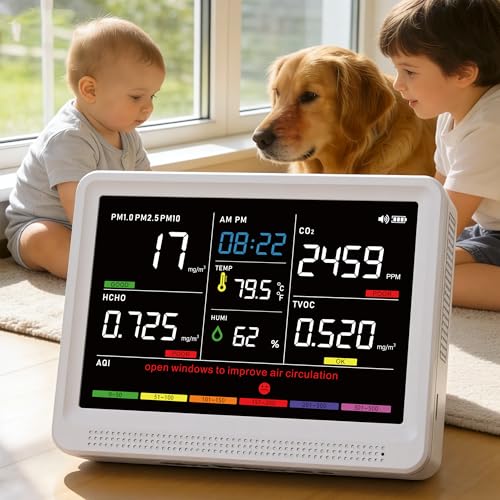
| 16-in-1 HD color screen monitor | Most readings per unit | CO2, PM1.0, PM2.5, PM10, HCHO, TVOC, USB-C |
| 10-in-1 data logging monitor | Tracking changes over days | Data logging, AQI grading, particles and CO2 |
| Temtop particle counter | Dust and smoke focus | PM2.5, PM10, formaldehyde, TVOC |
| GoveeLife smart monitor H5106 | Smart home users | PM2.5, 2 second refresh, 2-year data storage |
| Temtop CO2 monitor | Offices and classrooms | CO2, temperature, humidity, portable |
How to Choose
Decide which pollutant you actually worry about
Carbon dioxide tells you about ventilation: readings above roughly 1000 parts per million usually mean a room needs fresh air. Particulate sensors (PM2.5 and PM10) track smoke, dust, and cooking haze. TVOC and formaldehyde (HCHO) relate to furniture, paint, and cleaning products. A monitor that lists all of them is convenient, but a focused one often does its single job more steadily and with a simpler screen. Before you shop, write down the one symptom or situation that started the search, such as headaches in a closed office or a smell after new carpet, and pick the sensor that speaks to it.
Read sensor claims carefully
“16-in-1” counts readings, not sixteen different sensors. Temperature, humidity, and AQI are often derived from the same chips, and PM1.0, PM2.5, and PM10 usually come from one laser particle sensor. Count the physical measurements instead: CO2, particulates, TVOC, HCHO. Also look for whether CO2 comes from a true NDIR sensor; if the title does not say so, confirm on the listing, because cheaper estimators can mislead. Auto calibration, which appears in some titles, helps a unit settle on fresh-air baselines, but it works best if you air the room out occasionally so the monitor sees clean air.
Display, power, and logging
A color screen is readable from across a room, while a plain LCD is fine at arm’s length on a desk. USB-C rechargeable units move between rooms and into a car, whereas wired units stay put but never need charging. Data logging or long storage matters if you want to catch a pattern, such as CO2 climbing every night in a bedroom with the door shut, and it is worth confirming how the history is viewed or exported. Also think about the refresh interval: a monitor that updates every couple of seconds shows a cooking spike immediately, while a slow one smooths it out and can hide short events.
Where budget monitors cut corners
Low-cost formaldehyde and TVOC sensors drift over time and react to hand sanitizer, perfume, and cooking vapor. They are good for seeing a spike and poor for proving an exact figure. Treat any monitor in this tier as an early warning rather than a compliance tool, and use the readings to decide when to open a window or run a purifier, not to make claims about safety. If a reading ever seems alarming, compare it against a second device or move the unit to another room before reacting, because a single sensor in a bad spot can mislead.
The 6 Best Options
6-in-1 CO2 HCHO TVOC monitor
This handheld-style monitor lists carbon dioxide, formaldehyde, TVOC, temperature, and humidity on an LCD, powered by a USB rechargeable battery. The title also calls out use in homes, offices, and cars, which makes it the one to carry from room to room and into a vehicle without hunting for an outlet. It is a sensible first monitor for someone curious about stuffy air and new-furniture smells.
- Strength: portable and rechargeable, so placement is flexible.
- Strength: covers the main gas concerns without particle clutter.
- Trade-off: no particulate readings in the title, so smoke and dust are not covered.
Skip it if cooking haze or wildfire smoke is your main concern, or if you want a large screen you can read from across the couch.
16-in-1 indoor monitor with HD color screen
This unit packs CO2, PM1.0, PM2.5, PM10, HCHO, TVOC, AQI, temperature, and humidity onto one HD color display, with auto calibration, adjustable brightness, and USB-C charging. It is the broadest single-device option in the set and a fit for a buyer who wants every category visible at a glance. The brightness control is a quiet bonus if the monitor will live in a bedroom.
- Strength: gas and particulate sensors together on one screen.
- Strength: adjustable brightness suits sleeping spaces.
- Trade-off: many readings can overwhelm casual users.
Skip it if you only need one measurement and prefer a simpler display. If you do buy it, start by watching CO2 and PM2.5 and ignore the rest until you know what matters in your home.
10-in-1 monitor with data logging
The distinguishing feature here is data logging with AQI grading, alongside CO2, HCHO, TVOC, and PM1.0 through PM10 readings. It fits the buyer who wants to review how the air changed across a week rather than glance at a single number, such as someone trying to show that a bedroom needs better ventilation, or that a renovation is still off-gassing.
- Strength: logging reveals patterns like a nightly CO2 rise.
- Strength: AQI grading gives a quick good-or-bad summary.
- Trade-off: how the data is exported is not stated in the title.
Skip it if you never plan to look at history, since the logging is the main reason to choose this one over a simpler meter. Anyone who does want the logs should confirm the viewing or export method on the listing before ordering.
Temtop particle counter with formaldehyde and TVOC
Temtop’s title leads with PM2.5 and PM10 particle counting, then adds formaldehyde, temperature, humidity, and TVOC, and positions the unit for indoor and outdoor pollution checks. It suits dust, smoke, and renovation concerns where airborne particles are the headline issue, and it is the pick for people who live near traffic or a dusty work area.
- Strength: particle focus suits smoke and dust tracking.
- Strength: formaldehyde sensing helps after new furniture arrives.
- Trade-off: carbon dioxide is not listed, so no warning about stale air.
Skip it if ventilation is your chief concern, since stale air is invisible to a particle counter. A small meeting room or bedroom with the door shut would be better served by a CO2 meter.
GoveeLife smart air quality monitor H5106
This wired model reports PM2.5 with a 2 second refresh and keeps two years of stored data, with an LED display and smart home positioning. Wired power means no battery to charge, and the fast refresh makes cooking and candle spikes visible almost as they happen. It is meant to sit in one spot and quietly build a long history of that room.
- Strength: fast refresh shows particle spikes live.
- Strength: long data storage supports trend watching over seasons.
- Trade-off: PM2.5, temperature, and humidity only, with no CO2 or gas sensing.
Skip it if you want a portable unit, gas readings, or the freedom to carry the device between rooms, since it depends on a wall outlet and a fixed shelf.
Temtop CO2 monitor
A single-purpose meter reporting carbon dioxide, temperature, and humidity, aimed at homes, offices, and schools. Its narrow scope is its appeal: one glance tells you whether to open a window, with nothing else on the screen to interpret or argue about. It is the easiest of the six to explain to a family member or a coworker.
- Strength: portable and focused entirely on ventilation.
- Strength: simple readout suits shared spaces like classrooms.
- Trade-off: nothing about particles or chemicals.
Skip it if you want smoke or VOC tracking, because this one will stay silent about both. Buyers with a gas stove, a dusty workshop, or a freshly renovated room will want a second device or a broader model, and should compare the listed sensors before settling.
Which One Fits Your Situation
A work-from-home office with a closed door
The Temtop CO2 monitor is the direct answer. Ventilation is the issue, CO2 is the number that shows it, and a compact meter can sit on the desk without taking over the room. Glance at it before a long video call, and crack a window when the number climbs.
A new apartment with fresh paint and furniture
Choose the 6-in-1 CO2 HCHO TVOC monitor to follow chemical off-gassing over the first weeks, and carry it between bedrooms to see which room settles first. Check it at the same time each day so the comparisons stay fair, and keep the windows closed for an hour beforehand.
A kitchen open to the living room
The GoveeLife model’s fast PM2.5 refresh helps you see cooking spikes as they happen. If you also want gas readings, the 16-in-1 HD monitor covers both families of pollutant.
A tracker who likes reviewing data
The 10-in-1 logging monitor suits anyone who wants history, such as how bedroom air changes overnight with the door open versus shut.
Common Mistakes
- Counting “in-1” numbers as sensors rather than as listed measurements.
- Placing the monitor next to a window, vent, or stove, which skews what it reads.
- Trusting formaldehyde or TVOC figures as exact values rather than rough indicators.
- Skipping a warm-up period after first power on and judging the first readings.
- Buying a particle-only unit when the actual worry is stale, high-CO2 air.
Related guides
- Wrist Blood Pressure Monitor Under $150
- Pillows For Sleeping On Back And Side
- Memory Foam Pillows For Side Sleepers
Frequently Asked Questions
Do I need a monitor if I already have an air purifier?
A monitor tells you when the purifier is needed and whether the room has a problem a purifier cannot fix, such as high CO2. The two devices do different jobs, and together they make better decisions possible: for example, you can see whether running the purifier on a higher speed actually brings particle readings down, or whether opening a window does more.
Where should I place it?
Put it at breathing height, away from windows, vents, and cooking surfaces. In a bedroom, a nightstand or shelf works well, and in an office a desk corner is usually enough.
Are these readings reliable enough for decisions?
They are fine for noticing changes and deciding when to ventilate. They are not certified instruments, so avoid leaning on them for any formal or health-related decision.
Why does the reading jump when I cook or clean?
Particulate and VOC sensors respond to vapors and aerosols. A spike after cooking or using sprays is normal and usually settles as the air clears and the room is ventilated.
More from Amazon
Programs that pair well with the guide above. Offers and eligibility are set by Amazon and may change.
Collect the home and kitchen items you want in one registry that guests can shop from.
Create a wedding registrySet up recurring deliveries of everyday items on eligible products. Terms and savings are set by Amazon.
Explore Subscribe & SaveFree shipping on eligible items, Prime Video and more. Eligible new members can start with a free trial.
Start a Prime free trialAudiobooks and podcasts to listen to on the go. Eligible new members can start with a free trial.
Try Audible freeAs an Amazon Associate we earn from qualifying purchases.