Key takeaways
- Noise output in decibels: Anything at or under 65 dB is conversational-volume and won’t rattle sleeping children or thin drywall. Above 80 dB, treat it as hearing-protection territory and confine it to detached spaces or daylight hours.
- CFM at 90 PSI: This single number, not horsepower, tells you whether the pump keeps pace. Brad and finish nailers sip roughly 0.3–0.5 CFM; framing and roofing nailers demand two to four times that, and running two guns at once doubles it again.
- Tank capacity versus mobility: A one-gallon tank recovers constantly but is genuinely luggable up stairs. Six-gallon pancakes buffer enough air for sustained bursts; thirteen-gallon units reward you with quiet stretches between cycles but need wheels and floor space.
- Oil-free pump design: For furniture and interior trim, oil-free is the safer choice — no misting onto raw wood or unsealed veneer, no crankcase maintenance, and no seasonal viscosity problems in an unheated garage.
- Max PSI and regulation quality: A 175–200 PSI ceiling means more usable stored air per tank, but a smooth, drift-free regulator is what actually delivers consistent nail depth. Check for dual couplers if a second person will ever be working alongside you.
What's inside
Nothing wrecks a household’s rest quite like a compressor kicking on at 6 a.m. under the bedroom floor. As someone who spends most of my working life studying what disrupts human sleep — and who also spends weekends building bookcases and casing out doorways — I’ve come to see air compressors as a sleep-hygiene issue as much as a tool decision. A framing nailer needs air, but the pump that supplies it can push 90 decibels into your walls, which is roughly a garbage truck idling in the hallway. If you’re finishing trim in a nursery-adjacent room, restoring furniture in a shared garage, or working in an apartment where the neighbor’s headboard shares a stud with your workbench, the noise spec matters as much as the CFM rating.
This guide looks at the best air compressors for nail guns in 2026 through that dual lens: enough air to drive fasteners without stalling, and a sound profile that won’t tax anyone’s nervous system. I’ve grouped picks by realistic use case — quiet indoor finish work, all-day pancake workhorses for framing, and higher-volume units for those who also spray finishes on furniture. Below you’ll find the current standouts, followed by the specs worth understanding before you spend anything.
As an Amazon Associate we earn from qualifying purchases.



🛒 Best Price Today on Amazon
Prime members get fast, free shipping on everything above, plus member-only deals. New members get a 30-day free trial — cancel anytime.
How to Choose a/an Air Compressor For Nail Gun (2026)
- Noise output in decibels: Anything at or under 65 dB is conversational-volume and won’t rattle sleeping children or thin drywall. Above 80 dB, treat it as hearing-protection territory and confine it to detached spaces or daylight hours.
- CFM at 90 PSI: This single number, not horsepower, tells you whether the pump keeps pace. Brad and finish nailers sip roughly 0.3–0.5 CFM; framing and roofing nailers demand two to four times that, and running two guns at once doubles it again.
- Tank capacity versus mobility: A one-gallon tank recovers constantly but is genuinely luggable up stairs. Six-gallon pancakes buffer enough air for sustained bursts; thirteen-gallon units reward you with quiet stretches between cycles but need wheels and floor space.
- Oil-free pump design: For furniture and interior trim, oil-free is the safer choice — no misting onto raw wood or unsealed veneer, no crankcase maintenance, and no seasonal viscosity problems in an unheated garage.
- Max PSI and regulation quality: A 175–200 PSI ceiling means more usable stored air per tank, but a smooth, drift-free regulator is what actually delivers consistent nail depth. Check for dual couplers if a second person will ever be working alongside you.
The Best Air Compressor For Nail Gun (2026)s Reviewed
1 Gallon Ultra Quiet 60 dB Portable
At 60 dB, this is the only unit here I’d genuinely run past a closed bedroom door, and its 13-second fill time means the motor cycles briefly rather than droning. The 1.5HP oil-free pump is matched to brad nailers, pin nailers, and staplers — treat it as a finish-work and inflation tool, not a framing solution.
Metabo HPT EC914S 6 Gallon Pancake
Four CFM and a 200 PSI ceiling make this the most capable pick for real construction work, comfortably feeding two nailers at once without the depth-of-drive inconsistency you get from an underfed pump. It’s loud enough to warrant ear protection and a scheduling conversation with the household, but nothing else here handles roofing and siding nailers this confidently.
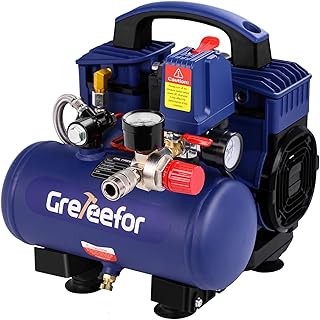
FORNAX Ultra Quiet 1.3 Gallon
A sensible middle ground: 65 dB and a slightly larger tank than the one-gallon class, so you get fewer restarts during a long baseboard run. The 125 PSI maximum and 1HP motor keep it firmly in the finish-nailer and tire-inflation lane, which is exactly where most furniture builders live.
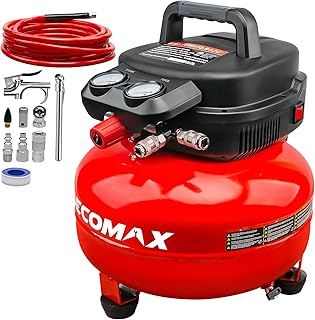
ECOMAX 6 Gallon Pancake
Three CFM at 90 PSI is plenty for brad and finish nailers with headroom to spare, and the dual quick couplers plus ten-piece accessory kit make it a genuinely complete first compressor. Consider it the value entry into pancake territory if framing isn’t in your future.
13 Gallon Portable, 3.7 HP
Six CFM and a large reservoir mean this one spends most of its time silent between cycles — a real advantage for extended sessions, even though peak noise is high. It’s the pick if you also spray lacquer or enamel on furniture, since HVLP and conventional guns need continuous volume that smaller tanks can’t sustain.
Frequently Asked Questions
Will a quiet compressor actually run a nail gun?
Yes, for brad, pin, and finish nailers. Those tools use tiny, intermittent bursts of air, so a one-gallon 60 dB unit keeps up easily. Framing nailers are a different story and need a pancake-class pump.
How late can I reasonably run a compressor indoors?
Sound above roughly 40 dB at the sleeper’s ear measurably fragments sleep architecture, even when it doesn’t cause full waking. A 60 dB compressor two rooms away is usually fine in the evening; a 90 dB pancake is not, at any distance inside the same structure.
Do I need an oil-lubricated compressor for longevity?
Not for homeowner-level use. Modern oil-free pumps last thousands of hours under intermittent duty, and they eliminate any risk of oil mist contaminating a finish you’ve spent hours preparing.
What hose and fitting setup should I pair with it?
A 25–50 foot, 3/8-inch hose keeps pressure drop negligible and lets you park the compressor in a hallway or outside the room entirely — the cheapest noise reduction available. Standard 1/4-inch industrial couplers fit nearly every nailer sold today.
Final Thoughts
For most people building or refinishing furniture at home, the 1 Gallon Ultra Quiet 60 dB unit is the right answer — it drives finish fasteners reliably without turning your house into a job site or costing anyone a night’s sleep. If your projects extend to framing, siding, or two nailers running simultaneously, the Metabo HPT EC914S is the durable, correctly specified choice, while the ECOMAX 6 Gallon Pancake splits the difference nicely for anyone who wants pancake-tank stamina at a gentler price.