Key takeaways
- Resaw height: Stock 14-inch saws typically clear 6 to 6-1/2 inches under the guides — enough for bookmatched drawer fronts and headboard panels. If you want to slice your own veneer from 12-inch boards, confirm the frame accepts a riser block before you buy, because many newer welded-frame models do not.
- Real motor output: Ignore the number on the box and read the amp draw. A genuine 1 HP single-phase motor pulls roughly 9 to 11 amps at 120V; anything claiming 2 HP on a 14-amp circuit is quoting peak, not continuous, power. For 8/4 maple and white oak, 1-1/2 HP is the comfortable floor.
- Guides and wheels: Ball-bearing guides above and below the table hold a blade steadier than steel blocks, and balanced cast-iron wheels with fresh rubber tires are the single biggest contributor to a smooth, low-vibration cut. Micro-adjustable guide posts save real setup time.
- Table and trunnion: A thick cast-iron table with a wide trunnion casting resists deflection when you lean into a curve. Check that it tilts at least 45 degrees right and that the miter slot is milled, not stamped.
- Noise and dust at home: Two-speed models let you drop to roughly 1,400 FPM for non-ferrous metal and slow resawing, which also cuts noise noticeably. Look for a 4-inch dust port and a tight lower wheel housing — sawdust in a bedroom-adjacent shop has a way of migrating into bedding.
What's inside
Most people come to a 14-inch band saw with a specific project in mind, and in a home furniture shop that project is almost always something you sleep on or beside: a solid-walnut headboard, a set of tapered nightstand legs, a platform bed with curved rails. As someone who spends most of my working life thinking about what makes a bedroom restorative, I’ll say the unglamorous part out loud — the furniture around your mattress matters. A bed frame that creaks at 3 a.m. because the joinery was cut on a wobbly saw will cost you more sleep than any supplement will give back. Precision at the machine is the first step toward silence in the room.
That’s the lens for this guide. Below you’ll find the 14-inch band saws worth considering in 2026, judged on the things that actually determine whether your cuts come out square and quiet: resaw height, wheel and guide quality, table rigidity, motor honesty (advertised horsepower versus what the amperage suggests), and how much vibration reaches your hands and your neighbors. I’ve flagged which machines suit weekend furniture builders and which earn their keep in a shop running hardwood every day, plus the tradeoffs in speed selection, dust collection, and voltage.
As an Amazon Associate we earn from qualifying purchases.


🛒 Best Price Today on Amazon
Prime members get fast, free shipping on everything above, plus member-only deals. New members get a 30-day free trial — cancel anytime.
How to Choose a/an 14 Band Saw (2026)
- Resaw height: Stock 14-inch saws typically clear 6 to 6-1/2 inches under the guides — enough for bookmatched drawer fronts and headboard panels. If you want to slice your own veneer from 12-inch boards, confirm the frame accepts a riser block before you buy, because many newer welded-frame models do not.
- Real motor output: Ignore the number on the box and read the amp draw. A genuine 1 HP single-phase motor pulls roughly 9 to 11 amps at 120V; anything claiming 2 HP on a 14-amp circuit is quoting peak, not continuous, power. For 8/4 maple and white oak, 1-1/2 HP is the comfortable floor.
- Guides and wheels: Ball-bearing guides above and below the table hold a blade steadier than steel blocks, and balanced cast-iron wheels with fresh rubber tires are the single biggest contributor to a smooth, low-vibration cut. Micro-adjustable guide posts save real setup time.
- Table and trunnion: A thick cast-iron table with a wide trunnion casting resists deflection when you lean into a curve. Check that it tilts at least 45 degrees right and that the miter slot is milled, not stamped.
- Noise and dust at home: Two-speed models let you drop to roughly 1,400 FPM for non-ferrous metal and slow resawing, which also cuts noise noticeably. Look for a 4-inch dust port and a tight lower wheel housing — sawdust in a bedroom-adjacent shop has a way of migrating into bedding.
The Best 14 Band Saw (2026)s Reviewed
JET JWBS-14SFX-BLK, 1.75 HP
The most refined machine here for serious furniture work: a rigid steel frame, generous resaw capacity out of the box, and a quick-tension lever that makes blade changes painless. The 1.75 HP motor pushes through 2-inch hard maple without bogging, and it runs smoothly enough that vibration barely reaches the table.
Powermatic PWBS-14CS, 1-1/2 HP
A cast-iron classic with the best fit and finish in this group — heavy trunnions, precise guides, and a footprint that accepts a riser block for tall resawing. The premium is real, but so is the accuracy, and these saws hold their value for decades.
JET JWBS-14CS, 1 HP
The traditional cast-iron 14-inch platform at a sane price, and still the most upgradeable saw on the list. One horsepower is adequate for curves, tapers, and joinery in 4/4 to 6/4 stock, though it asks for patience in thick hardwood.
WEN BA1411 Industrial, 1 HP Dual-Voltage
Strong value for a home shop that occasionally needs more power: it accepts 240V wiring for better torque under load, and the two-speed drive handles brass and aluminum inlay work. Expect to spend an hour dialing in the guides and table squareness before your first real cut.
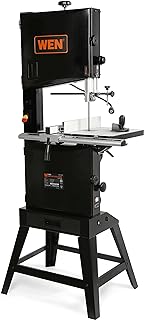
WEN BA1487 with Stand
The entry point for anyone building their first bed frame or nightstand set. It arrives essentially complete with its own stand, cuts clean curves in softwoods and moderate hardwoods, and its two speeds cover more material than the price suggests.
Frequently Asked Questions
What does “14-inch” actually measure?
It refers to throat capacity — the distance from the blade to the frame — which caps how wide a panel you can cut. It says nothing about resaw height, so check both specs.
Which blade should I keep on the saw?
A 1/2-inch, 3-TPI hook-tooth blade covers resawing and general ripping. Drop to 1/4-inch, 6-TPI for the tight radii on curved bed rails and cabriole legs.
Do I need 240V?
Not for most furniture work, but rewiring a dual-voltage motor to 240V reduces startup strain and voltage drop on long shop runs. It does not increase horsepower.
How loud is a band saw in a home?
Roughly 80–90 dB at the operator, mostly from the motor and dust collector rather than the cut itself. Wear hearing protection, and avoid running it late — bedroom-adjacent shops transmit low-frequency hum through framing far better than you’d expect.
Final Thoughts
If you build beds and case goods regularly, the JET JWBS-14SFX-BLK is the saw I’d buy without hesitation, with the Powermatic PWBS-14CS as the heirloom-grade alternative for anyone who values cast-iron mass and long-term upgradeability. For a first serious machine on a budget, the WEN BA1487 will cut clean, quiet joinery for years — and the frame you build with it should stay silent long after you’ve stopped thinking about the saw.