Key takeaways
- Support: queen and king inset frames should have a center rail with legs reaching the floor. Without it, the mattress well can sag in the middle over time.
- Slat spacing: about 3 inches or less for foam and hybrid mattresses; check your mattress warranty’s requirement.
- Materials: solid hardwood and plywood rails hold screws through repeated assembly; particleboard rails can strip out after one or two moves.
- Assembly: inset frames typically use bolted corner brackets or interlocking joinery; expect 45 to 90 minutes for two people, and check the rails sit flush so the well stays square.
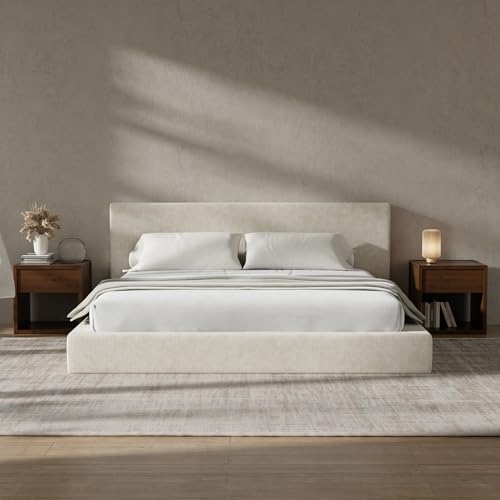
A bed frame where the mattress sits inside is usually called an inset, recessed or sunken platform bed: the side rails rise above the support deck so the mattress drops into a shallow tray instead of resting on top. It looks tailored and keeps the mattress from sliding, but it only works well when three numbers line up: the interior well size, the well depth and your mattress thickness. Get those right and it is one of the neatest-looking frames you can own; get them wrong and you will fight gaps, a too-low sleeping surface or sheets you cannot tuck.
Our top picks

As an Amazon Associate we earn from qualifying purchases at no extra cost to you. Ratings are shown as listed on Amazon.
Inset vs Standard Platform: The Difference
| Feature | Inset (mattress sits inside) | Standard platform (mattress on top) |
|---|---|---|
| How the mattress sits | Recessed 2–6 in into a tray framed by the rails | Flat on slats, rails at or below deck height |
| Mattress sliding | Virtually none; rails hold it in place | Possible on smooth slats; often needs a gripper pad |
| Look | Built-in, furniture-like, hides mattress sides | Mattress edge visible, more casual |
| Size tolerance | Tight; mattress must match the well | Forgiving; overhang of 1 in is invisible |
| Sheet changing | Harder with deeper wells | Easy |
| Sitting on the edge | Rail edge can press into thighs | Soft mattress edge |
Number 1: Interior Well Size
Mattress dimensions are nominal and can vary by about half an inch to an inch, especially with foam that expands after unboxing. A good inset frame builds in a small gap. Too tight and the mattress bows or bunches; too loose and a visible channel opens at one side.
| Mattress size | Standard mattress size | Ideal interior well | Gap you’ll see |
|---|---|---|---|
| Twin | 38 x 75 in | 38.5–39 x 75.5–76 in | About 0.25–0.5 in per side |
| Full | 54 x 75 in | 54.5–55 x 75.5–76 in | About 0.25–0.5 in per side |
| Queen | 60 x 80 in | 60.5–61 x 80.5–81 in | About 0.25–0.5 in per side |
| King | 76 x 80 in | 76.5–77 x 80.5–81 in | About 0.25–0.5 in per side |
| California king | 72 x 84 in | 72.5–73 x 84.5–85 in | About 0.25–0.5 in per side |
Before ordering, find the interior measurement in the frame specs, not just the overall footprint. Then measure your actual mattress with a tape at the center of each side, because edges bulge on many hybrids. If your mattress runs a full inch over, choose a different frame.
Number 2: Well Depth vs Mattress Thickness
The rails should hide part of the mattress side without swallowing it. A useful rule is to let at least 4 to 8 inches of mattress stand above the rail top.
| Well depth | Pairs best with mattress thickness | Mattress above rail | Notes |
|---|---|---|---|
| 1.5–2.5 in | 8–10 in | 6–8 in | Subtle lip, easy sheet changes |
| 3–4 in | 10–12 in | 7–9 in | Most common; balanced look |
| 5–6 in | 12–14 in | 7–9 in | Strong built-in look, tucking sheets is slower |
| 7 in or more | 14 in or thicker | 7+ in | Feels like a box; thin mattresses look sunken |
Watch out for thin mattresses in deep wells. A 6 or 8 inch mattress in a 5 inch well leaves the top barely above the rail, so you roll against wood when you turn near the edge.
Number 3: Total Sleeping Height
Inset frames often look low because the rails hide the mattress side. What matters is the height of the mattress top from the floor. For most adults, 20 to 25 inches is comfortable to sit on and stand up from; knee height is a good personal guide.
To estimate: floor-to-deck height + mattress thickness = sleeping height. For example, a frame with a deck at 9 inches plus a 12 inch mattress gives 21 inches, a comfortable standard height. A Japanese-style low frame with a deck at 4 inches and a 10 inch mattress gives 14 inches, which is fine for younger, flexible sleepers but harder for anyone with knee or hip issues.
Living With an Inset Frame
Changing sheets
Fitted sheets need you to lift the mattress corner above the rail. With wells deeper than about 4 inches, this is noticeably slower. Sheets with all-around elastic go on more easily than those with corner-only elastic. Skip bed skirts entirely; they have nowhere to hang.
Making the bed look full
A duvet or comforter that drapes over the rails hides the gap and softens the look. If you prefer the rails visible, tuck the duvet inside the well.
Sitting on the edge
The rail top becomes the edge when you sit. Look for rounded or chamfered rail edges, or upholstered rails, if you often sit on the side of the bed to dress.
Ventilation
The enclosed design can trap moisture, especially with foam mattresses. Choose slatted decks with gaps around 2 to 3 inches rather than solid panels, and avoid placing the bed against a cold exterior wall in humid climates.
Construction Details That Matter
- Support: queen and king inset frames should have a center rail with legs reaching the floor. Without it, the mattress well can sag in the middle over time.
- Slat spacing: about 3 inches or less for foam and hybrid mattresses; check your mattress warranty’s requirement.
- Materials: solid hardwood and plywood rails hold screws through repeated assembly; particleboard rails can strip out after one or two moves.
- Assembly: inset frames typically use bolted corner brackets or interlocking joinery; expect 45 to 90 minutes for two people, and check the rails sit flush so the well stays square.
Who Should Choose One
- Good fit: minimalist or Japandi bedrooms, restless sleepers whose mattress slides, homes where a tailored look matters, standard-size mattresses 10 to 14 inches thick.
- Poor fit: oversized or non-standard mattresses, people who change sheets frequently and dislike lifting corners, sleepers who sit on the bed edge a lot, very thin mattresses.
FAQ
Can I use a mattress topper with an inset frame?
Yes, and it can help if your mattress sits too low in the well. Toppers of 2 to 3 inches raise the surface and soften the edge, but they make fitted sheets tighter, so buy deep-pocket sheets.
Do inset frames need a box spring?
No. The slats or deck are the foundation; adding a box spring would lift the mattress out of the well and defeat the design.