Key takeaways
- Find a paddle board rack for your truck, with bed, cab and tailgate options compared, plus padding, tie-down and highway safety checks explained.
As an Amazon Associate we earn from qualifying purchases.


A paddle board looks simple to transport until you try to move one in a truck. Boards are long, wide, light for their size, and surprisingly fragile at the rails and nose. A short bed leaves half the board unsupported, a bare metal rail can dent a rail edge in a single journey, and highway airflow will lift and work at any board that is strapped loosely. The best paddle board rack for a truck is the system that supports the board along enough of its length, protects every contact point with padding, and holds it flat and quiet at highway speed, while still letting you use the truck for everything else you bought it for.
There is no single layout that suits every truck and every board. An inflatable board rolled into a bag needs no rack at all. A short recreational board in a long bed can travel safely on padded rails with the tailgate up or down. A long touring or race board usually belongs on a proper rack over the bed or the cab. This guide compares those routes honestly, explains the measurements that decide between them, and covers the strapping and care habits that keep a board, and everyone travelling behind you, safe.
Start With the Board, Not the Truck
Board length is the first deciding number. Measure your board from nose to tail and compare it with your bed length with the tailgate up and with the tailgate down. A board that overhangs the back of the truck by a small amount, resting on a padded tailgate, is a very different case from a board with nearly half its length hanging in the air, flexing over every bump and catching side winds.
Board construction matters just as much. Hard boards, whether epoxy, fibreglass, or plastic, need padding at every contact point and straps that are firm without crushing. Plastic recreational boards tolerate more handling but can still deform in heat under a narrow, tight strap. Inflatable boards, once deflated and rolled, travel inside the bed or cab in their bag and remove the rack question entirely, which is one reason they suit truck owners who also carry bikes, dogs, and camping gear in the same space.
Width and thickness affect rack choice too. Wide, stable recreational boards need wider bar spacing and pads than narrow touring boards, and two boards carried together need a plan for stacking or side-by-side carrying that protects both decks. Note your board weight as well. It feeds into the roof or rack load rating if you carry overhead, and it decides whether loading a high rack alone is realistic or a two-person job.
The Main Ways to Carry a Paddle Board in a Truck
In the bed, on padded rails or a bed pad
The simplest truck setup needs no frame at all. The board lies deck-down or deck-up in the bed, resting on padded bed rails and a padded tailgate, or on a purpose-made tailgate pad, with the nose toward the cab and the tail extending over the lowered tailgate. Straps run from the bed tie-down points over the board to stop it sliding or lifting.
This works best for shorter boards and shorter journeys, and for trucks with longer beds. Its strengths are cost, simplicity, and low loading height: you slide the board in rather than lifting it overhead. Its limits are support and security. A long board cantilevered far past the tailgate flexes and can be damaged by that repeated movement, and an open bed offers no protection from weather or from casual theft at a stop. Anything else carried in the bed must be arranged so nothing hard presses against the board.
Check your local rules on loads extending beyond the rear of a vehicle. Many places require a flag or marker on an overhanging load and set limits on how far a load may extend. Mark the end of the board clearly whenever it projects past the tailgate.
Over-bed racks
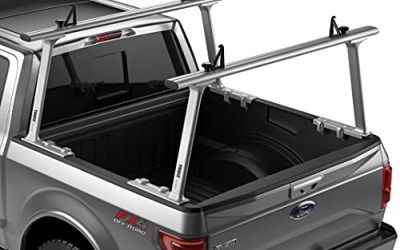
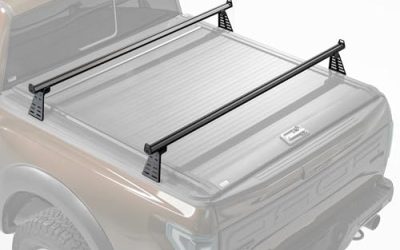
A rack that stands in or on the bed and carries boards above bed level, on padded crossbars, is the workhorse choice for regular paddlers with hard boards. The bars support the board at two well-spaced points, the board travels flat, and the bed below stays partly usable for coolers, bags, and other gear, depending on rack height.
Low over-bed racks keep loading easier and the load out of the worst of the wind, but they limit what fits underneath. Tall racks, including ladder-style and adjustable-height bed racks, clear tall cargo and can double for kayaks, lumber, and other long loads, at the cost of a higher lift and more wind exposure. Whichever height you choose, bar spread is the specification to check first: the two bars should support the board well inside its length, not near the nose and tail tips, and the rack rating must cover the combined weight of boards and any other gear carried on it.
Clamp-on racks that grip the bed rails suit owners who want to remove the system between trips, while bolted or track-mounted systems suit a permanent setup. Confirm compatibility with your exact bed, and with any tonneau cover you intend to keep, before ordering, because many racks and covers compete for the same rail space.
Cab roof racks and combined cab-and-bed systems
Crossbars on the cab roof carry a board entirely above the cab, which frees the whole bed. On a crew cab, the bar spread can be wide enough for medium boards. On a regular cab, the spread is short, and a long board balanced on it will pitch and lift at speed unless it is very carefully tied at bow and stern.
The strongest version of this idea combines one support over the cab with one over the bed, giving a long, level carrying plane for the longest boards. Purpose-built truck rack systems that span from behind the cab to the rear of the bed do the same job in a single frame. These are the right answer for long touring and race boards, and the overkill answer for a short board used twice a summer. Loading height is the price: plan the lift, use two people for long boards, and protect the cab roof edge while sliding a board into place.
Soft racks and pads as a light-duty option
Removable soft racks, essentially padded blocks with straps that pass through the cab or around a frame, can carry a board occasionally without permanent hardware. They suit a borrowed board or a holiday trip better than weekly use. Their padding compresses, their straps run against paint and door seals, and their security at highway speed depends entirely on careful fitting. Treat them as an occasional-use solution and check strap tension early and often.
Racks and Carriers You Can Buy Today
Two current Amazon US listings show how the main layouts above look in practice. Check dimensions and fit against your own truck and board before ordering either.
Viking Solutions Truck Bed Kayak/SUP Rack
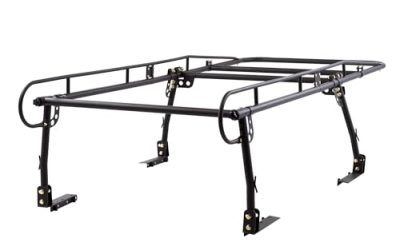
This is the over-bed layout in steel form. The rack mounts in the bed with brackets and no drilling, adjusts to different bed widths, and carries boards angled so they pitch above the cab, leaving bed space below for other gear. The maker rates it for up to three kayaks or SUPs with a 150-pound capacity, fits rubber bumpers at the loading points to protect board rails, and includes ratchet straps and tie-down rings for securing the load. Because the front and rear sections adjust independently, it suits a range of bed widths, but measure your inside bed width against the listed adjustment range first.
Thule SUP Taxi XT
The SUP Taxi XT is a dedicated paddle board carrier that mounts on crossbars, whether those bars sit on the cab roof or on a bed rack. Its telescoping design adjusts to boards up to 34 inches wide and it can carry two boards. A push-button locking strap with steel-reinforced webbing adds security at stops, the padding is weather-resistant, and mounting is tool-free on Thule bars, round bars and most factory racks. It is a carrier rather than a complete rack, so it only works if your truck already has, or can take, suitable crossbars with enough spread for your board length.
Padding: The Detail That Protects the Board
More boards are damaged by bad padding than by bad racks. Crossbar pads or rack pads should cover every bar the board touches, be wide enough that the board cannot roll off the padded surface onto bare metal, and be replaced when they split, flatten, or start to crumble. Rail savers and pieces of foam under strap contact points protect the board edges, which are the easiest part of a hard board to crush.
Deck pads and board bags add another layer. A board bag is worth using for overhead carries on longer journeys: it shields the board from stone chips, strap rub, and sun, and it keeps a waxed or textured deck from scuffing the rack pads. In hot climates, avoid leaving a hard board strapped tightly on a dark rack in full sun for hours, because heat plus strap pressure is the classic recipe for pressure dents.
Strapping a Paddle Board Down Properly
Two straps over the board, one at each crossbar or support point, are the baseline for any rack carry. Straps should pass over the board and around the bar or rack frame, sit on padding, and be tightened firmly by hand so the board cannot shift sideways or lift, without being cranked down hard enough to dent the rails. Position straps away from the fin area and away from any hatch, valve, or fitting on the board.
For bed carries, use the truck bed tie-down points and cross the straps so the board cannot slide forward under braking or backward under acceleration. For overhead carries of longer boards, add lines from the nose and tail of the board to solid points at the front and rear of the truck. These lines control the ends of the board in highway airflow and are a second line of defence if a main strap fails.
Cam straps in good condition are the common choice for boards because they tighten by hand and are hard to over-tighten compared with ratchet mechanisms. Whatever style you use, inspect webbing for fraying and sun damage, keep buckles padded or sleeved where they touch the board, tie off loose tails so nothing flaps against paint or the board, and stop soon after setting off to check tension again. Boards settle into padding during the first miles, and a strap that felt finished in the driveway often needs one more pull.
Driving With a Board on the Truck
A paddle board overhead or over the bed changes how the truck feels in crosswinds. The board is a large, light surface, and gusts will push on it. Slow down in strong side winds, leave more space in traffic while you learn how your setup behaves, and be alert to noise changes from the load: a new hum, buzz, or thump usually means a strap has loosened or a tail is flapping, and it is worth a stop to check rather than turning up the radio.
Watch your height. A board on a tall bed rack or cab rack raises the overall height of the truck, which matters at car parks, drive-throughs, low branches at the launch, and garage doors at home. Note the loaded height and keep it visible to the driver until it becomes second nature. At the water, unload the board before manoeuvring in tight launch areas whenever you can, rather than threading a long overhead load between other vehicles and trailers.
Security at stops deserves a thought as well. A board on an open rack is visible and removable, so for longer stops choose a locking strap or cable where your system supports one, or move the board inside a locked space. At minimum, do not leave a board on an open rack overnight in an unsecured place if you have any alternative.
Matching the Rack to How You Actually Paddle
Frequency should drive the budget and the permanence of the setup. Weekly paddlers benefit from a fixed over-bed or full-length rack that is always ready, with pads left in place and straps kept in the truck. Occasional paddlers are better served by a padded bed or tailgate setup that costs little, stores in a corner, and adds no height or wind noise the rest of the year.
Households with several boards should decide early whether boards will stack, travel side by side, or make two trips, because that decision sets bar width and rack rating. Stacked boards need padding between them and longer straps, and the bottom board carries the strap pressure for both, so stacking suits shorter journeys and robust boards best.
Think also about the rest of the load. If the bed must carry a fridge, bikes, or a dog crate on the same trips, an over-bed rack that keeps the bed usable earns its place. If the truck tows, remember that anything tall at the rear of the bed, and any board extending far back, must be checked against trailer swing and hitch access, and a board should never rest on or interfere with towing hardware.
Care and Checks That Keep the System Safe
Rinse rack pads, straps, and mounting feet after coastal use, because salt and sand accelerate corrosion and wear webbing quickly. Inspect clamp and bolt fixings at the intervals the rack maker specifies, and after the first journey with any new installation, since vibration settles hardware into place. Check pads each season and replace them before they fail, not after a board has ridden home on bare metal. Store straps dry and out of sunlight, and retire any strap with cuts, heavy fading, or a damaged buckle.
Once a season, do a full rehearsal at home: fit the rack, load the board, strap it as you would for the highway, then unload it. It takes minutes, confirms every part is present and working, and is far better than discovering a missing pad or a seized buckle at the launch.
Frequently Asked Questions
Can I carry a paddle board in a short bed without a rack?
Yes, for shorter boards, using padded rails and a padded tailgate with the tailgate down, the board strapped firmly to the bed tie-down points, and the overhang marked as local rules require. The longer the board is beyond the tailgate, the weaker this option becomes, and long boards belong on a rack with proper two-point support.
Is it better to carry a board deck up or deck down?
Follow the board and rack makers’ guidance for your model. In practice, many hard boards travel deck down on padded bars so the hull rests on the pads and the fin points up and clear, while inflatable boards are more forgiving either way. What matters most is that the board rests on padding, cannot rock, and the fin is not taking the board’s weight.
Do I need pads if my rack bars are already coated?
Yes. A thin coating on a bar is not cushioning. Proper bar pads spread the load, grip the board, and protect the rails from the concentrated pressure and vibration of a long drive.
Can one rack carry both a paddle board and a kayak?
Often yes, if the rack rating covers the combined weight and the bars are wide enough, with suitable carriers or padding for each. Check total width, keep each item strapped independently, and confirm the combined load still respects the truck roof or bed limits for your mounting style.
How fast can I drive with a board on the roof or bed rack?
Stay within the lowest speed guidance given by the rack, carrier, or board maker, and slow down in crosswinds, heavy rain, or rough roads regardless. If the load becomes noisy or moves, stop somewhere safe and fix the strapping rather than continuing.
Conclusion
The best paddle board rack for a truck is the one matched to your board length, your bed, and how often you paddle. Short boards and occasional trips need little more than good padding and careful strapping in the bed. Regular paddling with hard boards earns a proper over-bed or full-length rack with wide bar spread, real pads, and two well-routed straps plus end lines for long boards. Measure first, protect every contact point, check the load early in every journey, and the board will arrive at the water in the same condition it left home, trip after trip.
More from Amazon
Programs that pair well with the guide above. Offers and eligibility are set by Amazon and may change.
Collect the home and kitchen items you want in one registry that guests can shop from.
Create a wedding registrySet up recurring deliveries of everyday items on eligible products. Terms and savings are set by Amazon.
Explore Subscribe & SaveFree shipping on eligible items, Prime Video and more. Eligible new members can start with a free trial.
Start a Prime free trialAudiobooks and podcasts to listen to on the go. Eligible new members can start with a free trial.
Try Audible freeAs an Amazon Associate we earn from qualifying purchases.