Key takeaways
- Compare kayak racks for trucks towing a fifth wheel, with clearance checks, cab and bed mounting options, tie-down tips and safe loading advice.
As an Amazon Associate we earn from qualifying purchases.
Towing a fifth wheel changes the kayak problem completely. On a truck that is not towing, a kayak can lie in the bed, rest on a bed extender, or sit on almost any rack that fits the rails. With a fifth wheel hitched, the middle of the bed belongs to the hitch, the trailer nose swings over the bed every time you turn, and the space that looked generous in the driveway becomes a moving clearance puzzle. The best kayak rack for a truck with a 5th wheel is therefore not simply the strongest rack or the one that carries the most boats. It is the rack that keeps every kayak, cradle, strap, and buckle clear of the trailer through full turns, steep driveway entries, fuel stops, and uneven campsite approaches, while still letting you load the boats without climbing into a crowded bed.
This guide works through the problem in the order that matters: clearance first, mounting position second, and only then cradle style, capacity, and convenience. It also explains how to measure your own rig before ordering anything and how to do a slow, safe test turn once a rack is fitted.
Why Fifth Wheel Towing Rules Out Most Bed Racks
A fifth wheel trailer pivots on a hitch mounted near the middle of the truck bed, usually just ahead of or over the rear axle. When the truck turns, the wide front cap of the trailer sweeps across the bed from side to side. The sharper the turn, and the shorter the truck bed, the larger that sweep becomes. Anything tall standing in the bed near the cab, beside the hitch, or along the bed rails can enter the path of the trailer nose.
That single fact eliminates a whole category of products. Tall bed racks that rise well above the rails and stretch the full length of the bed may be excellent for a rooftop tent or for kayaks on a truck that never tows, but their rear uprights and crossbars sit exactly where a fifth wheel cap needs to travel. Ladder racks with rear legs have the same problem. Even a low rack is not automatically safe: a kayak carried on its side in a vertical cradle adds height and width, and a strap tail or buckle left hanging can catch.
Clearance is also dynamic, not static. A setup that clears the trailer by a comfortable margin on flat ground can close that gap when the truck drops into a dip while the trailer is still on higher ground, or when the rig twists over a campsite entrance. Experienced towers leave a generous buffer rather than chasing the last inch, and they recheck clearance whenever the hitch height, pin box, truck, or trailer changes.
The Three Mounting Positions That Can Work
Once the bed itself is treated as a shared space rather than free storage, three mounting positions remain realistic for most fifth wheel rigs. Each has real trade-offs, and the right choice depends on bed length, cab size, kayak length, and how often you load and unload.
Cab roof racks
A rack mounted entirely over the cab keeps kayaks completely out of the bed and therefore completely out of the trailer sweep. For many fifth wheel owners this is the cleanest answer. Crossbars on the cab roof, fitted with kayak cradles or saddles, carry one or two boats above the cab while the bed stays devoted to the hitch.
The limits are loading height and roof capacity. Lifting a kayak to cab height is harder than sliding it into a bed, especially after a day of paddling, and it usually takes two people or a careful step-by-step technique using a step stool and a towel or mat to protect the cab while the boat is slid into place. Roof load limits in the truck manual apply to the moving load, not just parked weight, and long kayaks carried only on short cab bar spreads can overhang a long way front and back. Bow and stern tie-downs become essential rather than optional, and you need anchor points at the front and rear of the truck that do not rub paint or cross hot or moving parts.
Cab racks suit shorter and medium kayaks best. A very long touring kayak on a short regular cab is a poor match because so much of the boat is unsupported. Crew cab trucks give a wider bar spread and make this option far more practical.
Front-of-bed and over-cab racks
A second family of racks mounts at the front of the bed, just behind the cab, and cantilevers or extends the load area forward over the cab. The kayaks sit high and forward, ahead of the hitch, with their weight near the cab rather than over the middle of the bed. Because nothing stands at the rear of the bed, the trailer cap keeps the sweep area it needs.
Fit is everything here. The rack frame, the front of the kayaks, and the highest point of the load all need to be measured against the trailer cap at full turn, not just straight ahead. On short beds the distance between the cab and the hitch is small, so a front-mounted rack can still crowd the swing zone. Owners should measure from the hitch jaw to the back of the cab, compare it with the rack footprint from the manufacturer, and leave a clear buffer. If the numbers are tight on paper, they will be tighter on a sloped fuel station forecourt.
These racks also raise the centre of gravity of the load and put kayaks in the wind. Crosswind behaviour, wind noise, and fuel use all change, and straps need to be checked after the first stretch of highway driving whenever a new setup is used.
Hitch and rear options, and why to be careful
It is tempting to look behind the rig for space, and some owners carry kayaks on a rack fitted to the rear of the trailer itself. That is a different product category from a truck rack, it depends entirely on whether the trailer rear structure and any receiver are rated for that kind of load, and it places boats where the driver cannot see them. Loads on the back of a trailer also bounce far more than loads on the truck. Treat any rear-of-trailer idea as an engineering question for the trailer manufacturer, not as a simple accessory purchase, and never assume a bumper that looks sturdy is rated to carry a rack and boats.
A truck bed extender, the kind that supports a long kayak lying in the bed with the tailgate down, is not compatible with fifth wheel towing at all, because the bed is occupied by the hitch and the trailer is directly behind the truck. Cross that option off the list before shopping, however well it worked before you bought the trailer.
Racks and Carriers That Fit the Fifth Wheel Rules

Three products sold on Amazon US match the mounting positions described above. None of them removes the need for the measuring and slow turn test in the next section: treat each as a candidate to be verified against your own rig, not as a guaranteed fit.
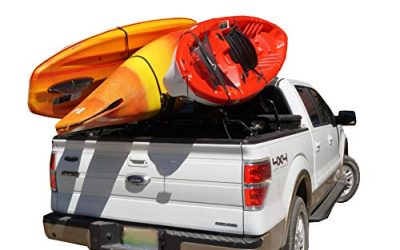
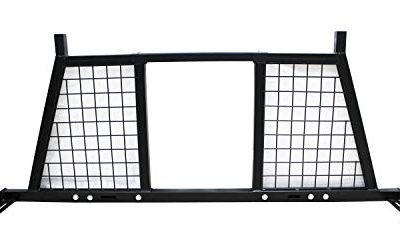
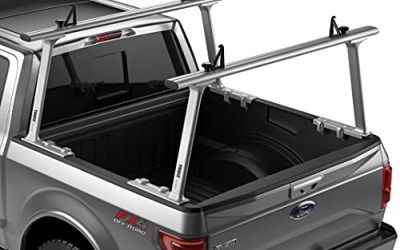
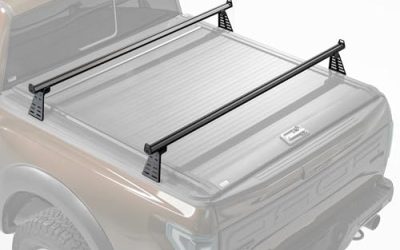
Elevate Outdoor UPUT-Rack-V2 Universal Steel Over-Cab Truck Ladder Rack. A powder-coated steel over-cab rack that clamps to the bed sides with no drilling. The listing gives an 800-pound capacity, an adjustable width of 49 to 64 inches, and a removable rear bar. For fifth wheel use, the over-cab section is what carries the kayaks forward of the hitch; confirm that the rack frame and the rear bar position stay outside the trailer cap sweep at full lock before relying on it, and note the listing’s exclusions for step-side beds and integrated tie-down rails.
ASIN: B00LG53622
https://www.amazon.com/dp/B00LG53622
PIRIPARA Kayak Roof Rack 2 Pairs J-Bar Carrier Holder, Set of 4. A set of four J-bar carriers, two pairs, that mount on crossbars such as a cab roof rack and hold two kayaks on their sides, with a listed load capacity of 150 pounds. Used over the cab, this set keeps both boats entirely out of the bed and out of the trailer sweep. Remember the trade-off from the cradle section: boats carried on their sides sit higher and catch more crosswind, so measure total height and use bow and stern lines.
ASIN: B09TW4638K
https://www.amazon.com/dp/B09TW4638K
Yakima JayLow J-Cradle Rooftop Kayak Mount. A folding J-cradle carrier for cab crossbars, listed for one kayak up to 80 pounds in the J-cradle position or two kayaks up to 110 pounds total in the vertical position, with heavy-duty straps and bow and stern tie-downs included. It fits round, square, factory, and aerodynamic crossbars, and folds when not in use. On a crew cab it is a practical way to carry one or two boats above the cab while the bed stays devoted to the hitch.
ASIN: B00FUHDYZQ
https://www.amazon.com/dp/B00FUHDYZQ
Measuring Your Rig Before You Buy Anything
Good measurements prevent almost every expensive mistake in this category. Work through them with the trailer hitched, on level ground, with the truck loaded as it normally travels.
First, measure the bed. Note the bed length, the distance from the back of the cab to the centre of the hitch, and the height of the bed rails above the bed floor. Then note the hitch height and how far the trailer pin box and nose extend over the bed when straight.
Second, perform a slow turn check with a helper watching. In a large empty area, turn the rig gradually toward a full lock in both directions while your helper watches the gap between the trailer cap and the cab, rails, and any existing equipment. Note where the gap is smallest. This is the zone your rack and kayaks must never enter. Never do this check at road speed, and stop immediately if anything looks close.
Third, measure your kayaks, not the catalogue length alone. Overall length, width at the widest point, and depth of the hull all affect how a boat sits in a cradle. Two wide recreational kayaks side by side need far more bar width than two narrow touring boats. Add the height of the cradle itself when you estimate total load height, and compare the result with the overall height limits of anywhere you plan to go, including campground entrances, ferries, and low branches at lakeside launches.
Fourth, check weights honestly. Add the weight of the rack, the cradles, and every kayak, then compare the total with the truck roof or bed rating that applies to your chosen mounting position, and remember that the truck payload figure also has to cover the trailer pin weight, passengers, fuel, and everything else in the truck. Fifth wheel pin weights are substantial, and a rack that looks light on its own can be the item that pushes a heavily loaded rig past a limit.
Choosing Cradles and Carriers
The rack is only the frame. What actually holds the kayak matters just as much for hull protection and highway security.
Saddle-style carriers support the hull on padded surfaces that roughly follow its shape, spreading the load and reducing the risk of dents on plastic boats during hot weather, when hulls soften and can deform under narrow pressure points. They suit carrying a kayak flat, which keeps the load lower and more stable in wind.
Vertical or J-style carriers hold a kayak on its side, saving bar width so two boats fit on a narrower spread. The trade-off is height and wind exposure: a boat on its side presents a larger side profile to crosswinds and raises the top of the load, which matters when you are already checking trailer and tree clearance. On a cab roof over a truck that also tows, that extra height deserves a second thought.
Stacker-style uprights carry boats on edge against a central post and can fit more kayaks in less width, but loading is more physical and strap routing is more complex. Choose the carrier style you can load correctly when you are tired, at a busy ramp, in wind. Straps should run over strong parts of the hull, not over hatch covers or rudders, and buckles should sit against padding so they do not fret against the boat or the truck finish.
Straps, Tie-Downs, and Highway Security
Every kayak needs two straps over the hull at the crossbars, plus bow and stern lines when the boat is carried on a cab or front-of-bed rack. Bow and stern lines are not there to hold the boat down by themselves; they stop the ends of a long kayak from lifting and twisting in highway airflow and from shifting if a main strap loosens.
Use straps in good condition, with no frayed webbing or cracked buckles, and route them so they cannot slide toward a narrow part of the hull. Twist a strap once on long exposed runs if it hums or flutters, keep tails tied off so nothing can reach the trailer or a wheel, and stop early in the first journey with a new setup to check tension again. Kayaks settle, padding compresses, and straps that felt tight in the driveway can gain slack within the first hour.
Loading Technique for High Racks
Most damage in this category happens during loading, not driving. Kayaks are awkward rather than heavy, and a boat that slips at cab height can injure a person or damage the truck, the boat, or both.
Load with two people whenever the rack is at cab height or higher. Agree on the lift before starting, lift from the ends using proper carry handles where fitted, and rest the boat on a protected surface, such as a mat over the edge of the rack, before sliding it into the cradles. Never climb on the hitch, the pin box, or the trailer to load a kayak. If loading a particular kayak onto a high rack feels marginal, that is useful information, not a challenge to overcome: a lower-effort carrier style or a single kayak may be the safer system for your household.
Living With the Setup on the Road
A few habits make fifth wheel kayak transport routine rather than stressful. Keep a written note of your total rig height with kayaks loaded where the driver can see it. Recheck rack mounting hardware torque at the intervals the manufacturer specifies, and rinse straps, cradles, and rack feet after coastal trips, since salt accelerates corrosion. Finally, revisit the whole clearance check whenever anything changes: a different hitch, a lifted truck, a new trailer, a different rack, or longer kayaks. A change to any part of the combination deserves a fresh slow turn test.
Frequently Asked Questions
Can I use a full-length bed rack while towing a fifth wheel?
Usually not safely. Rear uprights and bars on a full-length bed rack typically stand inside the sweep of the trailer front cap during turns. Unless the rack manufacturer and careful measurements on your exact rig prove clear space through full turns and over uneven ground, treat full-length bed racks as incompatible with fifth wheel towing.
Is a cab roof rack strong enough for two kayaks?
It can be, on a truck whose roof rating covers the combined weight of the rack, carriers, and both boats while moving, and with a bar spread wide enough to support the boats properly. Crew cab trucks are generally better suited than regular cabs. Always work to the lowest rating in the chain: truck roof, rack, or carrier.
How much clearance should I leave between the kayaks and the trailer?
More than the minimum you measure on flat ground. Clearance closes when the rig twists over dips and entrances, so a buffer you can clearly see at full lock, in both directions, is the standard to aim for. If the gap is small enough that you have to guess, the setup is too tight.
Do I still need bow and stern lines for short kayaks?
For cab and front-of-bed carries, yes, treat them as standard. They control the ends of the boat in highway airflow and add a second line of defence if a main strap loosens, whatever the length of the kayak.
What if no rack clears my trailer?
Carry the kayaks another way rather than forcing a tight setup: an inflatable or folding kayak inside the trailer, or rentals at your destination. A missed paddle is a small cost next to contact between a trailer cap and a loaded rack.
Conclusion
The best kayak rack for a truck with a 5th wheel is the one designed around the trailer, not around the kayak alone. Start with the sweep of the trailer cap, choose a mounting position that stays out of it, most often the cab roof or a carefully measured over-cab arrangement, and then select cradles you can load safely and strap securely every time. Measure your own rig, test turns slowly with a helper, and recheck whenever any part of the combination changes.
More from Amazon
Programs that pair well with the guide above. Offers and eligibility are set by Amazon and may change.
Collect the home and kitchen items you want in one registry that guests can shop from.
Create a wedding registrySet up recurring deliveries of everyday items on eligible products. Terms and savings are set by Amazon.
Explore Subscribe & SaveFree shipping on eligible items, Prime Video and more. Eligible new members can start with a free trial.
Start a Prime free trialAudiobooks and podcasts to listen to on the go. Eligible new members can start with a free trial.
Try Audible freeAs an Amazon Associate we earn from qualifying purchases.