Key takeaways
- Crosscut capacity: Look for at least 12 inches of nominal crosscut at 90°. Standard bed rails and headboard panels frequently run 11½ inches or wider, and flipping a board to finish a cut is where angles drift.
- Single vs. double bevel: Double bevel lets you tilt left and right without flipping the workpiece. For crown-style headboard trim or mirrored angled legs, it eliminates the flip that causes mismatched pairs.
- Detent quality over detent count: Nine positive stops that lock crisply beat a dozen mushy ones. Test whether the miter lock holds when you nudge the table — drift of even half a degree compounds across four corners.
- Cut-line visibility: Shadow-cast LED systems track the actual blade kerf and don’t need calibration. Lasers are cheaper but require alignment and wash out under bright shop lighting.
- Dust and noise reality: A bag captures maybe half the debris; plan on a shop vac at the port. If your shop shares a wall with a bedroom, note that these saws spike above 100 dB under load — worth scheduling around, and worth hearing protection every single time.
What's inside
Anyone who has built a bed frame in a garage knows the moment the project goes wrong: the miter joint on the headboard closes tight at the top and gaps at the bottom, and no amount of clamping pressure hides it. Bedroom furniture is unforgiving that way. A nightstand sits at eye level when you’re lying down, a bed frame carries a few hundred pounds of static load every night, and a headboard is the last thing you look at before the lights go off. Sloppy angles show. Buyers usually blame their measuring, when the real culprit is a saw that can’t hold a repeatable 45 or cross a wide board in one clean pass.
This guide looks at sliding miter saws through that specific lens — the furniture people actually build for the rooms they sleep in. I’ve weighted the picks toward crosscut capacity (wide headboard stiles and bed rails eat capacity fast), bevel repeatability, dust control in a shared or attached garage, and noise, because a saw you can only run at midday is a saw that stalls your build for weeks. Below are the models worth your money in 2026, plus the specs that matter and the ones that are marketing filler.
As an Amazon Associate we earn from qualifying purchases.


How to Choose a Sliding Miter Saw (2026)
- Crosscut capacity: Look for at least 12 inches of nominal crosscut at 90°. Standard bed rails and headboard panels frequently run 11½ inches or wider, and flipping a board to finish a cut is where angles drift.
- Single vs. double bevel: Double bevel lets you tilt left and right without flipping the workpiece. For crown-style headboard trim or mirrored angled legs, it eliminates the flip that causes mismatched pairs.
- Detent quality over detent count: Nine positive stops that lock crisply beat a dozen mushy ones. Test whether the miter lock holds when you nudge the table — drift of even half a degree compounds across four corners.
- Cut-line visibility: Shadow-cast LED systems track the actual blade kerf and don’t need calibration. Lasers are cheaper but require alignment and wash out under bright shop lighting.
- Dust and noise reality: A bag captures maybe half the debris; plan on a shop vac at the port. If your shop shares a wall with a bedroom, note that these saws spike above 100 dB under load — worth scheduling around, and worth hearing protection every single time.
The Best Sliding Miter Saws Reviewed
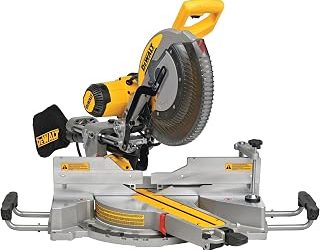
DEWALT DWS780 (12-Inch Double Bevel Sliding)
The XPS shadow light is the reason to pay the premium: it projects the blade’s true shadow onto the stock, so you cut to a pencil line without ever calibrating a laser. Between that, the honest 13¾-inch crosscut, and a dust collection system that genuinely outperforms its class, this is the saw I’d point a serious furniture builder toward first.
DEWALT DWS779 (12-Inch Double Bevel Sliding)
Mechanically this is the DWS780’s twin minus the shadow light, with the same 3,800 RPM 15-amp motor and increased crosscut capacity. If you already work under good task lighting and trust your own sightlines, the savings are close to free performance.
DOVAMAN 10-Inch Sliding Miter Saw
A genuinely thoughtful budget entry: dual 5,000/3,200 RPM speeds let you slow down for aluminum or laminate, three TCT blades ship in the box, and ambidextrous controls suit awkward garage layouts. The 3.5 x 13.4-inch capacity handles most nightstand and frame stock, though the fence benefits from a squaring check out of the box.
12-Inch Dual Bevel Sliding Miter Saw with Extension Table
The 80-tooth blade and integrated extension wings make this a competent value pick for long bed rails, and ETL certification is reassuring at this price. Expect to spend twenty minutes tuning the laser and bevel stops before your first real cut — do it once and it holds.
DEWALT DWS715 (12-Inch Single Bevel Compound)
Not a slider, but worth naming: if your builds are legs, aprons, and trim rather than wide panels, the DWS715’s 12-inch blade and tall fence cover a surprising amount of furniture work for far less money and bench space.
Frequently Asked Questions
Do I need 12 inches, or will 10 do?
Ten inches is sufficient for legs, aprons, and trim. Choose 12 if you regularly crosscut panels wider than about 11 inches or want headroom for thick reclaimed stock.
Is a double bevel worth the upgrade for furniture?
Yes, if you build anything with mirrored angled components — canted legs, splayed nightstand sides, angled headboard caps. Flipping stock is the single most common source of mismatched pairs.
Can I use one of these in an attached garage at night?
Practically, no. Peak noise under load rivals a chainsaw and transmits readily through shared framing. Save cutting for daytime blocks and reserve evenings for sanding, glue-up, and finishing.
What blade should I use for hardwood furniture?
An 80-tooth thin-kerf crosscut blade for finish cuts, and a 40- to 60-tooth general blade for rough breakdown. The stock blade on most saws is adequate for framing, not for joinery you’ll see.
Final Thoughts
For most people building bedroom furniture, the DEWALT DWS780 is the saw to buy once and stop thinking about — the shadow light alone earns its keep across a lifetime of miters. The DWS779 delivers nearly identical results if you’d rather put that money into blades and clamps, and the DOVAMAN 10-Inch is the smart entry point for anyone furnishing a first workshop without a first-rate budget.