Key takeaways
- Match amps to your actual engine: Peak amperage headlines are less useful than the engine displacement rating printed in the specs. A 2000A unit rated to 5L gas is plenty for a commuter sedan; a diesel truck or large V8 wants 3000A or more, with diesel ratings listed separately because compression ignition demands a harder pull.
- Watch watt-hours, not just peak current: Capacity determines how many starts you get and how long the compressor can run. Something in the 37Wh range handles a single emergency; 59Wh to 89Wh lets you jump a car, inflate four tires, and still charge a phone without recharging the pack.
- Insist on an auto-shutoff inflator: A compressor that stops at your target PSI turns tire maintenance into a set-and-forget task. Manual gauges invite overinflation and, more practically, get skipped — the whole point is removing friction from a chore you’ll otherwise postpone indefinitely.
- Check the temperature window: Lithium packs lose punch in deep cold, precisely when batteries fail. Look for a stated operating range, and if you park outdoors in a harsh climate, consider a supercapacitor-based system that tolerates extremes far better than conventional chemistry.
- Think about where it lives: A hard-shell case that slides into a bench drawer or entry cabinet gets recharged every few months. Something loose and awkward migrates to the garage floor and dies of neglect. Storage design is a reliability feature.
What's inside
Ask anyone who has spent a night staring at the ceiling before a 5 a.m. airport run, and they’ll describe the same loop: what if the car doesn’t start? As someone who spends most of my working life on sleep quality, I’ve learned that the enemy of deep rest is rarely caffeine or blue light alone — it’s unresolved logistics. The brain refuses to fully downshift while a solvable problem sits unsolved in the driveway. A weak battery, a soft tire you keep meaning to top off, a cold snap in the forecast: these are the small open files that keep the nervous system in a low idle all night.
That’s why a combined jump starter and air compressor belongs in the same category as blackout curtains and a decent pillow. It’s not a car gadget so much as a piece of household infrastructure that removes a recurring worry from your mental queue. This guide breaks down how these units differ in real use — peak amperage, battery capacity, inflator pressure, cold tolerance, and how they’re stored — then reviews the models worth your money in 2026. Whether you keep one in the entryway console or tucked in the trunk, the goal is the same: nothing left to rehearse at 2 a.m.
As an Amazon Associate we earn from qualifying purchases.




How to Choose a Jump Start And Air Compressor (2026)
- Match amps to your actual engine: Peak amperage headlines are less useful than the engine displacement rating printed in the specs. A 2000A unit rated to 5L gas is plenty for a commuter sedan; a diesel truck or large V8 wants 3000A or more, with diesel ratings listed separately because compression ignition demands a harder pull.
- Watch watt-hours, not just peak current: Capacity determines how many starts you get and how long the compressor can run. Something in the 37Wh range handles a single emergency; 59Wh to 89Wh lets you jump a car, inflate four tires, and still charge a phone without recharging the pack.
- Insist on an auto-shutoff inflator: A compressor that stops at your target PSI turns tire maintenance into a set-and-forget task. Manual gauges invite overinflation and, more practically, get skipped — the whole point is removing friction from a chore you’ll otherwise postpone indefinitely.
- Check the temperature window: Lithium packs lose punch in deep cold, precisely when batteries fail. Look for a stated operating range, and if you park outdoors in a harsh climate, consider a supercapacitor-based system that tolerates extremes far better than conventional chemistry.
- Think about where it lives: A hard-shell case that slides into a bench drawer or entry cabinet gets recharged every few months. Something loose and awkward migrates to the garage floor and dies of neglect. Storage design is a reliability feature.
The Best Jump Start And Air Compressor (2026)s Reviewed
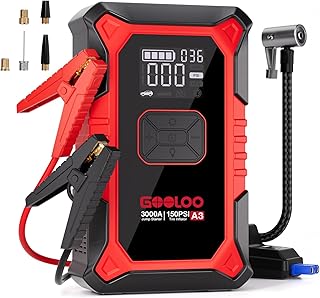
GOOLOO A3 3000A Jump Starter with Air Compressor
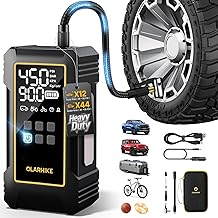
The A3 is the sensible default for most households: 3000A of peak output covers 9L gas and 6.5L diesel engines, and the 150 PSI inflator shuts itself off at your chosen pressure. Its safety interlocks are forgiving of clamp mistakes, which matters when you’re working in the dark and half-awake.
WOLFBOX MV16A 3000A Jump Starter with Air Compressor
With 59.2Wh of capacity, a 160 PSI compressor, and 65W fast charging in both directions, the MV16A is the model I’d hand to someone who wants one device to cover jumps, tires, and dead phones. The higher pressure ceiling makes it genuinely usable on light truck and trailer tires, not just passenger cars.
WOLFBOX MV24 4000A Jump Starter
This is the heavy-duty option — 4000A and 88.8Wh, rated to 10L gas and 10L diesel — with an LED display that reports state of charge instead of leaving you guessing. There’s no onboard compressor here, so choose it only if raw starting power for a large engine outranks tire duty on your list.
ANCEL BS300 Super Starter
Rather than living in your trunk, the BS300 wires permanently to the battery and uses supercapacitors to deliver 1000A of start assistance on demand, with health monitoring and a genuinely remarkable −40°F to 176°F range. For anyone whose worry is specifically “will it turn over tomorrow morning,” this is the most direct answer available.
WOLFBOX MV10A 2000A Jump Starter with Air Compressor
At 37Wh and 2000A for engines up to 5L, the MV10A is the compact, sedan-and-hatchback pick, and the 150 PSI inflator is the same essential feature found on pricier units. It’s the easiest of the group to keep in a drawer indoors, which is where these devices actually survive.
Frequently Asked Questions
How often should I recharge one of these packs?
Top it up every three to four months, and always after use. Set a recurring reminder tied to something you already do seasonally — changing smoke detector batteries or rotating bedding is a natural anchor.
Can I leave it in the car year-round?
You can, but lithium units age faster in temperature extremes and self-discharge more quickly in heat. Indoor storage near your entryway is better for longevity; a permanently installed supercapacitor system is the alternative if trunk storage is non-negotiable.
Will the compressor inflate anything besides tires?
Most include needle and nozzle adapters for sports balls, bike tires, and inflatable mattresses — genuinely handy for guest bedding. Air beds need volume rather than pressure, so expect the pump to work slowly on them.
Do I still need jumper cables?
Keep a set as backup, since a discharged pack is useless on its own. That said, a charged jump starter avoids the whole ritual of flagging down a stranger and hoping their battery is healthy.
Final Thoughts
For most households, the WOLFBOX MV16A offers the best balance of capacity, 160 PSI inflation, and fast charging, while the GOOLOO A3 covers the same ground reliably at a friendlier entry point. If your concern is chronic cold-morning anxiety rather than roadside rescue, the ANCEL BS300’s permanently connected supercapacitor design is the one that will actually let you sleep through the night.