Key takeaways
- Swing and throat depth: Swing is twice the distance from spindle to column, so a 10-inch machine centers a hole 5 inches from the edge of your stock. For nightstand carcasses and bed rails that’s plenty; for wide headboard panels, size up to 12 inches or plan on flipping and clamping a fence.
- Variable speed versus stepped pulleys: Belt-and-pulley systems are cheaper and perfectly reliable, but you’ll open the cover and move the belt every time you switch between a Forstner bit and a twist drill. Electronic variable speed removes that friction, which in practice means you’ll actually run the correct RPM instead of guessing.
- Cast iron mass: Weight is not dead weight. A cast iron head and table absorb the harmonics that otherwise travel down the column, through your bench, into the floor, and up a wall into an adjacent bedroom. It is the single best predictor of both hole quality and how quietly a machine runs.
- Table tilt and spindle travel: Look for a table that tilts to at least 45 degrees for angled leg mortises and canted headboard supports. Three inches of quill travel handles most furniture stock; less than two becomes limiting fast.
- Lasers and work lights: Treat them as convenience features, not accuracy features. Cross-hair lasers drift out of calibration and need occasional adjustment, but a bright LED over the bit genuinely reduces layout mistakes when you’re working late and tired.
What's inside
Most of the woodworking I do these days is for the bedroom: platform bed rails, floating nightstands, headboards with hidden cable channels. Spending years advising people on sleep environments has changed how I evaluate tools, and a drill press is the clearest example. A bed frame that develops a squeak eighteen months in almost always traces back to a bolt hole drilled a couple of degrees off square — the joint works itself loose, the wood telegraphs every shift in position, and the sleeper wakes up four times a night without ever knowing why. A handheld drill wanders. A drill press does not.
The second thing I’ve learned is that shop noise and household sleep are on a collision course. Most home builders work evenings, which in a typical house means running a motor thirty feet from someone’s pillow. Vibration through a shared floor joist carries further than the sound itself. So this guide weighs the usual specs — swing, spindle travel, speed range, quill runout — alongside how smoothly a machine actually runs under load, because a benchtop press that chatters is a press you’ll end up using less. Below are six options I’d genuinely put in a home shop, from a 12-inch variable-speed workhorse down to a rotary-tool stand that fits in a drawer.
As an Amazon Associate we earn from qualifying purchases.


How to Choose a Drill Press For Home Shop (2026)
- Swing and throat depth: Swing is twice the distance from spindle to column, so a 10-inch machine centers a hole 5 inches from the edge of your stock. For nightstand carcasses and bed rails that’s plenty; for wide headboard panels, size up to 12 inches or plan on flipping and clamping a fence.
- Variable speed versus stepped pulleys: Belt-and-pulley systems are cheaper and perfectly reliable, but you’ll open the cover and move the belt every time you switch between a Forstner bit and a twist drill. Electronic variable speed removes that friction, which in practice means you’ll actually run the correct RPM instead of guessing.
- Cast iron mass: Weight is not dead weight. A cast iron head and table absorb the harmonics that otherwise travel down the column, through your bench, into the floor, and up a wall into an adjacent bedroom. It is the single best predictor of both hole quality and how quietly a machine runs.
- Table tilt and spindle travel: Look for a table that tilts to at least 45 degrees for angled leg mortises and canted headboard supports. Three inches of quill travel handles most furniture stock; less than two becomes limiting fast.
- Lasers and work lights: Treat them as convenience features, not accuracy features. Cross-hair lasers drift out of calibration and need occasional adjustment, but a bright LED over the bit genuinely reduces layout mistakes when you’re working late and tired.
The Best Drill Press For Home Shop (2026)s Reviewed
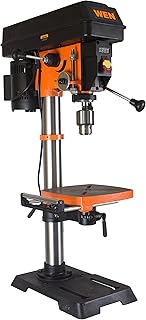
WEN 12-Inch Benchtop Drill Press (DP1263V)
The variable-speed 6.2-amp motor and full cast iron construction make this the most capable benchtop press here, and it holds a steady cut through hardwood bed rails without the belt slip you get from lighter machines. If you build furniture regularly rather than occasionally, this is the one I’d buy.
SKIL 6.2 Amp 10-Inch 5-Speed Drill Press (DP9505-00)
SKIL’s five-speed benchtop unit runs unusually smoothly for its price bracket, and the laser alignment plus onboard work light are well executed rather than tacked on. A sensible pick if 10-inch swing covers your projects and you’d rather not pay for electronic speed control.
WEN 8-Inch 5-Speed Cast Iron Drill Press (4206T)
At 2.3 amps this is a light-duty machine, but the cast iron head keeps it composed on small work — drawer pulls, shelf pins, dowel joinery. The best choice for a cramped shop or a first drill press where bench real estate matters more than capacity.
Dremel Drill Press Rotary Tool Workstation (220-01)
Not a drill press so much as a way to make your rotary tool behave like one, with two inches of travel and adjustable angles for precise small holes. Excellent for inlay, hardware fitting, and detail work; it will not drill a bed bolt hole.
VEVOR 1300W Portable Magnetic Drill Press
A specialist tool: 1300 watts, nearly 3,000 pounds of magnetic hold, and the ability to bore up to 1.57 inches in steel wherever the work happens to be. Relevant if your furniture involves welded steel bases or you’re drilling structural plate in place.
Frequently Asked Questions
Can a benchtop press really be quiet enough for evening work?
A heavy cast iron machine at moderate RPM is roughly conversation-level, but the transmitted vibration matters more than the airborne noise. Set the press on a rubber mat or dense foam pad on a freestanding bench rather than one lag-bolted to a shared wall.
What speed should I use for furniture work?
Broadly: high speeds for small twist bits in softwood, low speeds for large Forstner bits, hole saws, and any metal. Running a big bit too fast burns the wood and dulls the edge, and you’ll hear the machine complaining before you see the scorch marks.
Do I need a floor-standing model?
For bedroom furniture, almost never. Benchtop machines handle stock up to typical headboard thickness; floor models earn their footprint when you need long spindle travel or the capacity to drill tall assembled pieces.
Is a mortising attachment worth adding?
If you build bed frames with traditional joinery, yes — square mortises cut on a press are far more consistent than chiseled ones, and consistent joints are the ones that don’t loosen and squeak later.
Final Thoughts
For most home shops building real furniture, the WEN DP1263V is the machine to own: variable speed, generous swing, and enough cast iron mass to run smoothly late at night. The SKIL DP9505 is the value alternative if 10 inches of swing is enough, while the WEN 4206T earns its place in tight spaces where a small, steady press beats a large one you have to shuffle around.