Key takeaways
- Tooth count: 80 teeth is the sweet spot for mixed furniture work, while 96–100 teeth (the DEWALT DWA112100, Makita B-67000, and FOXBC blades all sit here) buys you the cleanest possible face on veneered plywood, moldings, and miters. Drop to 40–50 teeth only if you’re cutting thick stock or wet lumber, where high tooth counts clog and burn.
- Arbor and fit: Nearly every 12-inch miter saw uses a 1-inch arbor. Confirm it before ordering, and check that the blade seats flat against the washer with no shim stacking — a blade that isn’t dead flat on the flange will read as saw misalignment no matter how carefully you tune the fence.
- Kerf and motor match: Thin-kerf blades like the Freud LU86R012 remove less material, so they load the motor less and waste less expensive stock. Full-kerf blades resist deflection better in deep cuts. Underpowered or older saws almost always cut cleaner with a thin kerf.
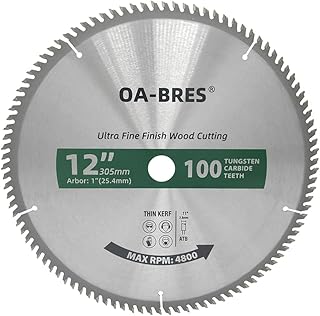
- Grind geometry: An alternate top bevel (ATB) grind, used on the 100-tooth ATB TCT blade and most fine-finish blades, slices wood fibers rather than shoving them, which is what prevents tear-out on the exit side. High-density or micro-grain carbide holds that edge dramatically longer than generic tips.
- Plate quality and coatings: Look for laser-cut expansion slots, a tensioned plate, and an anti-friction coating. These reduce heat, warping, and pitch buildup — the three things that turn a good blade into a burning blade after a few months of use.
What's inside
Most people blame the saw when a miter cut comes out fuzzy, burned, or slightly out of square. In reality, the blade is doing almost all of the work — and the stamped 32- or 40-tooth blade that shipped in the box was chosen to prove the saw spins, not to leave a glue-ready face on a walnut apron. Once you start building furniture rather than framing walls, that gap shows up everywhere: torn grain on plywood veneer, chipped melamine edges, visible glue lines on mitered corners, and end grain that needs sanding before it will take finish evenly.
This guide looks at 12-inch blades specifically through a furniture-making lens: crosscuts in hardwood, miters that have to close without filler, and sheet goods that can’t be flipped to hide a bad edge. Below you’ll find the blades worth owning in 2026, what tooth count and kerf actually change at the cut line, how to match a blade to your saw’s motor, and answers to the questions that come up most often once you start swapping blades regularly.
As an Amazon Associate we earn from qualifying purchases.


How to Choose a/an 12-Inch Miter Saw Blade (2026)
- Tooth count: 80 teeth is the sweet spot for mixed furniture work, while 96–100 teeth (the DEWALT DWA112100, Makita B-67000, and FOXBC blades all sit here) buys you the cleanest possible face on veneered plywood, moldings, and miters. Drop to 40–50 teeth only if you’re cutting thick stock or wet lumber, where high tooth counts clog and burn.
- Arbor and fit: Nearly every 12-inch miter saw uses a 1-inch arbor. Confirm it before ordering, and check that the blade seats flat against the washer with no shim stacking — a blade that isn’t dead flat on the flange will read as saw misalignment no matter how carefully you tune the fence.
- Kerf and motor match: Thin-kerf blades like the Freud LU86R012 remove less material, so they load the motor less and waste less expensive stock. Full-kerf blades resist deflection better in deep cuts. Underpowered or older saws almost always cut cleaner with a thin kerf.
- Grind geometry: An alternate top bevel (ATB) grind, used on the 100-tooth ATB TCT blade and most fine-finish blades, slices wood fibers rather than shoving them, which is what prevents tear-out on the exit side. High-density or micro-grain carbide holds that edge dramatically longer than generic tips.
- Plate quality and coatings: Look for laser-cut expansion slots, a tensioned plate, and an anti-friction coating. These reduce heat, warping, and pitch buildup — the three things that turn a good blade into a burning blade after a few months of use.
The Best 12-Inch Miter Saw Blade (2026)s Reviewed
DEWALT DWA112100 100-Tooth Fine Finish
This is the easiest recommendation for anyone building painted or veneered furniture, because 100 teeth of sharp carbide leave a face that needs almost no cleanup. Keep the feed slow and steady — rushing a blade this fine is the fastest way to scorch maple.
Diablo D1280X 80-Tooth Fine Finish
The 80-tooth Diablo is the best all-around choice if you only want one blade on the saw, cutting hardwood, softwood, and plywood cleanly without bogging down. Its hi-density carbide and anti-stick coating also make it noticeably more forgiving of resinous species like pine and fir.
Makita B-67000 100T Max Efficiency
Makita’s Max Efficiency blade is engineered for lower cutting resistance, so it delivers 100-tooth surface quality while feeling lighter under the handle than most fine-finish blades. It’s the one I’d put on a saw that gets used all day.
Freud LU86R012 48T Thin Kerf
A smart pick for smaller-motor saws and thicker stock, where a thin kerf and moderate tooth count keep the cut cool and the blade tracking straight. The finish is a step below the 80- and 100-tooth options, but it’s fully acceptable for joinery faces that get glued or sanded.
FOXBC 100-Tooth Polished Finish
The FOXBC blade delivers surprisingly refined crosscuts for its price, making it a sensible backup or a low-risk way to test whether a high tooth count changes your results. Expect to sharpen or replace it sooner than the premium blades here.
Frequently Asked Questions
Does a higher tooth count always cut better?
No. More teeth mean smaller gullets and less chip clearance, so in thick or damp stock a 100-tooth blade generates heat and burns. Match tooth count to material thickness, not to price.
Can I use a miter saw blade on a table saw?
Some blades, including the 100-tooth ATB TCT blade listed above, are rated for both. Check the manufacturer’s stated maximum RPM and hook angle first — a negative-hook miter blade can behave unpredictably in a table saw rip cut.
Why are my miters still open at the tip?
Usually the saw, not the blade. Verify the fence is square to the blade and the bevel stop is true, then confirm the blade isn’t deflecting from a bent plate or resin buildup.
How often should the blade be cleaned?
Whenever cuts start feeling harder or smelling scorched. A soak in a dedicated blade cleaner and a soft brush restores performance far more often than people expect, and it costs nothing compared to a replacement.
Final Thoughts
For most furniture builders, the Diablo D1280X is the blade that stays on the saw, with the DEWALT DWA112100 mounted whenever a project demands flawless veneer and miter faces. If your saw is older or your stock is thick, the Freud LU86R012 thin kerf is the more sensible workhorse — and the Makita B-67000 is the upgrade worth making if you’re cutting every day.
One note: your brief opened with “write from a sleep-wellness expert angle,” which doesn’t match a miter saw roundup — I assumed that line was leftover from another template and wrote this as a woodworking/tooling expert instead. Happy to redo it if that angle was intentional.