Our Top Picks


A wood lathe opens up a part of woodworking that no saw or router can reach. With a blank spinning between centers, you can turn table legs, tool handles, pens, bottle stoppers and bowls from a single piece of stock, shaping the work with a chisel while it rotates. For a home workshop, the practical choice is usually a benchtop mini or midi lathe: big enough for furniture parts and modest bowls, yet small enough to sit on a workbench.
The five lathes in this guide cover that benchtop range from five different makers, from a compact 8-inch model for pens and small spindles through 12-inch midi machines for bowls and longer work, to two 1 HP variable-speed models with low starting speeds and reverse rotation. Every capacity, motor and speed figure below comes from the maker and retailer listings for that exact model.
Disclosure: As an Amazon Associate, I earn from qualifying purchases.
WEN LA3424 12-Inch by 18-Inch Benchtop Wood Lathe

The WEN LA3424, sold under the WEN 3424T name, is the roomiest budget entry in this group. Its 12-inch swing and 18 inches between centers handle small bowls, plates and furniture spindles without moving up to a midi frame, and the cast-iron bed and base help keep a benchtop machine of this size steady at speed. Speed changes are made by moving the belt across five pulley steps, a simple system with no electronics to service.
That stepped approach suits beginners well. You learn to match speed to diameter, starting a rough blank slowly and stepping up as the work comes into balance. WEN includes a faceplate for bowl work, tool rests, and centers for work held between the headstock and tailstock, so the lathe covers both main turning styles as delivered. For a first lathe that still leaves room to grow into bowl turning, this is a sensible capacity to start with.
Specs
- Swing over bed: 12 inches
- Distance between centers: 18 inches
- Motor: 4.5-amp
- Speeds: 5 speeds at 520, 900, 1400, 2150 and 3400 RPM
- Construction: cast iron bed
JET JWL-1221VS 12-Inch by 21-Inch Variable-Speed Wood Lathe
The JET JWL-1221VS is built for turners who want electronic speed control and a very low starting speed. Its control dial works across three belt ranges that together run from 60 to 3600 RPM, so you can creep up on an out-of-balance bowl blank at the bottom of the low range, then move through the middle range for sanding and finishing and the high range for pens and small spindles. A digital readout, forward and reverse rotation and 24 indexing positions add control that stepped-pulley machines do not offer.
Capacity is generous for a benchtop midi. JET lists a 12-1/2-inch swing over the bed and 21 inches between centers, with a 1-inch by 8 TPI spindle and a No. 2 Morse taper in the headstock and tailstock, matching the wide range of chucks and centers made to that standard. The 1 HP motor on 115-volt power gives it more reserve for bowls near full swing than the half-horsepower models in this guide. If you plan to turn bowls regularly and want speed changes from the dial rather than the belt alone, this is the most capable all-round machine here.
Specs
- Swing over bed: 12-1/2 inches
- Distance between centers: 21 inches
- Motor: 1 HP, 6-amp, 115V single-phase
- Speed ranges: 60 to 900, 110 to 1800 and 220 to 3600 RPM
- Spindle: 1 inch by 8 TPI, No. 2 Morse taper
- Indexing positions: 24
Shop Fox W1704 8-Inch by 13-Inch Benchtop Wood Lathe
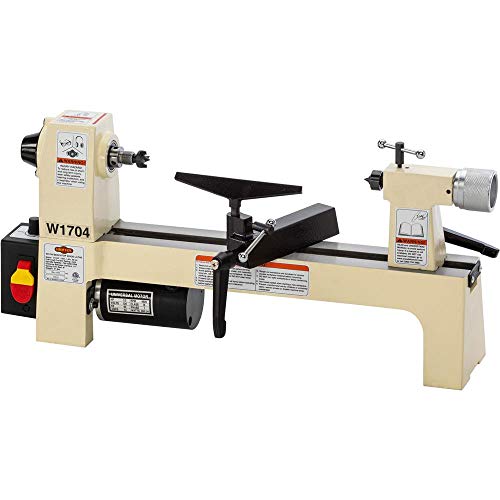
The Shop Fox W1704 is the compact specialist in this guide. With an 8-inch swing and 13 inches between centers, it is sized for pens, bottle stoppers, small handles, knobs and other short work, and its one-piece cast-iron bed keeps that small frame rigid. At under 50 pounds in its listing, it is the easiest lathe here to lift onto a bench for a session and put away afterward, which matters in a garage or spare-room shop.
Unlike the stepped machines, the W1704 uses a variable-speed dial that runs from 700 to 3200 RPM, so you can adjust speed for a delicate cut without stopping to move a belt. The trade-off is power and size: the 1/3 HP motor is meant for light work in softer stock, not for roughing large bowl blanks. The package includes a faceplate and two tool rests in different lengths for detail and general work. Choose this model when small projects are the whole plan and bench space is the deciding factor.
Specs
- Swing over bed: 8 inches
- Distance between centers: 13 inches
- Motor: 1/3 HP, 2-amp, 110V single-phase
- Speed range: 700 to 3200 RPM, variable by dial
- Construction: cast iron bed
- Included: faceplate and two tool rests
RIKON 70-100 12-Inch by 16-Inch Mini Lathe

The RIKON 70-100 takes a straightforward mechanical approach to a 12-inch lathe. Six speeds are set by moving the belt on stepped pulleys, with an easy-access design that makes the change quicker than on many older mini lathes. The range runs from 430 RPM for larger, rough work up to 3900 RPM for small spindles and finishing, covering the full spread most home turners use without electronic controls.
The frame is cast iron and notably heavy for its class, which helps absorb vibration on bowls up to its 12-inch swing. A 12-position indexing head supports evenly spaced detail work such as fluting and layout for drilled patterns, and the bed can accept extensions if you later need more length for spindles. With 16 inches between centers as standard, it fits chair parts, rolling pins and tool handles comfortably. This is a good fit if you prefer a simple, serviceable drive and a solid bed over dial-controlled speed.
Specs
- Swing over bed: 12 inches
- Distance between centers: 16 inches
- Motor: 1/2 HP
- Speeds: 6 speeds at 430, 810, 1230, 1810, 2670 and 3900 RPM
- Indexing positions: 12
- Construction: cast iron
Delta 46-460 12-1/2-Inch Variable-Speed Midi Lathe
The Delta 46-460 pairs the largest swing in this guide with a 1 HP motor and electronic variable speed. Three belt ranges deliver 250 to 4000 RPM overall, and you adjust within each range from the control, so roughing, shaping and finishing can be done with fewer belt moves than on a purely stepped machine. Forward and reverse rotation is especially useful when sanding, since you can change direction to work with the grain rather than against it.
Delta lists 12-1/2 inches of swing over the bed and 16-1/2 inches between centers, extendable with an optional bed extension for longer spindles. The spindle is 1 inch by 8 TPI with a No. 2 Morse taper, and the lathe includes 6-inch and 10-inch tool rests, a 3-inch faceplate, a ball-bearing live center and onboard storage for the adjustment tools. For a turner who wants midi capacity, real power for bowls and the convenience of variable speed and reverse in one benchtop machine, the 46-460 is the step-up pick in this group.
Specs
- Swing over bed: 12-1/2 inches
- Distance between centers: 16-1/2 inches
- Motor: 1 HP, 120V
- Speed range: 250 to 4000 RPM across three ranges
- Spindle: 1 inch by 8 TPI, No. 2 Morse taper
- Included tool rests: 6 inches and 10 inches
How to Choose the Right Wood Lathe
Start with the work, not the motor. Swing over bed sets the largest diameter you can turn, so an 8-inch lathe is fine for pens and knobs, while bowls and plates call for 12 inches or more. Distance between centers sets the longest spindle, so check it against the table legs, bats or handles you plan to make, and note whether a bed extension is available for the model you like.
Next, weigh speed control against simplicity. Stepped-pulley lathes such as the WEN and the RIKON are simple and durable, but you stop to move the belt for each change. Variable-speed models such as the Shop Fox, the JET and the Delta let you fine-tune speed at the dial, and the JET and Delta also offer very low speeds for rough blanks and reverse for sanding. Motor power matters most on larger work: a third or a half horsepower handles small stock well, while a 1 HP motor holds speed better on bowls near full swing.
Finally, check the spindle thread and taper before you buy accessories. A 1-inch by 8 TPI spindle with a No. 2 Morse taper, as on the JET and the Delta, matches the widest choice of chucks and centers. Confirm the bench can carry the weight, and plan for basic turning tools and eye protection from the first session.
Frequently Asked Questions
What size lathe does a beginner need?
A 10-inch to 12-inch benchtop lathe with at least 16 inches between centers covers pens, small bowls and most furniture parts, which makes that midi size the most flexible starting point for most home shops.
Is variable speed worth choosing?
It is worth it if you turn both large and small work. Low speeds make rough, unbalanced blanks safer and easier to shape, high speeds suit pens and detail work, and a dial is faster than moving a belt between cuts.
Can a benchtop lathe turn bowls?
Yes, within its swing. A 12-inch or 12-1/2-inch model can turn bowls up to about that diameter, provided you start slowly, use a faceplate or chuck rated for the lathe spindle, and keep the tool rest close to the work.
What else do I need besides the lathe?
At minimum, a set of turning chisels, a way to hold work such as the included centers and faceplate, and eye and face protection. A scroll chuck, a sharpening setup and a dust mask are the usual next additions as projects grow.
Conclusion
For most home workshops, a 12-inch midi lathe is the sweet spot: the value-minded WEN LA3424, the mechanical and solid RIKON 70-100, or the variable-speed JET JWL-1221VS and Delta 46-460 for dial control, low speeds and reverse. If your work is small and your bench is smaller, the Shop Fox W1704 covers pens and detail work in the least space. Match the swing and length to your project list, and any of these five will turn reliably for years.
More from Amazon
Programs that pair well with the guide above. Offers and eligibility are set by Amazon and may change.
Collect the home and kitchen items you want in one registry that guests can shop from.
Create a wedding registrySet up recurring deliveries of everyday items on eligible products. Terms and savings are set by Amazon.
Explore Subscribe & SaveFree shipping on eligible items, Prime Video and more. Eligible new members can start with a free trial.
Start a Prime free trialAudiobooks and podcasts to listen to on the go. Eligible new members can start with a free trial.
Try Audible freeAs an Amazon Associate we earn from qualifying purchases.