Key takeaways
- Unplug the machine or switch off the icemaker arm. Empty the ice bin completely and discard the ice — it absorbs odors.
- Drain the reservoir using the drain plug or by tipping the unit over a sink.
- Mix the descaler with water per the label, usually a tablet or a measured pour into a full reservoir. Never guess the concentration.
- Run one or two full cleaning cycles, or standard ice cycles if your machine has no clean mode, then discard everything produced.
- Drain again, then run two or three cycles of plain water to rinse. Taste-test a cube before you trust it.
- Hand-wash the bin, scoop, and drip tray with warm soapy water. Use a soft brush on corners and gaskets, where slime hides.
- Leave the lid open and let the interior dry fully overnight. Dry surfaces don’t grow mold.
What's inside
As someone who spends most days talking with people about their sleep, I’ve learned that the small, unglamorous corners of a home often shape rest more than any mattress upgrade. Hydration is one of them. People who drink enough water during the day and keep a cold glass within reach at night report fewer 3 a.m. wake-ups from dry mouth and thirst. But if the ice in that glass tastes faintly metallic, cloudy, or vaguely like the inside of a plastic bin, you stop reaching for it. A neglected ice maker quietly discourages the very habit that helps you sleep — and it can develop biofilm and mold in its damp interior, which is the last thing you want near a bedside table.
This guide walks through how to actually clean an ice maker properly in 2026: what the mineral buildup inside is, which cleaners are safe for the nickel-plated parts most machines use, the full step-by-step process for both countertop nugget makers and built-in freezer units, how often to repeat it, and the maintenance habits that keep the job from becoming a chore. Below are the cleaning products I’d stock if you want to do this once and do it right.
As an Amazon Associate we earn from qualifying purchases.




Understand What You’re Actually Removing
Two different problems build up inside an ice maker, and they need different treatment. The first is limescale — hardened calcium and magnesium deposited by your tap water onto the evaporator plate, water lines, and pump. Scale insulates the freezing surface, so cycles run longer, cubes come out hollow or small, and the machine works harder and louder. The second problem is organic: slime, yeast, and mold colonizing the reservoir and drip tray, which is what creates that stale, musty taste. Descalers dissolve minerals with food-grade acid; sanitizers kill biological growth. A complete cleaning does both, in that order.
Choose a Nickel-Safe Cleaner (Not Vinegar Alone)
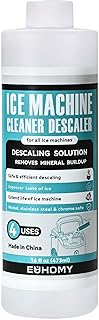
Household vinegar is a mild descaler, but it’s weak, slow, and leaves a lingering smell that transfers to ice for days. More importantly, many evaporator plates are nickel-plated, and aggressive or repeated acid exposure can pit that coating. Look explicitly for “nickel safe” on the label. Tablet formats are the easiest for portable machines — the Ice Machine Cleaner and Descaler 24-tablet pack and the ACTIVE Ice Machine Cleaner tablets both dose consistently and store indefinitely without spilling. If you prefer a liquid, Affresh Ice Machine Cleaner is widely specified by appliance manufacturers, and the EUHOMY Ice Machine Cleaner Descaler gives you four uses per 16 oz bottle and doubles as a coffee and espresso machine descaler. For a commercial unit or a multi-machine household, a Nickel Safe 1 gallon Ice Maker & Machine Cleaner meeting Manitowoc spec GES-6 is far cheaper per cycle.
The Step-by-Step Clean
- Unplug the machine or switch off the icemaker arm. Empty the ice bin completely and discard the ice — it absorbs odors.
- Drain the reservoir using the drain plug or by tipping the unit over a sink.
- Mix the descaler with water per the label, usually a tablet or a measured pour into a full reservoir. Never guess the concentration.
- Run one or two full cleaning cycles, or standard ice cycles if your machine has no clean mode, then discard everything produced.
- Drain again, then run two or three cycles of plain water to rinse. Taste-test a cube before you trust it.
- Hand-wash the bin, scoop, and drip tray with warm soapy water. Use a soft brush on corners and gaskets, where slime hides.
- Leave the lid open and let the interior dry fully overnight. Dry surfaces don’t grow mold.
Set a Realistic Schedule
Frequency depends on water hardness far more than on usage. On soft or filtered water, a deep descale every three to four months is plenty. On hard well water, aim for every six to eight weeks — and if cubes start shrinking or the cycle time stretches, descale immediately rather than waiting for the calendar. Wipe the bin weekly regardless. If you’re using a 36-pack of descaler tablets, that’s genuinely a year or more of coverage for most homes, which is why bulk tablets tend to be the better value than single bottles.
Fix the Water Going In
Cleaning treats the symptom. A carbon or scale-inhibiting inline filter on your supply line, or simply filling portable units with filtered water, cuts buildup dramatically and improves taste on day one. This matters for sleep specifically: better-tasting water means you drink more of it in the afternoon and early evening, when hydrating helps most, rather than gulping a large glass at bedtime and waking to use the bathroom.
Tips
- Photograph the reservoir and pump before disassembly so reassembly isn’t guesswork.
- Clean right before you leave for a weekend — the machine gets uninterrupted drying time.
- Never use bleach in a descale cycle; it damages seals and the residue is difficult to flush.
- Store the scoop outside the bin. A scoop buried in ice is a reliable route for bacteria.
Frequently Asked Questions
Can I just use lemon juice or citric acid?
Citric acid works, but concentration is unpredictable and it lacks the corrosion inhibitors and surfactants in commercial formulas. For a machine you drink from nightly, a labeled nickel-safe product is the safer choice.
Why does my ice smell like the freezer?
Ice absorbs volatile odors from stored food. Descaling won’t fix it — cover strong-smelling items, keep an open box of baking soda in the freezer, and cycle ice more often.
Is cloudy ice a sign of a dirty machine?
Usually not. Cloudiness is trapped air and dissolved minerals freezing quickly. It’s cosmetic. Slow cycles, small cubes, and off-taste are the real warning signs.
Does this apply to nugget and countertop machines?
Yes, and they need it more, since their reservoirs sit at room temperature. Most tablet cleaners list compatibility with Opal, GE Profile, Frigidaire, and KitchenAid units specifically.
Conclusion
A clean ice maker is a small piece of infrastructure supporting a habit that genuinely affects how well you sleep: staying comfortably hydrated without waking up parched or over-drinking at midnight. Pick a nickel-safe descaler, run a proper cycle with a real rinse, dry the interior fully, and put the next date on your calendar. Fifteen minutes, a few times a year, for water you actually want to drink.