Key takeaways
- Backrest contact point: Sit down and notice where the chair meets your spine. Contact just below the shoulder blades supports an upright, open chest — which keeps the diaphragm free and makes relaxed post-meal breathing possible. Contact too low or too high forces you to brace, and bracing is the enemy of a slow dinner.
- Seat depth and edge: You want roughly two fingers of clearance between the seat’s front edge and the back of your knee. A shallower seat with a rounded waterfall edge prevents the pressure behind the knee that makes people fidget and stand up early.
- Cushioning versus breathability: Foam-and-fabric seats are kinder for 45-minute meals, but tightly woven synthetics trap heat. Look for a breathable weave — thermal comfort at the table matters more than people expect, since being overheated in the evening blunts the natural pre-sleep drop in core temperature.
- Noise and stability: Wobble and scraping create low-grade startle responses that keep the nervous system alert. Check that legs are cross-braced or wide-set, and plan on felt pads regardless of what the chair ships with.
- Weight and stackability: If your dining area doubles as a workspace or yoga corner, a light chair you can move without effort is worth more than an extra inch of padding. Friction is what kills good routines.
What's inside
Most people shop for dining chairs by looking at them. As someone who spends my working life studying how the last four hours of the day shape the next eight hours of sleep, I’d argue you should shop by asking a different question: will I actually stay seated in this? The evening meal is one of the strongest behavioral anchors we have for the sleep-wake cycle. A slow, screen-free dinner where you linger, chew properly, and let conversation stretch out is a genuine circadian cue — it tells the body that the active phase is closing. A chair that pinches your thighs, digs into your lumbar curve, or tips you forward onto your ribs quietly sabotages that ritual. You eat faster, you leave the table, you migrate to the sofa with a phone, and the wind-down never happens.
This guide looks at IKEA’s dining chair range for 2026 — plus a few widely available alternatives that solve the same problem at similar prices — through a rest-and-recovery lens. I’ve weighted seat depth, backrest shape, upholstery breathability, and how the chair behaves during a long, unhurried meal rather than a ten-minute one. Below you’ll find quick comparisons, then a buying framework and individual reviews.
As an Amazon Associate we earn from qualifying purchases.




How to Choose Ikea Dining Chairs (2026)
- Backrest contact point: Sit down and notice where the chair meets your spine. Contact just below the shoulder blades supports an upright, open chest — which keeps the diaphragm free and makes relaxed post-meal breathing possible. Contact too low or too high forces you to brace, and bracing is the enemy of a slow dinner.
- Seat depth and edge: You want roughly two fingers of clearance between the seat’s front edge and the back of your knee. A shallower seat with a rounded waterfall edge prevents the pressure behind the knee that makes people fidget and stand up early.
- Cushioning versus breathability: Foam-and-fabric seats are kinder for 45-minute meals, but tightly woven synthetics trap heat. Look for a breathable weave — thermal comfort at the table matters more than people expect, since being overheated in the evening blunts the natural pre-sleep drop in core temperature.
- Noise and stability: Wobble and scraping create low-grade startle responses that keep the nervous system alert. Check that legs are cross-braced or wide-set, and plan on felt pads regardless of what the chair ships with.
- Weight and stackability: If your dining area doubles as a workspace or yoga corner, a light chair you can move without effort is worth more than an extra inch of padding. Friction is what kills good routines.
The Best Ikea Dining Chairs (2026) Reviewed
IKEA Ingolf Chair, White
The Ingolf remains the most sensible unupholstered pick in the lineup: solid pine, a slightly scooped seat, and a spindle back that hits the mid-thoracic spine at a genuinely useful height. It’s firm, so I’d add a thin seat pad if your dinners run long, but the posture it encourages is excellent and the wood breathes in a way vinyl never will.
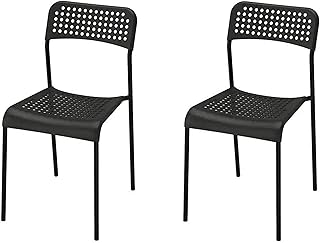
IKEA ADDE Chair, Black (2-Pack)
ADDE is the lightweight, stackable workhorse — perfect for small apartments and for anyone who needs to clear the floor quickly. The moulded plastic seat and shell are supportive for shorter meals, though the shallow back and hard surface make it better suited to weekday dinners than three-hour gatherings.
UVV Metal Dining Chairs, Set of 4 (Beige)
A strong alternative if you want IKEA’s clean lines with real padding. The upholstered seat and mid-height fabric back deliver the sustained comfort that keeps people at the table, and the metal frame stays quiet and rock-steady over time. The neutral beige also reads as a calm, low-stimulation colour in the evening.
COLAMY Wooden Dining Chairs, Set of 4 (Beige)
These pair a padded seat with wooden foot pegs and a tapered leg profile — a farmhouse look with better lumbar shaping than most in this price band. Seat depth is generous, so shorter sitters should test the knee clearance before committing to a set of four.
CHUN YI Upholstered Dining Chairs, Set of 4 (Beige)
The ergonomic curved backrest is the headline here, and it earns the description: the curve follows the natural spinal contour closely enough that you can sit back and stay back. My pick for households that treat dinner as the day’s actual wind-down ritual.
Frequently Asked Questions
Does a dining chair really affect sleep?
Not directly — but consistent, unhurried evening meals help stabilise circadian timing, and comfort determines whether that habit survives contact with reality. A chair that makes you want to leave the table shortens the ritual.
Firm wood or upholstered fabric?
Firm wood promotes better active posture; upholstery wins for meals longer than half an hour. A removable, washable seat pad on a wooden chair like the Ingolf gets you most of both.
How many chairs should I buy?
Seating for your household plus two. Sets of four are usually cheaper per chair than pairs, so mixing a four-set with a two-pack is often the most economical route to six.
Are IKEA chairs compatible with non-IKEA tables?
Generally yes. Aim for 10–12 inches between the seat top and the underside of the tabletop — less than that and your forearms lift, which reintroduces shoulder tension at exactly the wrong time of day.
Final Thoughts
For most homes, the CHUN YI upholstered set offers the best combination of back shaping and padding for genuinely long, restorative dinners, while the IKEA Ingolf is the smarter choice if you prefer breathable solid wood and upright posture. If space is tight or you need overflow seating, add a pair of IKEA ADDE chairs in black or white — light, stackable, and easy to bring out when the table fills up.