Key takeaways
- Airflow over PSI: Nearly every unit claims 150 PSI, but that number only tells you the ceiling. CFM (or ft³/min) tells you how fast it gets there. For 31-inch tires and up, look for 2 CFM minimum; serious off-roaders should target 5 CFM or more.
- Duty cycle and cooling: A truck tire from 15 to 35 PSI is a long run. Metal housings, dual cylinders, and stated duty cycles separate compressors that finish all four tires from ones that need a cool-down break after the first.
- Power source honesty: Cordless is wonderful for topping off in a driveway; battery packs struggle with full inflations on large tires. Direct-to-battery alligator clips draw the most current and work hardest. Dual-power designs hedge your bets.
- Hose reach and fittings: Measure from your battery terminal to your rear passenger tire, then add a few feet. Brass chucks, quick-connect couplers, and a hose that doesn’t stiffen in cold weather save real frustration.
- Noise and night usability: If you camp, sleep in your rig, or park near neighbors, prioritize LED work lights, auto-shutoff presets, and dampened mounts. A compressor you can run without waking your family is one you’ll actually use.
What's inside
Most people don’t think about tire pressure until they’re standing on a shoulder at 11 p.m., phone flashlight in their teeth, wondering how far the nearest gas station air pump really is. As someone who spends most of my working life talking about rest — how it’s built, protected, and stolen — I’ve come to see truck maintenance as a sleep issue in disguise. A soft rear tire on a loaded pickup is a small thing that becomes a 3 a.m. thing: the tow truck, the motel, the rearranged morning. Underinflated tires also ride harder and drone louder, which matters more than people admit if you’re crashing in a camper shell or a converted van and trying to fall asleep after a long haul.
This guide takes the same approach we use for mattresses and bedroom gear: look at how something performs under real load, not just what the box promises. Below, I’ve broken down the specs that actually predict whether a compressor will fill a 33-inch tire without stalling out, then reviewed five heavy-duty inflators worth your money in 2026 — from cordless grab-and-go units to dual-cylinder kits built for off-road airing down and back up again.
As an Amazon Associate we earn from qualifying purchases.


How to Choose a Truck Tire Air Compressor (2026)
- Airflow over PSI: Nearly every unit claims 150 PSI, but that number only tells you the ceiling. CFM (or ft³/min) tells you how fast it gets there. For 31-inch tires and up, look for 2 CFM minimum; serious off-roaders should target 5 CFM or more.
- Duty cycle and cooling: A truck tire from 15 to 35 PSI is a long run. Metal housings, dual cylinders, and stated duty cycles separate compressors that finish all four tires from ones that need a cool-down break after the first.
- Power source honesty: Cordless is wonderful for topping off in a driveway; battery packs struggle with full inflations on large tires. Direct-to-battery alligator clips draw the most current and work hardest. Dual-power designs hedge your bets.
- Hose reach and fittings: Measure from your battery terminal to your rear passenger tire, then add a few feet. Brass chucks, quick-connect couplers, and a hose that doesn’t stiffen in cold weather save real frustration.
- Noise and night usability: If you camp, sleep in your rig, or park near neighbors, prioritize LED work lights, auto-shutoff presets, and dampened mounts. A compressor you can run without waking your family is one you’ll actually use.
The Best Truck Tire Air Compressors (2026) Reviewed
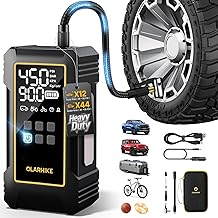
OlarHike 12000mAh Heavy Duty Tire Inflator
The most convenient option here by a wide margin: run it cordless off the internal 12000mAh pack for quick top-offs, or clip into 12V for full inflations without draining the battery. It’s the one I’d keep behind the seat for pressure checks before a long drive, though a fully flat 35-inch tire will test the cordless mode’s limits.
ALL-TOP Dual Cylinder 12V Kit (12.35 ft³/Min)
This is overkill for pavement and exactly right for anyone who airs down regularly. Twin cylinders move air fast enough to reinflate a full set of oversized tires in one uninterrupted session, and the kit’s hardware feels closer to shop equipment than accessory-aisle plastic.
ALL-TOP 12V Portable Inflator (7.06 CFM)
The single-cylinder sibling gives up some speed but keeps the build quality and long hose, at a friendlier price and a smaller footprint in your gear bin. For most half-ton and three-quarter-ton trucks running stock-plus tires, it’s the sensible middle of the range.
AstroAI T4 Heavy Duty Truck Tire Inflator
My pick for the driver who wants set-and-forget simplicity: dial in a target pressure, let the auto-shutoff handle it, and use the LED light for the part of the job that always seems to happen after dark. The 120 PSI ceiling is plenty for passenger and light truck applications.
GSPSCN 12V Dual Cylinder Metal Compressor
An all-metal, dual-cylinder workhorse that has quietly been a favorite among RV and van owners for years. It handles truck tires, air beds, and camp gear equally well — genuinely useful if your vehicle doubles as your bedroom.
Frequently Asked Questions
How long should it take to inflate a truck tire?
A capable 12V unit should add 10 PSI to a 33-inch tire in roughly one to two minutes. If yours takes five, you’re either underpowered for the tire size or losing air at the fitting.
Can I run one of these with the engine off?
Briefly, yes — but high-draw compressors can pull a weak battery down fast. Idle the engine during long sessions, especially in cold weather.
Are cordless models good enough for a pickup?
For top-offs, absolutely. For repeated full inflations on large tires, a 12V hardwired or clip-on unit remains the more dependable choice.
How often should I check pressure?
Monthly, plus before any long trip and whenever temperatures swing sharply. Tires lose roughly 1 PSI per 10°F drop.
Final Thoughts
If you want maximum speed for off-road airing up, the ALL-TOP dual cylinder kit is the clear choice. For everyday truck ownership, the AstroAI T4 offers the best balance of simplicity and capability, while the OlarHike cordless unit is the one you’ll be most grateful for on a dark shoulder at midnight — which, in the end, is the whole point: fewer roadside emergencies, and more uninterrupted nights.